Showing posts with label Doctor Strange. Show all posts

Saturday, September 27, 2014

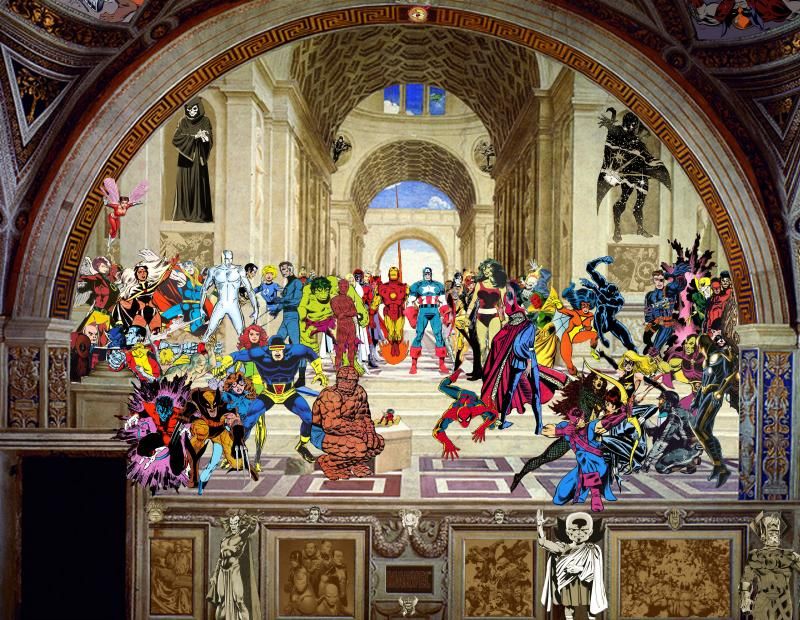
Marvel at the School of Athens


by Adam Ruvola
(Original art by Jack Kirby, George Perez, John Romita Sr., John Romita Jr., Werner Roth, Arthur Adams, Alan Davis, Dave Cockrum, Mike Mignola, Jim Starlin, Steve Ditko, Rick Leonardi, Paul Smith, John Byrne, Bob Layton, Neal Adams, Raphael Sanzio da Urbino, Jim Steranko, Dave Mazzuchelli, Gil Kane, Moebius, John Buscema, Daniel Acuna, Mike Zeck, Bill Sienkiewicz, and many more)
Click here for a full size version.

Sunday, January 20, 2008

Marvel Alchemy

Photobucket
Art by John Byrne and Terry Austin

I grew up in a household where at least a few comic books were usually around. This is the first comic book I remember really noticing. I must have been around six or seven years old since the book was originally published in December of 1978. I'm not surprised this issue was in my household because my parents were Doctor Strange fans. It was the cover that most captured my young attention. The story it contained, the first chapter of a two-parter, was beyond me. But I was as familiar with the symbolic figures of the Rider-Waite Tarot deck as a seven year old could be maybe. Even then I knew I was looking at something interesting. The presence of this comic book as a young child might explain a lot. It doesn't get much more blatant then this.

Looking at this cover now I'm struck by several factors. It is an illustration by the eighties powerhouse team of John Byrne and Terry Austin. I have great respect for Byrne's artwork (though not so much as a writer, where I find his approach to be callow and destructive) and his pencils always looked their best inked by Austin. The issue was written by Chris Claremont. Claremont, Byrne and Austin were the team responsible for classic X-Men epics like "The Dark Phoenix Saga" and "Days of Future Past".

The image itself is very powerful and the symbolism it invokes entirely apt. Marvel's major initiatory character Spider-Man (see Tingly Intuition) is depicted bursting forth from Doctor Strange's Orb of Agamotto, an artifact related to the Doctor's All-Seeing Eye of Agamotto, and a literal and figurative stargate. A magician's crystal ball is for certain a Looking Glass. Spider-Man as the Fool too is absolutely appropriate. The Fool is the initiate's card. They say wisdom begins with accepting one's own foolish nature. With great power comes great responsibility. Doctor Strange (see Doctoring Art Gotic Part II) is a natural as the Magician, adept in all the elements of the Minor Arcana. Ms. Marvel is The Star (see The Great Marvel Mysteries Part Three), connected to Virgo and the Goddess.

That's Clea on the High Priestess card and this is completely appropriate as well, especially within the context of this storyline. Clea is Doctor Strange's student and lover, and the niece of the god-like Dormammu. The figure on the Death card is a fairly obscure Doctor Strange villain, Silver Dagger. Here is perhaps the only real miscast, though it is understandable why Byrne made this choice. The symbolism of the Tarot plays a key role in the storyline, including Doctor Strange as the Magician and Clea as the High Priestess but reversed. Spider-Man as the Fool and Ms. Marvel as the Star are not specified, but in the story the card representing Silver Dagger is the Hierophant reversed. This is much more appropriate as Silver Dagger, a character created by Steve Englehart, is a fanatical Catholic driven mad by reading a book of magic called "The Shiatra Book of the Damned", an item clearly inspired by Lovecraft's Necronomicon (Doctor Strange refers to the Shiatra Book inspiring the Necronomicon in part two of this storyline, reversing the relationship). Reading the Shiatra Book conveyed great sorcerous power to Silver Dagger, which he utilized to hunt down and murder other spell-casters who he considered to be sinners and heretics. He is literally a Hierophant reversed.

In a previous encounter in Doctor Strange's own title, Silver Dagger became trapped within the Orb of Agomotto, in an Otherworld termed an "Unreality". The "Marvel Team-Up" issues relate his escape, achieved by drawing the astral bodies of Clea and Doctor Strange in so that he could exit. Within the Orb Doctor Strange faced Clea at her full and darkest potential, very similar in fact (but far less involved) to the Dark Phoenix Saga Claremont and Byrne presented a couple of years later. Naturally, as this is a team-up title, all would have been lost if fate had not delivered both Spider-Man and Ms. Marvel to the scene to lend Doctor Strange assistance. Of great interest here is the depiction of the Unreality within the Orb.

Photobucket
Art by Howard Chaykin

The Land Inside the Looking Glass. According to a flashback this continued the model established by Englehart in Silver Dagger's original appearance in the Doctor Strange series, which I have never read, but would love to get my hands on. It seems that the Orb's Unreality is one and the same as Wonderland. It also appears to be highly plastic, confirming at one point to the home dimension of Clea (the Dark Dimension) and then to the inner-world of Spider-Man. The hookah-smoking, mushroom-perched Caterpillar of Wonderland is remarkably similar to the initiatory, Mugwump Spider-Man.

In Doctoring Art Gotic Part IV I mentioned the symbol combining potential of the big two comic book publishers' various team-up titles. For a long span of issues DC's "The Brave and the Bold" involved primarily Batman teaming up with random characters of the DC pantheon. The same was done in "DC Comics Presents" with Superman pre-Crisis, and again by Byrne for a little over a year in "Action Comics" post-Crisis. There is certainly pure Gold created in some of these serial, chemical weddings. "DC Comics Presents" notably includes a visit by Superman to Eternia where he met He-Man and the Masters of the Universe during a time when DC held a license for that property. The long-running "World's Finest Comics" featured the singular pairing of Batman and Superman, who shared many weird adventures.

Besides "Marvel Team-Up", Marvel also had "Marvel Two-In-One" which featured pairings with the Thing from the Fantastic Four. There was even a couple of Giant Size issues and a regular series titled "Marvel Super-Villain Team-Up" in the late seventies, featuring Doctor Doom mostly with the Submariner except in the last few issues where Doom worked with Magneto and the Red Skull. Most of these titles, including "World's Finest" which started in 1941, lasted no later then 1988, and that was Byrne's take on "Action", a title which continued but in the form of a weekly (very weakly) anthology series. The rest had all been canceled by late 1986. This coincides with what I consider to be the Iron Age of American comic books. Interestingly all of these titles have been revived recently in one way or another.

"Marvel Team-Up" is of particular interest given recent topics on Spider-Man, Doctor Strange, and the X-Men. Spider-Man was the primary figure of the title. The few issues that did not have Spider-Man featured either the Hulk or the Promethean Human Torch (see The Life Pyrotic), and in one case the two together. The initial three issues were in fact all team-ups between Spider-Man and the Human Torch. A panel from the first issue, March 1972, speaks volumes.

Photobucket
Art by Ross Andru

The villain they faced in issue #1 was Marvel's Sandman, an enemy shared by Spider-Man and the elemental Fantastic Four. The name "Sandman" alone refers to initiation patterns, the altered-state of consciousness achieved while sleeping, and also a Man of the Earth, an Adam. In "Marvel Team-Up" #2 Spidey and the Torch again fought Sandman as well as two other members of The Frightful Four. The wonderful Frightful Four are every bit as elemental as the Fantastic Four. The anti-gravity expert the Wizard is Air, Paste-Pot Pete is Water, and the Inhuman Medusa is Fire. Interesting here that the element missing from the Frightful Four in this issue is the single one present from the Fantastic Four. The issue also features the extra-dimensional, Cosmic Rod wielding Annihilus. In this case Annihilus is the fifth element, the ether or astral substance associating with Kiby's universal Cosmic Energy.

In issue #3 the Torch and Spider-Man faced the vampire Morbius. Vampires inherently embody life-after-death initiation rites. The story continued into issue four which featured Spider-Man and one of the last appearances of the original X-Men before the second generation was introduced in 1975. The adventure ended with Spider-Man planting a kiss on Jean Grey/Marvel Girl/Phoenix, the true High Priestess of the Marvel Mysteries.

Photobucket
Art by Gil Kane

Interesting that without knowing the context one might naturally assume Spider-Man was kissing Mary Jane Watson in the panel above. Depending on who is rendering them, they are more or less identical in appearance. Claremont, Byrne and Austin did an interesting story with Mary Jane in "Marvel Team-Up" #79. Unearthed artifacts from the Hyborian Age (described as the Age following the fall of Atlantis, c. 10,000 years ago) were on display in a New York City museum, including an amulet that possessed a hapless night watchmen. His physical form was taken over by the wizard Kulan Gath. Spider-Man naturally got involved but he was overpowered by Gath's demonic minions. Mary Jane tagged along to the scene with Peter Parker and was herself possessed by the sword of Red Sonja who reincarnated in Mary Jane's form. Unfortunately Spidey and Red still got captured and hung on X-crosses above a dimensional portal.

Photobucket
Art by John Byrne and Terry Austin

Kulan Gath returned several years later in a two-issue multi-character team-up in "Uncanny X-Men" #190-191. This time Gath managed to transform the island of Manhattan into a city out of the Hyborian Age, including everyone on the island. Due to the spell they had no memory of their normal reality. The spell affected the X-Men, the New Mutants, and the Avengers. Unaffected were Spider-Man and Doctor Strange. Issue 191 opened with Spider-Man crucified again, this time in the traditional form, and it was apparent that he had been heavily tortured. Many of the characters die in the course of the story, but all was resolved when Doctor Strange combined his abilities with those of Illyana Rasputin to reverse time and erase Kulan Gath's spell from existence. This represents one of the more significant examples of Marvel's licensed properties being directly folded into the Marvel Universe, in this case the pulp, fantasy sword and sorcery realms of Robert E. Howard. Spider-Man also met King Kull in "Marvel Team-Up" #112.

Photobucket
Art by Sal Buscema and Mike Esposito

I've been thinking about "Marvel Team-Up" since I mentioned it in Doctoring Part IV. Then Christopher Knowles of the Secret Sun posted Silver Star, part 5- Iran, the CIA and the Lord of Light where I learned for the first time about Jack Kirby's role in a proposed film based on the 1967 novel "Lord of Light" by Roger Zelazny. Be sure to read Chris' article if you haven't yet for an amazing "truth is stranger then fiction" CIA involvement in the project. The "a-ha" moment for me in this came because amongst the many gems amidst the run of "Marvel Team-Up" is "Marvel Team-Up Annual" #1 from 1976, featuring Spider-Man's first meeting with the full New X-Men team, "The Lords of Light and Darkness", undoubtedly inspired by Zelazny's works, primarily "Lord of Light" due to its Hindu mythological structure, but also the 1969 Egyptian pantheon based "Creatures of Light and Darkness". In the splash above the heroes are before what Zelazny might term "the tall man of smoke who wears a wide hat". Note in this image how the various figures are mostly balanced in pairs, Storm and Banshee, Wolverine and Nightcrawler, and Cyclops and Colossus. This by default leaves key initiator Spider-Man in association with Phoenix, the Goddess herself. I have not read "Lord of Light", or any of Zelazny's novels besides a few of the "Amber" series many years ago, but even the cursory, Cliiff-notes treatment on Wikipedia makes the source material for the Team-Up annual readily apparent.

The plot involves a top-secret government installation called "The Nest" working to solve the energy crisis through use of secret method of irradiating common minerals. A team of eight international scientists were at the Nest working on the project. The developer of the method, Araman Nila, was a devout Hindu. An earthquake struck the underground complex while Nila was performing a delicate procedure, causing the unstable, radioactive compounds to explode.

As chance would have it Peter Parker was part of a press junket following American and Soviet scientists and politicians going to visit the Nest. Even more amazing was the presence on this flight of Professor Xavier and his students, as stand-ins for Reed Richards, Mister Fantastic, who was unable to attend. The plane carrying the visitors flew into the path of the smoke from the destroyed Nest and the controls went haywire due to the radiation. It was then attacked by a squadron of flying robots called Rakks, security droids for the Nest, named for the Hindu demonic entities Rakshasas, here described by Peter Parker as "Guardians of the Gates of Hell". The Rakks cut the nose off the plane with lasers and it dropped into a nosedive. Spider-Man averted disaster by quickly weaving a giant web-parachute to slow the plane's descent.

On the ground the heroes soon discovered the former site of the Nest shielded by a rainbow hued radiation field. The crack in the earth leading to the underground complex was termed a "Hellpit", highly similar to the "Hellwell" of "Lord of Light". The heroes were then attacked by entities calling themselves Yama Dharma and Kali. Kali wields an item called "the Chaos Wheel" that emits maddening, hyper-sonic frequencies, seemingly identical to the skull-wheel used by the Kali in "Lord of Light". The self-styled gods revealed that they brought the plane down in order to capture an individual on board that they term "the One". The One, as you may expect, is Jean Grey/Phoenix.

Photobucket
Art by Sal Buscema and Mike Esposito

In this scene Wolverine's claws revealed Yama Dharma's transcendental nature. My god, he's full of stars! Following the proper super hero comic book formula, all the heroes were instantly knocked out by Kali's powerful Chaos Wheel. They awakened suspended and immobile in a force field. This was the perfect moment for some comic book exposition. Spider-Man and the X-Men learned that the powerful explosion filtered through the mind of the Hindu Araman Nila, transforming himself and his fellow scientists into god-like entities based on the templates of Nila's faith.

Photobucket
Art by Sal Buscema and Mike Esposito

Note the caduceus styling of Shiva's trident. They further explained that they sensed Jean's great power as the plane approached, and they required her to become their ninth member, completing their ennead. They furthered that their corporeal forms were unstable, in danger of disruption. They needed to transcend or die. To this end they were drawing in "stellar energy" and when they had absorbed enough they would leave the planet. However, this process would leave the Earth a "dying husk", a fact the Lords of Light and Darkness were completely indifferent to. Phoenix was needed to "bind their energies" and stabilize their "path to godhood".

Before this could happen Nightcrawler deduced that the stasis fields were particularly attuned to each captive, so while they couldn't free themselves they could use their powers to free one another. Once Spider-Man and the X-Men were free they quickly subdued the Lords, who were apparently not all that tough as far as godlike beings go. The Lords began to dissolve. Unfortunately, for some reason, their dissolution would also cause the Earth to die. Spider-Man deduced that the only solution was to get the Lords off the planet before it was too late. Cyclops devised a plan to accomplish this, that naturally involved coordinating several of the X-Men's powers.

Photobucket
Art by Sal Buscema and Mike Esposito

This involved the many characters forming a circle, a Magic ring. The end result was the Lords transforming into energy and traveling deep into space on one of Cyclops' optic beams, where they finished their evolution, combining to become a new star. "Marvel Team-Up Annual" #1 is not a classic by most standards. Neither writer Bill Mantlo nor artist Sal Buscema are largely considered to be top talents in the field (unfairly in the case of Buscema). However, I find the issue delightful as modern super heroes are brought into conflict with (somewhat) mythological entities, more or less on equal terms, blurring the distinctions between them. In fact, these gods were created in exactly the manner of many if not most of the "science" based super heroes (like Spider-Man, the Hulk, the Flash, etc.). And it is the symbolism of the art of alchemy that underlies this story of transmutation from mortal, to divine, and ultimately to stellar, the ultimate source of all mythologies.

The "Marvel Team-Up" Volume 1 series was a monthly alchemical formula, the chemical wedding of symbolic entities, and primarily initiatory in format. This is apparent by the major use in the title of Spider-Man as well as the Promethean Human Torch. We find synchronistic confirmation of this concept through a very unusual issue, "Marvel Team-Up" #74, published in October of 1978, which featured a meeting of Spider-Man and "Saturday Night Live's" Not Ready For Prime-Time Players, including Bill Murray (see Bill Luminati), again written by Chris Claremont.

Photobucket
Art by Bob Hall and Marie Severin

That's Jane Curtin and Gilda Radner in this scene with Murray and Spidey. The issue also includes Dan Aykroyd, Laraine Newman (dressed as Ms. Marvel), Garrett Morris (dressed as Thor!), and John Belushi in a samurai duel with the mutant Silver Samurai. The plot involves Belushi accidentally receiving a ring in the mail that he tried on and couldn't remove. The Silver Samurai wanted the ring and hired a group of goons to take over the "Saturday Night Live" studio. As chance would have it Peter Parker and Mary Jane Watson had tickets for that night's show. The host of the show was Stan Lee (the most unlikely element of the issue). Interestingly the Samurai kind of wins this encounter.

This is far from the only instance when Marvel characters encounter real world celebrities. The Human Torch and the Thing once met the Beatles, Kirby once had Captain America and the Falcon taking orders from a dead-ringer for Kissinger, Daredevil had a team-up with Uri Geller and I've mentioned Doctor Strange's friendship with Tom Wolfe, and there are many more. In this instance the Promethean/initiatory character of the roles of Bill Murray intersect with Spider-Man, Mary Jane, and the alchemical qualities symbolized with Silver based characters. Plus the all important Magic Ring. Clearing away all doubt is the magical ability the ring is revealed to confer:

Photobucket
Art by Bob Hall and Marie Severin

Hiyo Silver away!

Wednesday, December 5, 2007

Doctoring Art Gotic Part II

In Part I of this series I discussed the esoteric nature of the character of the Doctor from the long-running BBC science fiction program "Doctor Who". If Part I was a relatively easy slide down the time corridor, Part II is more akin to Himalayan quest. In Part II I'm going to examine the illuminated Doctors of the Marvel Comics Universe. And if we're discussing occult Doctors of the Marvel Universe, the only place to start is with the Sorcerer Supreme himself, the Master of the Mystic Arts, Doctor Strange.
Photo Sharing and Video Hosting at Photobucket
Art by Steve Ditko

Doctor Strange was created by artist Steve Ditko and writer/editor Stan Lee, the same team that created the Amazing Spider-Man. Strange first appeared in "Strange Tales" #110, cover dated July 1963. He appeared twice in "Strange Tales", was absent two issues, and then returned as a regular feature of the title with issue #114, dated November 1963. Doctor Strange's introduction came mere months before the initial broadcast of "Doctor Who".

"Strange Tales" was a two feature title shared between Doctor Strange and the Human Torch . In 1965 the Human Torch feature was replaced by adventures of the left-eye missing super-spy Nick Fury, Marvel's answer to James Bond and "The Man From U.N.C.L.E."

The association between Strange and John Dee is not missed by Neil Gaiman who cast Doctor Strange in the role of court magician and adviser to Queen Elizabeth I in the 2003 miniseries "Marvel 1602".

Photo Sharing and Video Hosting at Photobucket
Art by Scott McKowen

Doctor Strange is one of the rare comic book super heroes to have an established date of birth, November 18th, 1930, making him a Scorpio. There are few other super heroes whose daily horoscope one could peruse. Strange was born in Philadelphia, PA, a characteristic I believe was chosen as a reference to America's most famous "wizard" Benjamin Franklin.

Before being trained in magic Doctor Strange was an accomplished neurosurgeon, highly gifted but arrogant and self-interested. An auto accident caused permanent nerve damage that limited the fine-motor control of his hands. This led him to seek out a legendary Tibetan healer known as the Ancient One. The Ancient One sensed great potential in Strange and offered to take him on as an apprentice, an offer Strange dismissed. As a scientist Strange could not accept the existence of literal magic. But while at the Himalayan abode Strange witnessed a mystical attack on the Ancient One by the sorcerer's apprentice Baron Mordo.

Mordo prevented Strange from warning the Ancient One by mystically binding him. Aware now of the reality of magic, Strange had a spontaneous change of heart and decided he must learn to wield magic in order to serve as a counter to the evil Baron Mordo. The Ancient One, who as a far greater magician was never in any danger, released Strange from Mordo's binding and revealed that he let events proceed in order for Strange to find his true purpose. Strange studied with the Ancient One for seven years before returning to New York City as a protector of humanity from all things supernaturally malicious. Amongst Doctor Strange's near infinite array of magical abilities is his frequent use of astral projection and acts of clairvoyance assisted by his illuminating Eye of Agamotto which when used in this manner positions itself over Doctor Strange's third eye.

The process of enlightenment is readily apparent in Doctor Strange's origin, complete with Himalayan quest, and finding a higher purpose while "bound". Doctor Strange's base of operation is termed the The Sanctum Sanctorum (Latin for the "Holiest of Holies"). Like the TARDIS, the Sanctum Sanctorum is dimensionally transcendent, with an interior of much greater size than the exterior. A few years into his career Doctor Strange is forced to sacrifice the Ancient One in order to save the world from the entity Shuma-Gorath, an extrapolation of a Robert E. Howard creation with Lovecraftian overtones, which sought entry to the Earthly plane via the Ancient One's mind. Strange inherited the mantle of Sorcerer Supreme, and the Ancient One transcended into a purely spiritual entity who continues on occasion to advise Strange in ghostly form.

Other major opponents of Doctor Strange include the supernatural entity Nightmare, Mephisto, Marvel's Satan, the Marvel Comics version of Dracula and the Dreaded Dormammu, ruler of the Dark Dimension. In "Strange Tales" #138, November 1965 Doctor Strange first met Eternity, the sum of all existence incarnate.

Photo Sharing and Video Hosting at Photobucket
Dormammu and Eternity, art by Steve Ditko

In issue #157-158, the summer of 1967, Strange communed with an even greater conceptual entity, the Living Tribunal, a tripartite god in singular form representing three essential principles described as Necessity, Equity and Vengeance.

Photo Sharing and Video Hosting at Photobucket
Art by Steve Ditko

The above image was reproduced a year later on Pink Floyd's album "A Saucerful of Secrets", the last to feature Syd Barrett.

Photo Sharing and Video Hosting at Photobucket

The Tribunal can be seen in the upper left corner, Strange, in Orion posture, is on the far right. Doctor Strange is also referenced in Pink Floyd's "Cymbaline", as well as in the T.Rex song "Mambo Sun", and "Superbird" by Country Joe and the Fish. Another album cover featuring Doctor Strange is Al Stewart's "Past Present and Future" from 1973.

Photo Sharing and Video Hosting at Photobucket

Doctor Strange is also one of many comic book super heroes referenced in Tom Wolfe's "The Electric Kool-Aid Acid Test". Wolfe made an appearance in "Doctor Strange" #180, May 1969, as an acquaintance of Doctor Strange. In recent days Doctor Strange is depicted as one of the members of Marvel's Illuminati, a ultra-secret organization revealed to have been manipulating certain key-events of Marvel history. Other members include the Hermetic Submariner, and the mentor of the X-Men Professor Charles Xavier. The concept of a super team whose existence is unknown to the world at large, including most of the super hero community, was first explored in association with Doctor Strange in 1969 when he founded the "non-team" called The Defenders. The other initial members were again the Submariner, the Apollonian/Dionysian Incredible Hulk, and on occasion the Hermetic Silver Surfer.

Photo Sharing and Video Hosting at Photobucket
Art by Gil Kane and John Romita (Surfer figure)

Photo Sharing and Video Hosting at Photobucket
Art by Jack Kirby

Doctor Victor von Doom is unquestionably the greatest Marvel super-villain and arguably the greatest of all comic book super villains. He first appeared in "Fantastic Four" #5, July 1962, designed to be the arch nemesis of Marvel's first super team. In the issue Doom took the Invisible Girl hostage and forced Mr. Fantastic, the Thing and the Human Torch to utilize Doom's Time-Platform to travel hundreds of years into the past and steal the pirate Blackbeard's treasure. The Time-Platform is considered the first operational Time Machine of the Marvel Universe.

Doctor Doom (note the phonetic similarity to Doctor Du) was born in the fictional nation of Latveria and is of Roma/Gypsy decent. His mother was a witch who sold her soul to Mephisto, and was murdered by soldiers of Latveria's baron while Victor was still an infant. A few years later, when his father, a healer, was unable to prevent the death of the baron's wife, Victor and his father were forced to flee to a local mountain range where Victor's father died of exposure. Young Doom vowed at that time to make all of humanity pay for the loss of his parents. Discovering his mother's collection of mystic artifacts, young Doom began his study of both the occult and modern science.

Doom possesses one of the greatest minds of the Marvel Universe, rivaled only by Reed "Mr.Fantastic" Richards of the Fantastic Four. The enmity between the two first arose when both were students at Empire State University. Doom was conducting dangerous experiments and constructed a device to allow him to look into other dimensional planes in order to locate his mother's soul. Richards noted an error in Doom's "trans-dimensional projection device", but Doom felt Richards to be his inferior and ignored his warning. Doom's device did work but the machine exploded, scarring Doom's face, a condition his vanity could not abide. He blamed Richards for the accident and vowed revenge. Expelled from ESU, Doom traveled the world looking for any means of curing his scars. He eventually made his way to an enclave of Tibetan monks with whom he stayed for several years. Mastering their magic, Doom soon came to control the monastery. The monks assist Doom in the forging of his emblematic suit of armor and mask (note the similarity to the origin of Dr. Strange). Doom further adapted the mystic armor by adding numerous technological devices and weapons including jets for flying and an impenetrable force field. During his villainous career Doom builds numerous inventions including robots with full artificial intelligence.

After Doom donned his armor he returned to Latveria, overthrew the government and crowned himself king. Doom is an absolute monarch but his rule brought unprecedented prosperity to his nation. Wikipedia describes Doom's manner of rule as enlightened absolutism. Doom's sovereignty further granted him a near unique attribute as a super-villain, diplomatic immunity.

Amongst Doom's magical powers is an ability to open portals to other dimensional planes such as Mephisto's Hell-like realm and the Australian Aboriginal Dream Time. Early in the character's career Doctor Doom learned from an alien race called the Ovoids to psionically transfer his consciousness with another individual by making eye contact.

Doctor Doom teams up frequently with the Submariner, the first time in Doom's second appearance, "Fantastic Four" #6, August 1962.

Photo Sharing and Video Hosting at Photobucket
Art by Jack Kirby

Another milestone in Doctor Doom's career occurred in "Fantastic Four" #s 56-60, December 1966 to March 1967. Doom managed to capture the Silver Surfer by trickery and stole the Surfer's Cosmic Power and Surfboard.

Photo Sharing and Video Hosting at Photobucket
Art by Jack Kirby

Doctor Doom and Doctor Strange have also worked together as allies, most notably in the Marvel Graphic Novel "Doctor Strange and Doctor Doom: Triumph and Torment", in which the two enter Mephisto's realm and free the soul of Doom's mother.

Photo Sharing and Video Hosting at Photobucket
Art by Mike Mignola

While much of the mythology of "Star Wars" was clearly drawn from Jack Kirby's Fourth World, the character of Darth Vader was largely inspired by Kirby's Doctor Doom.

1963 it seems was a banner year for Doctors in high fantasy fiction. The July 1963 "Amazing Spider-Man" #3 introduced the world to Doctor Octopus, a character once again created by the team of Lee and Ditko.

Photo Sharing and Video Hosting at Photobucket
Art by Steve Ditko

Lacking the apparent occult overtones of Doctors Strange and Doom, Doctor Octopus allows us the opportunity to observe the super hero comic book use of nuclear science and radiation as a metaphor for transformation/illumination. Doctor Octopus is a member of that wonderful species of super villain, the Mad Scientist (and while Strange is clearly magical and Octopus scientific, Doom is the balanced synthesis of the two, a proper alchemist). All Mad Scientists are branches off the Tree of the Promethean Doctor Frankenstein.

Otto Octavius was born into a working class family in Schenectady, New York (the home of General Electric) and was the victim of lifelong physical abuse from his father. This led Octavius to pursue a study of the physical sciences so that he could escape the life of a common laborer. A scientific genius (with socialization difficulties that today might label Octavius a victim of Asperger Syndrome), he comes to be one of the world's most gifted and respected nuclear physicists and inventors. His greatest invention is his tentacled harness, designed as a device to conduct atomic research with radioactive isotopes. A radiation leak caused an explosion that fused the tentacles to Octavius' body. The accident also mutated Octavius' mind, allowing him complete motor-control of his accidental prosthetics as if they were his natural limbs and making him a sociopathic criminal. He was reborn as Doctor Octopus. Later in his career, after the tentacles were surgically removed, Octopus displayed his mental control to be fully psychokinetic, allowing him operation of the tentacles even at a distance.

Doctor Octopus is perhaps Spider-Man's greatest villain (a status rivaled only by the original Green Goblin). With his multi-functional tentacles strong enough to bend steel Doctor Octopus is a fair match for the web-slinger. In their first encounter Spider-Man was so badly beaten he considered giving up his heroic career, but was inspired to carry on by the Human Torch (of course).

There is interest to be had in the symbolic connotations of the Octopus. We can of course easily see the significant number eight in the character's name and his design. The fact that four of his limbs are normal and four specialized or enhanced, adds a clear duality to this allegorical Octagram. The symbolic significance of this does not seem to have been missed by illustrator Kaare Andrews, the artist of 2004's "Spider-Man/Doctor Octopus: Year One".

Photo Sharing and Video Hosting at Photobucket
Art by Kaare Andrews

Photo Sharing and Video Hosting at Photobucket
Leonardo DiVinci's "Vitruvian Man", c. 1492

The symmetrical form of the Octopus, it's aquatic nature, it's large round eyes, and other factors (such as the tentacles propensity to take spiral form) make it a deeply significant symbol since prehistoric times. It was the model for mythological beasts like Scylla and the Kraken. Its physical appearance may also relate to Medusa and other Gorgons. Hans Biedermann informs us that the cuttlefish is occasionally associated with the zodiac sign of Cancer. Juan Eduardo Cirlot intriguingly states, "(the Octopus) is related to the spider's web and the spiral, both being symbolic of the mystic Centre and of the unfolding of creation". Add to this the symbolic envisioning of a world-controlling collection of secret cabals as an "Octopus" and the dark, godlike cephalopodic forms of the Lovecraft mythos, and you have a very potent metaphorical chowder indeed. As formidable, or even more so, then the Spider.

Photo Sharing and Video Hosting at Photobucket
Art by Jack Kirby

The focus of this investigation is on high fantasy characters identified by name as Doctors, which I contend is a detail that designates them as symbolic instructors of the Invisible College. The only possible term that could be even more indicative of this is that of Professor. This is a topic I discussed earlier in Mercury Retrograde. In that article I make mention of the Lee/Kirby character Professor X and his School For Gifted Youngsters, a clandestine education center where Professor X houses and trains the X-Men and The New Mutants.

Professor Charles Xavier was introduced in "X-Men" #1, again in 1963. Like his students he is a mutant, specifically a telepath of great power, termed the world's most powerful mutant mind. These mental gifts are contrasted with Xavier's status as a paraplegic, a condition Xavier suffered when his legs were crushed by a block of stone early in his career while fighting an alien entity calling itself Lucifer (prior to his first appearance). This life-altering event occurred in Tibet.

Xavier's mutant ability is such that he can read and manipulate minds in a radius of hundreds of miles. He can also fully alter perceptions, erase memories, induce mental, emotional or physiological experiences, fire "mental bolts" that debilitate their targets, and astral project like Doctor Strange.

Photo Sharing and Video Hosting at Photobucket
Art by John Byrne

Xavier is the son of a wealthy nuclear physicist, ostensibly the cause of Xavier's mutant nature. A child prodigy, Xavier graduated with honors from Harvard at the age of sixteen and went on to earn Ph.D.s in genetics, biophysics and psychology. Besides his clandestine Professor status, he also for a time served as an Adjunct Professor at Columbia University. Xavier also displays great skill as an inventor, designing the elaborate X-Men training center "the Danger Room" and the mutant detecting device Cerebro.

During his world travels, but prior to his encounter with Lucifer, Xavier engaged in a psychic duel with Amahl Farouk, the Shadow King, in Cairo, Egypt. This encounter caused Xavier to dedicate his life to the protection of humanity from evil mutants, and to protect mutants from the prejudices of humankind. Xavier believed humans and mutants could learn to coexist peacefully, a philosophy that came to be termed "Xavier's Dream" by his students, and in contrast to the terrorist tactics of his former friend Magneto. It is not uncommon for parallels to be drawn between Professor X and Reverend Martin Luther King, Jr. both inside and outside the comic book page.

The purely mental abilities of Professor X are contrasted by the purely physical nature of his step-brother Cain Marko, the Juggernaut. Marko is not a mutant, but rather was mystically transformed by the Crimson Gem of Cyttorak. The dimension of Cyttorak is the source of one of Doctor Strange's most frequent spells, the Crimson Bands of Cyttorak, which are capable of binding almost any entity. As mentioned earlier, Xavier and Strange are both members of Marvel's Illuminati. Xavier has had more then one love interest, most notably Lilandra, Empress of the multi-galaxy spanning Empire of the Shi'ar, a race evolved from birds.

Like nearly all comic book characters with any amount of history Professor X has seemingly been killed and returned many times. Perhaps the most prominent example of this came in "X-Men" #42, March 1968, when the Professor was mortally wounded while battling Grotesk, the Prince of a subterranean civilization.

Photo Sharing and Video Hosting at Photobucket
Art by Don Heck

He remained dead until issue #65, February 1970, where it was revealed that the Professor X who had died was really the shape-changing mutant Changeling. Xavier employed Changeling to stand-in for him while he sequestered himself in preparation for repelling an alien invasion he had psionically detected. Despite his altruistic principles Professor Xavier demonstrates frequent instances where he behaves in a highly secretive, and at times manipulative manner. His mutant advocacy not withstanding, Professor Xavier's own status as a mutant and as the leader of the X-Men was not made public until recently in X-Men continuity.

According to Wikipedia the name Charles Francis Xavier may have been derived from St. Francis Xavier (cofounder of the Jesuit Order), the physiologist Marie Francois Xavier Bichat , or the character Charles Xavier Vseslav/Charles Kinbote from the 1962 Vladimir Nabokov novel "Pale Fire". The latter perhaps carries the most credence as the middle name "Francis" was not added to the character until the mid-90s (a fact I was unaware of until researching this article). However, the addition very well could have been made to attach the symbolism of St. Francis Xavier to Professor X, as well as that of the major esoteric figure Francis Bacon.

That's more then enough for now I'm sure. There are of course more obscure Marvel Doctors that I hope to make mention of at a later time. Part III of this series, however, deals with the major Doctor figures of Marvel's Distinguished Competition.