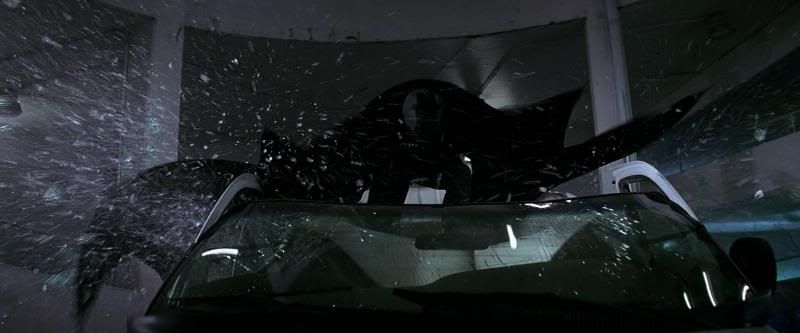
Showing posts with label Batman. Show all posts

Sunday, October 6, 2013

Legerdemain of the Dark Knight IV - Coin Tricks and Cartomancy


"- but his face deep scars of thunder had entrenched-"
-John Milton describing Lucifer in Paradise Lost

This article is a continuation of the Legerdemain series and benefits from reading the previous three installments. You might also want to read Bat Time, Bat Channel and This Joke Isn't Funny parts 1 and 2.  It has been five years since The Dark Knight was released, so I have no qualms about spoiling this movie.  It's not a synopsis anyway, but still, if you haven't seen The Dark Knight then you really have missed one of the greatest achievements of film making and performance of , well, of all time really.  Go watch it right now.  If you have already seen it, you probably should see it again.

I could talk about this movie forever and I probably will be.  It is deep and it is great and there is much, much for consideration here.  Seriously, fantasy film is the art form of the masses of the early 21st century, and there are few works that achieve these heights.  I called Batman Begins "Batman Sublime," and The Dark Knight Rises is excellent as well.  But The Dark Knight?  This is a different animal altogether.  If those other films are angels in the form of films, The Dark Knight is an archangel.  One with deep scars of thunder.  Let's take a look at some of what lies beneath the top level of this particular magic trick.


The Dark Knight is about duality, hoax building, initiatory process, sovereignty personification, and more than anything, sacrifice, on many, many levels.  This promotional piece featuring the three main figures quite overtly broadcasts an occult manifesto.  Totemic items are displayed obscuring one eye.  Odin, the Norse equivalent of Thoth/Mercury/Hermes, sacrificed an eye for a drink from the well of knowledge.  Horus, the avenging, solar messiah of ancient Egypt, lost his left eye in battle with Set.  When his eye was later restored he sacrificed it again in hopes of restoring Osiris to life.  You might be thinking now that these characters are covering their right eyes, and that's true, if we are a spectator looking them in the face.  But might we be being cast in a reflective position (correcting, of course, the lettering on the pin and card)?  That would be a more interesting view point for these psychological portraits after all.  Note how this image equivilates these three rather than differentiates.

That there is a sacrificial theme to this story is inherent in the title alone.  The Knight is a very common motif representing a transformative ordeal, a quest, that leads towards a perfected state.  Just think of the Knights questing for the Holy Grail.  It hardly needs explaining then that the Knight partaking in this quest represents the initiate.  A Dark Knight symbolizes expiation and sacrifice, tribulations of sin and periods of obscurity on the path towards heightened consciousness or a higher level of being.  This is an important concept to keep in mind.  The White Knight, by contrast, stands for purity and illumination.  The White Knight is the "Chosen One."  Harvey Dent is presented and even described in the film as a "White Knight" as opposed to Batman's Dark Knight.  But, huh, which of the major figures of this movie is overtly white?  One of Heath Ledger's early major roles was in the 2001 film A Knight's Tale.  The strangely anachronistic  A Knight's Tale is overtly initiatory.  It is also about the perpetuation of a hoax, as Ledger's character is a commoner masquerading as a noble.

Yes, the real star of The Dark Knight is Heath Ledger's Joker.  It is very interesting to see how much charisma this villain of villains exudes, especially in comparison to Bale's Batman.  Don't get me wrong.  Bale produces charisma on command at the necessary story beats.  Certainly the lack of personality is a storytelling, character-driven choice, representing the insular nature of an armored, hoax perpetuator operating as a living symbol.   At any rate, the Joker steals the show.  It's kind of what he does.
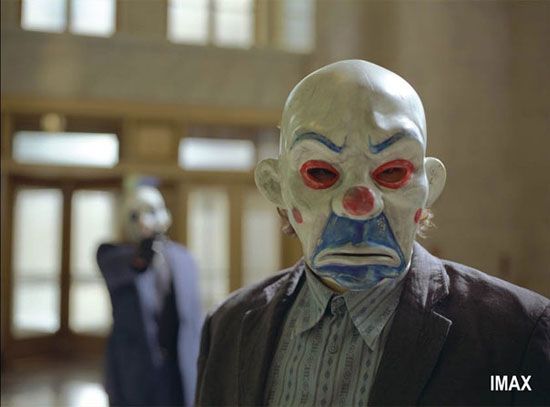

The movie begins with a brazen bank heist orchestrated by the Joker.  And its done so with very deliberately utilized masks, which of course, as a Batman film, is a major symbolic item.  A mask in a visual work represents illusion and concealment, key components to magic tricks and sleights of hand.  It also stands for transformation, being equivalent to the chrysalis, and it confers a magical character.  Of course metaphorical masks are necessary for the performance of con-jobs and hoaxes.  The use of masks in plays evolved from activities of the ancient Dionysian Mysteries.  This led to their use in sacred plays as representing the supernatural forces of deities and the inner psychology of characters normally hidden.  And they still do.  The origins of theater seem to stem from the worship of Dionysus.  There's a long but direct stream (an Underground Stream) through history to every item of contemporary popular culture.  Just think of how important the Mask is to the comic book hero, particularly the Batman.  This is a Dionysian device.  These works, whether they know it or not, are an expression of his Mystery.

And these masks are clowns because this is a Joker operation.  The Joker is a clown.  The Clown is the equivalent of the Fool, and of course the modern playing card Joker is the equivalent of the Tarot trump The Fool.  The Fool is the initiate's card, the status of the seeker at the onset of his/her process of enlightenment.  The Fool is the Ain Soph of the Kabbala, the unknowable, primary cause.  The Clown/Fool is the opposite of the King (keeping in mind that Batman is the self-described King of Clubs).  The King represents order and the Fool represents chaos, and this is very apparent in the presentation of these characters.  This is the essential duality of this story, and one represented in many ways throughout the film.  The Clown/Fool is also emblematic of unregenerate man, and this is an aspect certainly readable in this presentation of the Joker.  Most importantly, the Fool is a symbol of sacrifice.  In past cultures where the sovereignty of the king was felt to have direct correlation to the fecundity of the land, there were times when it was deemed necessary to sacrifice him for the common good.  Kings don't like to be sacrificed, of course, and a system developed wherein the lowest member of the court was substituted.  Or so the mechanism is described.  Heath Ledger's first listed role on Wikipedia is a 1991 Australian film called Clowning Around.

It is not overtly presented in the film but reading the Nolan brothers' script for The Dark Knight reveals an interesting aspect of the bank heist.  The assumed identities of these hired criminals, obviously strangers to one another in the manner of Resevoir Dogs, are Bozo (that's the Joker seen above), Chuckles, the unnamed bus driver, and then Dopey, Grumpy and Happy.  The use of the Disney dwarf names might seem a simple throw away, but it is suggestive of a system of seven.  Seven is a complete cycle, the days of the week and the days of Creation, both of which derive from the seven observable planets in a geocentric model.

But wait.  There's only six actual robbers involved. Yes and no.  The robbers don't realize that Bozo is the Joker.  They talk about the Joker as the mastermind of the operation and as an additional share.  So an alter-ego, a duality, a hoax, a trick, creates the extra figure.  The bus driver is unnamed and unseen, and so he must be Bashful.  The brains of the outfit, the obvious leader?  That sounds like Doc.
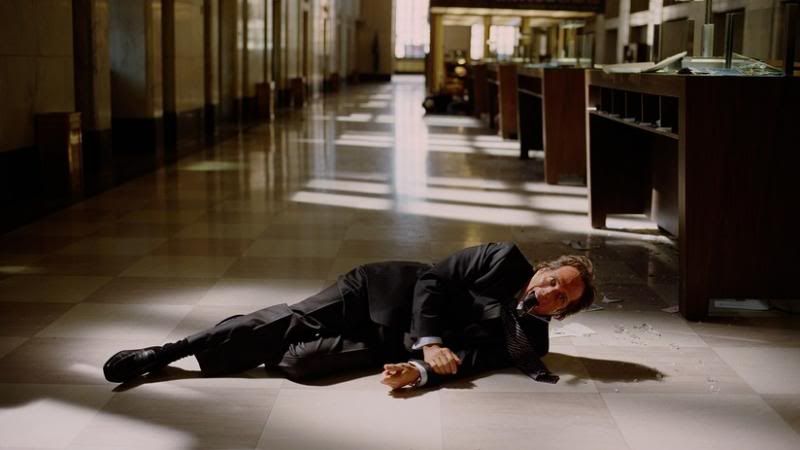

Here is Doc Joker teaching the mob-tied, criminal bank manager a lesson.  Note the checkerboard floor.  The Nolan films are rife with this symbol of initiatory process (I discuss checkerboard symbolism to great extent in Illuminating Harry Potter I: Romancing the Stone amongst other articles).  Put simply, it is the interplay of dualities, positive and negative, night and day, solar and lunar, male and female.  The tensions of these polarities controls the inherent irrationality by placing it within a strict, governed order.  We see these interplays throughout this movie in many different forms, obvious and covert.  The actual bi-colored grid is in place at very key moments that I will point out as this article progresses.  They are all directly related to initiatory steps enacted by the Joker.  This bank heist, the first step in the Joker's elaborate, criminal act of performance magic, is stage one.  The subject is Gotham City.  Note that the Harlequin, which is the exact equal of the Clown and the Fool, is traditionally garbed in a checker-pattern.

Is a Tarot analogy a stretch?  Even if it weren't deliberate, a perceived symbolic content carries meaning even without the author's intent.  This is one of the major themes of this blog.  In this case I am certain the Tarot is being utilized quite purposefully as the story tellers tip their hat to this fact at the end of the scene (and far more overtly further on).  The Joker makes a clean get away driving a bus marked "District 22."  There are 22 Tarot trump cards.  At the outset The Dark Knight is slyly declared as a work of cartomancy.
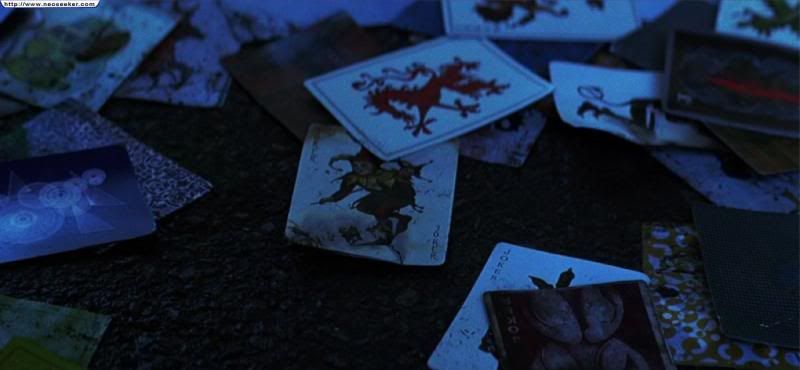

Let's talk a little bit about cards.  The above still is a shot of the hundreds of Joker cards that litter the street after he blows up the judge's car.  Note the geometric circles and triangles on the card to your far left.  Without being able to specifically identify it, it looks like alchemical or Rosicrucian diagrams.  The kind of thing you might find in a Manly P. Hall book.  Hall was a genius of card (symbolism) tricks.  Hall points out that in the two color scheme of cards we again find our dualistic patterning.  There are thirteen cards of each suit which represent the thirteen lunar months of the year.  That the 52 cards equal 52 weeks is easy enough to see.  If you count the Jacks, Queens and Kings as 11, 12 and 13 then all the pips equal 364.  If you add the Joker you get 365.  The twelve court cards stand for the zodiac, which is always about time and timing.  Timing is key to magic.  Note how integral proper timing is to every major action enacted by the Joker throughout this film.  This magician characteristic is not hidden.
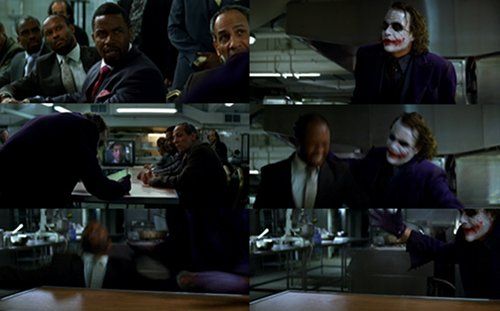
 
Ta da!  The disappearing pencil trick.  The Joker is very much presented as a Magician in this film.  And Batman has already been presented as a Magician.  They are hoax builders at war.  This is the same central core as The Prestige. A striking example of the importance of timing in Batman's actions occurs in his first scene in this film, when he jumps down the spiral ramp of the parking garage onto the roof of a moving van. 
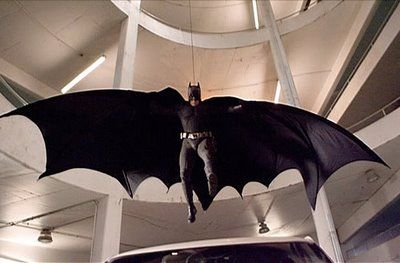

Let's take a moment to consider some of the connotations of the Bat.  As a double-natured entity, as a mouse/bird, the Bat's alchemical symbolism is related to that of the androgyne. It's the Two-in-One, a duality personified.  In many cultures the Bat has stood for Vigilance, and that's fully appropriate here.  More commonly it represents superstition, fear, death and madness, something Francisco (that's fun to say, Francisco) Goya certainly understood.
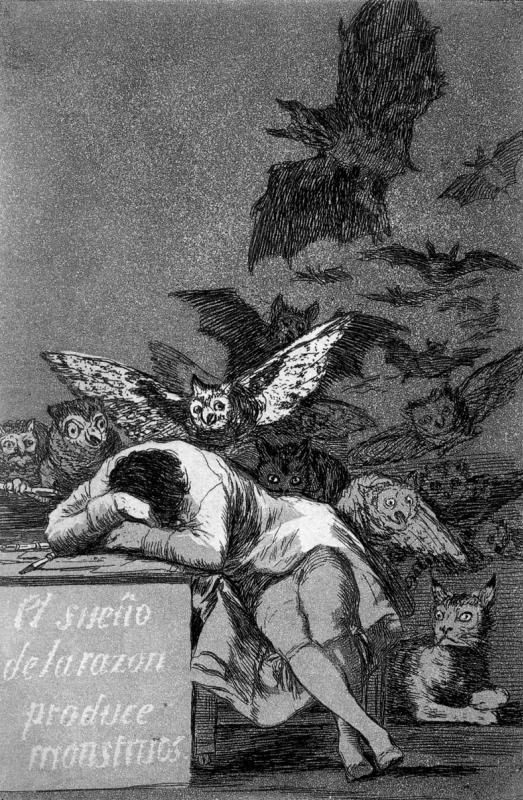
The Sleep of Reason Produces Monsters, Francisco Goya, c. 1799.


Which in its way depicts the essential plot of this film and the next one.  Bruce Wayne's dream of bringing rational order to Gotham results in a costumed psychopath arms race.  The full epigraph for this etching is really perfect: "Fantasy abandoned by reason produces impossible monsters: united with her, she is the mother of the arts and the origin of their marvels."  Testify Francisco.

The parking garage scene features a reappearance of Cillian Murphy's Scarecrow, a figure that is both Dionysiac and sacrificial (usually by fire, an important symbol set we'll return to).
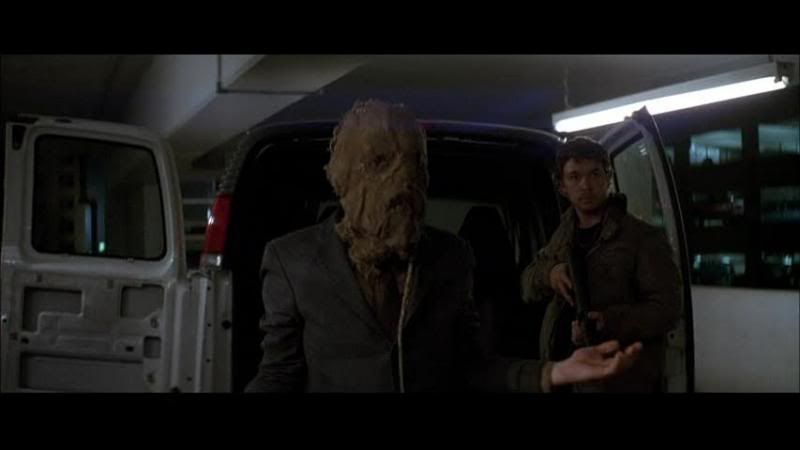

When criminally operative the Scarecrow appears masked.  I'm certain Dr. Crane, in this version of the character, could talk all about the psychological symbolism of the Mask.  Jungian archetypes, you know?  
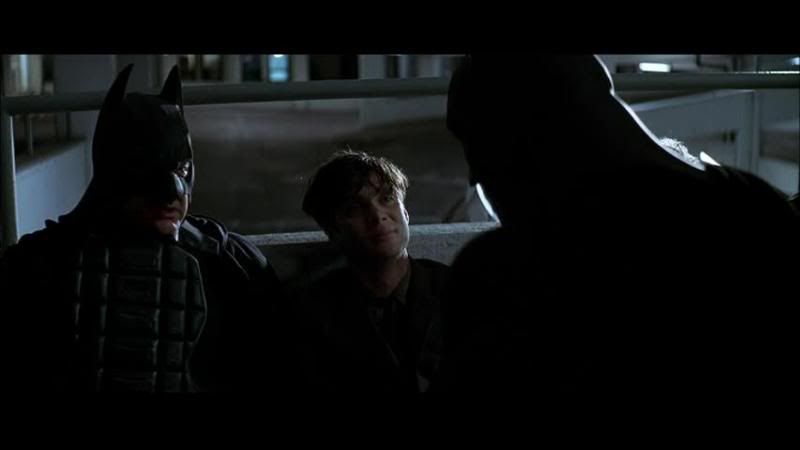

Once defeated his mask is removed.  Unmasking is is an integral aspect of this story, the undoing of all the symbolic connotations described above.  Unmasking is an unveiling, the exposure of the hoax, the undoing of the opponent's magic spells.  This still also shows the most prominent of the false Batmans that appear in this scene.  Duplicates, doubles, false figures.  Think about The Prestige.
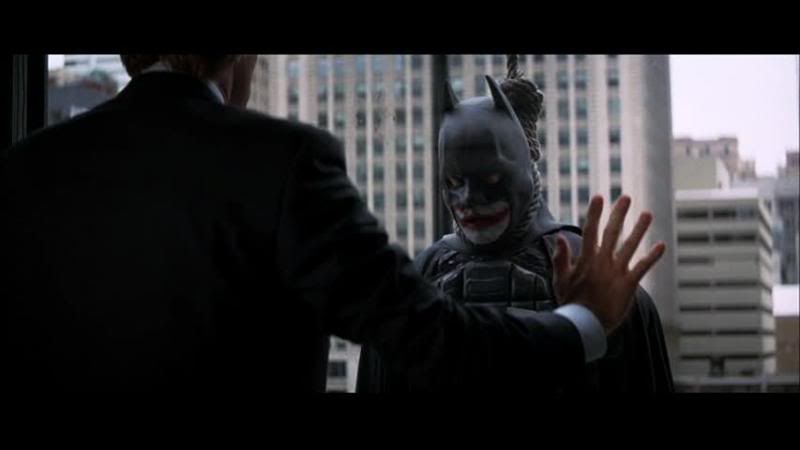

And about how these duplicate figures need to get sacrificed in magic acts.  We'll talk about the significance of the Hanged Man later.  Note how the Joker and Batman are combined here, the synthesis of opposites.
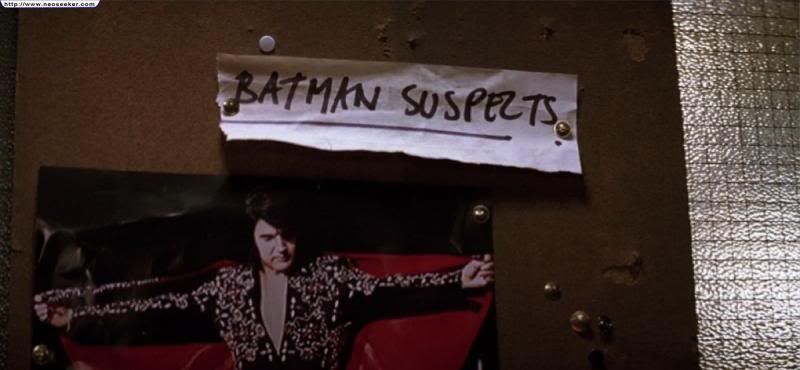

The hoaxing nature of the Batman is alluded to in the Gotham police department's joking bulletin board of Batman suspects.  Besides Elvis we see Bigfoot and Lincoln, all figures attached to hoaxes and conspiracies. Note the silver grid work.  We'll see this motif more prominently elsewhere. 


Speaking of grid work, the second example of the initiatory checkerboard pattern associated with the Joker's activities occurs when he pretends to be dead in order to get to Gambol.  The floor and the walls are all checkered.  You can see it better in the video then in any still I can find.  This Rising From the Dead scene is of course a major initiatory rite symbol, and one particularly tied to Dionysiac Mysteries.  Here we also have the first of the Joker's explanations for his Glasgow Smile, which is an aspect of his hoax building.  The scene ends with the Joker forcing Gambol's thugs to fight to the death for a position in the Joker's gang, emphasizing the sacrifice theme.  Also note how this is just one of the false deaths/rebirths in this film as James Gordon later fakes his own death to get the drop on the Joker.  What occurs after Gordon's "rebirth?"  He achieves a higher rank/reaches a more elevated position as he is named the new police commissioner of Gotham City.
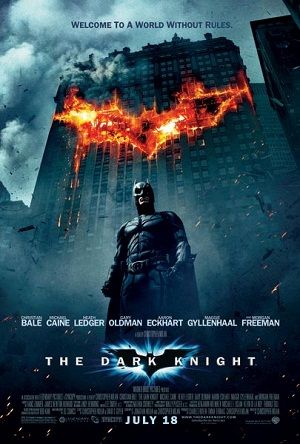

The primary poster for The Dark Knight combines two of the major symbolic devices of the film, those of Fire and the Tower.  Together they formulate a very clear depiction of Tarot Trump sixteen, the Tower Struck by Lightning, aka Le Feu du Ciel/The Fire of Heaven.  Seriously, if there were a Tarot deck combining popular super  heroes with modern day terror anxieties, this would be card sixteen.  Batman is positioned directly before the tower, like a column, repeating its format, identifying him with the structure of the city.  This is fully appropriate as the Tower of Trump sixteen is representative of  the human form.  The enigma of the Tower card relates to the fall of man and the devastating consequence of over confidence.  This happens to describe the Joker's objectives in this film.  "Welcome To A World Without Rules" is essentially a reading of the aftermath of Trump sixteen's symbolism.

The Tower is also quite overtly used as a symbol of Bruce Wayne/Batman in this movie.  His mansion having been destroyed by Ras al Ghul in Batman Begins, Batman is operating out of the tower of his corporate headquarters.  There's an implied movement here between the films from the maternal cave to the paternal tower (and back again in the third film).  The Cave is primordial shelter, and as an easy to read womb symbol representative of birth/rebirth.  It is emblematic of the unconscious mind and associated in many legends with gods and heroes.  The Tower is about ascent and vigilance, as well as the aristocratic nature Batman can never remove himself from, as it looms above the common level.  While it is overtly phallic it is yet another item of combined duality.  The protective nature of the Tower is a feminine quality, associating it with the Virgin.  This is seen in many stories and legends.  Just think about Rapunzel.
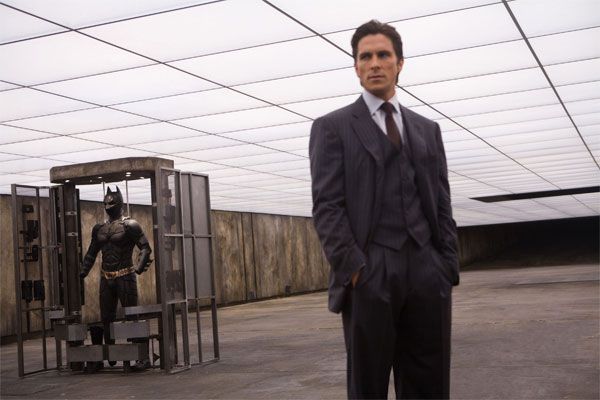

Here we see Bruce Wayne within a cave within his Tower.  The complex encasement of his costume is intriguing.  The arms of the Knight stand for symbolic potentialities.  There is an article unto itself in examining the symbolic significance in the equipment of Batman and the Joker.  But I include this still to display the striking ceiling used for Batman's secret headquarters.  Notice we again have a single-tone grid in place associated with Batman.  Its illuminated, as the grid on the police bulletin board is light reflective.  So this is a system, a grid work, implying activity and development, but its not dualistic in these instances.  Batman's essential initiation took place in Batman Begins.  He's acts in this movie from a more elevated status, with a level of enlightenment.  Note his desire to move up, and out, from this level and unite with Rachel Dawes, leaving it to Harvey Dent.   
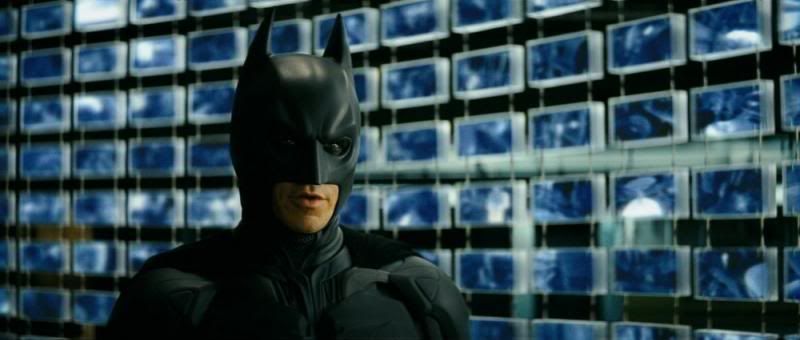
And another luminescent grid work associated with Batman/Bruce Wayne.  This one is crafted by Lucius Fox (the light-bringing Promethean) and confers upon Batman a heightened sensory awareness of his city, confirming his role of sovereignty figure.  This is truly what Batman and the Joker are fighting for in this story.  Harvey Dent as well.
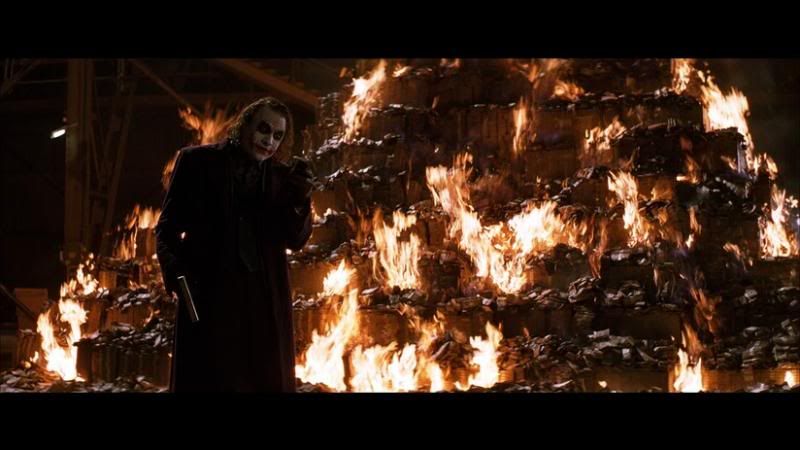

Here's another prominent combination of the Tower and Fire from the scene where the Joker demonstrates that his objectives are in no way material.  If I had to choose one symbolic device that was most relevant to The Dark Knight it would have to be Fire.  The first words of the Nolans' script are "Burning.  Massive Flames".  Interestingly the fire we see as the film opens are blue.  I used to keep a catalog of blue entities from popular culture here.  I did not bring that back with the resurrection of this blog, but the color Blue has a great deal of important connotations.  Blue represents the intellect and divinity (the latter the primary reason for all those blue people).  It is an attribute of Jupiter and Juno, and many other Sky Gods.  As a color used in the visual arts it is very functional as a visible darkness.  And while in ancient Egypt the color Blue represented Truth, it simultaneously represents Mystery and Deception.  The synthesis of opposites occurs here on many levels.

Fire is Divine Energy.  It is spiritual passion, purification, revelation, regeneration.  It is the medium for conveying messages to the heavens.  It is (again) dual natured, divine and demonic, creative and destructive, intellectual and emotional. It is a device of ritual sacrifice and a common means of Christian martyrdom.  It is the central element of alchemy.  Fire is traditionally associated with Trickster Gods like Prometheus and Loki. Let me underline here how this version of the Joker and Loki are the same figure.  There are many articles at this site delineating Promethean characters.  The Joker and Loki are in that camp, retrograde.

According to Gaston Bachelard's Psychoanalysis of Fire, it is "-the archetypal image of phenomena in themselves".  That's a bit of a hard concept to parse,  but the basic idea is that experiential existence is like the visible and tactile energy of something burning.  I'm still thinking about that one.  Existence is a kind of release of energies.  Think about the origins of the universe starting with a big explosion. 

Even more on target than Loki or Prometheus is the association  with Lucifer, as I suggest with the Milton quote at the top of the page.  Hall recounts a story told by 18th century alchemy scholar Georgius von Welling that the material universe was created accidentally by Lucifer's misuse of the Schamayim, the Divine Fire.  Here's the most prominent Joker card utilized in the film to hammer home this association.
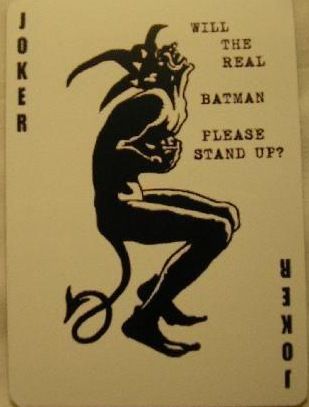

These cards are deployed to the potential victims of the Joker's triple murder plot.  The judge is killed by fire.  Fire in this context is about the Luciferian desire to annihilate time and bring all things to the end. This is what is meant by the key line of dialog for this film, when Alfred, speaking on how Wayne doesn't fully understand the Joker, states "Some men just want to watch the world burn".


It is by Fire that Rachel Dawes is murdered (sacrificed) and  Harvey Dent is turned into Two Face.  Note the floor Harvey's face is lying upon as it is half submerged in gasoline.
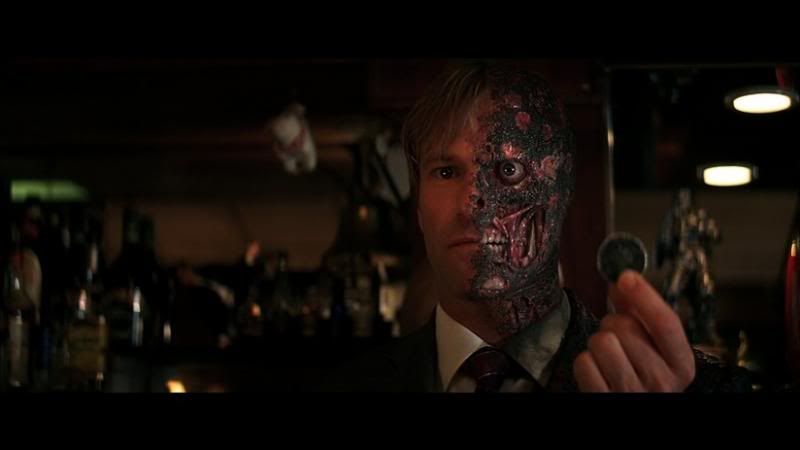

Here's Two-Face.  All this talk of duality and combined dualities?  That's overtly inherent in every iteration of this character.  I talk in Illuminating Harry Potter about the Roman god Janus (when discussing Prof. Quirrell and Voldemort).  Here he is again.  Janus is the god of thresholds and beginnings, exits and endings.  He is representative of acts of inversion and mutual sacrifice.  He is the transmitter of the knowledge of the law and of agriculture (that's sowing and reaping).
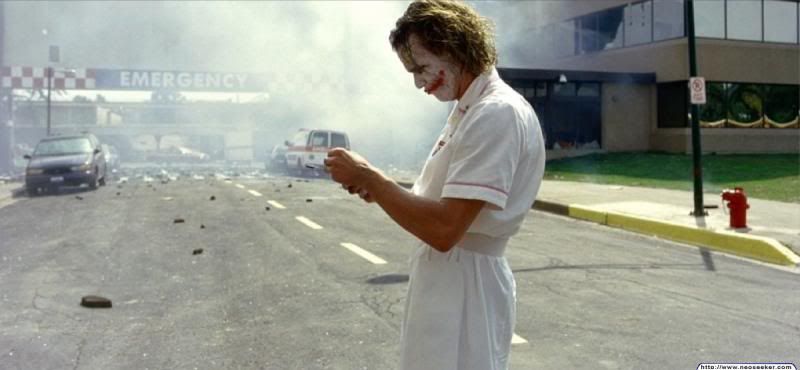

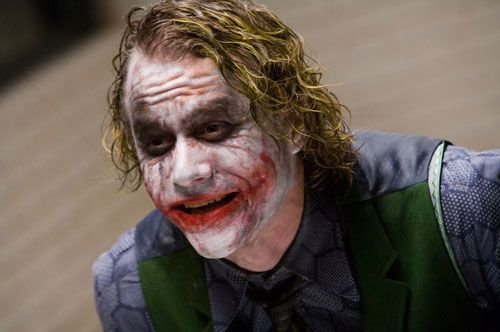
And when the Joker sets Two-Face, his initiate, loose on the city?  There's fire.  And there's a checkerboard.  And this vital stage of initiation involves a cross-dressing Joker, a synthesis of Randall Patrick McMurphy and Nurse Ratched, the union of opposites.  The androgyne or hermaphrodite is symbolically alchemy's coincidentia oppositorum, the incarnation of the Great Work.  It is the same meaning as a head with two faces, interestingly enough.  For this reason the androgyne is a common figure for conducting an initiation ceremony.  Now take a look at the very first image of this article and note the hexagon pattern of the Joker's shirt.  A hexagon is a six sided figure.  Six represents unity and equilibrium.  Why?  Because the hexagram is the combination of an upward pointing male triangle, and a downward pointing female triangle. It's an androgyne. 
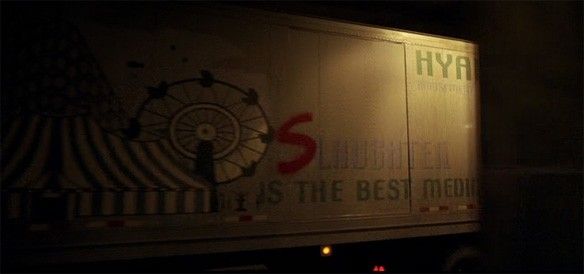

Here is the Joker's vandalized circus truck.  The word circus is related to the word circle, due to the shape of the performance area.  Circuses almost always involve animal acts.  A circle of animals is a manner of referring to the zodiac.  Every media use of circus can esoterically relate to the zodiac.  This is a key point.  The zodiac is important due to the precession of the equinox, a grand scale matter of astronomical timing, the shifting of ages (golden, silver, bronze, iron) which is allegorized in many, many places as stories about the end of the world.  We are living in the shifting from the Age of Pisces to the Age of Aquarius.  And think how popular apocalyptic stories are right now.  This harrowing scene starts with a burning fire truck, a pun by the Joker, and another deployment of Fire symbolism associated with him. 

Does this seem like a lot to extrapolate from the graphics on the side of a truck?  This is what esoteric symbolism is all about.  In this case the above is emphasized by the black and white  initiatory patterned tent, and the Ferris wheel, a circle, and one that looks like a sun burst and an eye.  A single eye emitting a black beam or sitting atop a column.  Now that I'm saying it, try not to see that Ferris wheel as a stylized Eye of Sauron.  Return, if you like, to the obscured eye image at the start of the article.  What is alchemy's Great Work?  Turning base metal into gold.  But that's an allegory.  The basis of mythology is astronomy.  It's time keeping.  It's a turning that's a returning, back to the start of the circle, iron into gold.
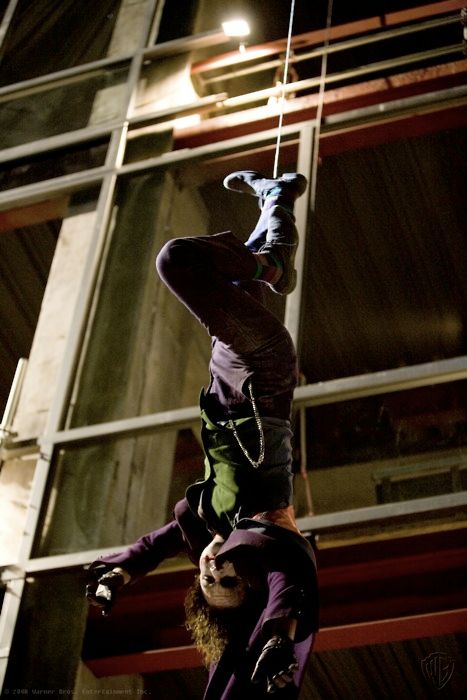

In his last act, the Joker has a failed use of fire involving the two ferries in a Prisoner's Dilemma  scenario, and creates a hoax that Batman uses his enlightened senses to see through involving masking hostages as Clowns and his thugs as Doctors.  As I contend in the Doctoring Art Gotic articles, Doctors are the teachers of the Invisible College.  Batman gets caught in a net (a grid-structure of the visible and invisible, and a symbol of magical authority) prior to the Joker being displayed as Tarot trump twelve, The Hanged Man.  The symbolism of this card is overtly sacrificial, and once again Odinic.  It represents expiation, inversion and realignment.  And what does The Hanged Man predict?  The elevated Batman's Fall, generating a new hoax wherein he takes responsibility for the murders committed by Two-Face, an act of expiation, and the Dark Knight entering into obscurity. 

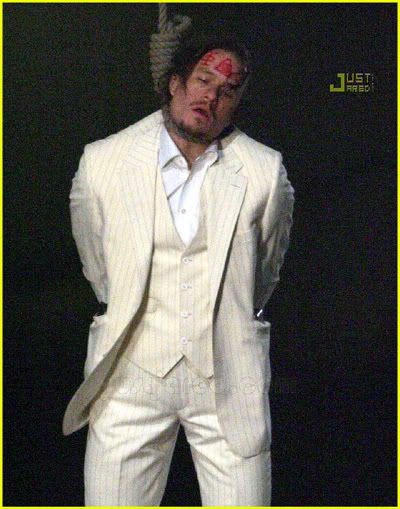
How interesting that in the Tim Burton Batman movie the Joker also hangs before falling (from a tower, weighed down by a statue of the Devil).  In The Dark Knight the Joker lives but Two-Face dies in a Fall.  Joel Schumacher's Two-Face also dies from a Fall.  The Dark Knight is Ledger's last full role.  He half finished Terry Gilliam's The Imaginarium of Doctor Parnassus.  He enters that story as a hanged man, where his Joker role left off.  Inverted.


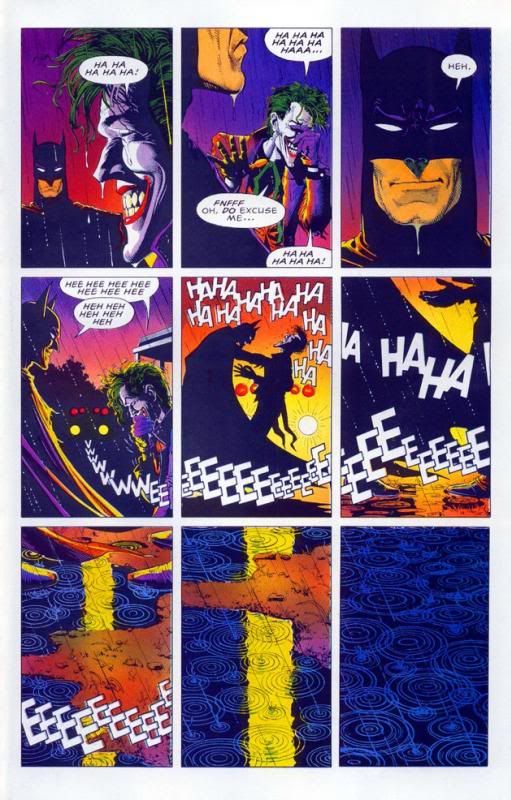
The Joker dies, the Joker lives, the Joker dies, the Joker lives.  The subject of this article is a few years gone by now.  This doesn't really make it more comfortable to talk about though.  And, though not nearly as prominently, this matter of the Joker's living and dying and living, and the questions about it all, have become topical again due to an interview comic book writer and so-called chaos-magician Grant Morrison gave to Kevin Smith where Morrison makes a claim regarding what is highly regarded as the best Joker comic book story ever produced, The Killing Joke.  The Killing Joke is by another self-professed comic book writer/magician, Alan Moore and the amazing Brian Bolland.  It involves the Joker shooting and paralyzing Barbara Gordon, who is secretly Batgirl, and photographing her naked, wounded body (and possibly raping her) with the intent of driving Commissioner Gordon insane.  It ends like this:

art by Brian Bolland


With the Batman and the Joker sharing a laugh at a joke as the police arrive.  Some comic readers find this scene, read straight, as touching, though I am not amongst their ranks. Morrison contends that it was Moore's intent to suggest, though not overtly, that Batman kills the Joker.  And I agree.  I always thought this was being suggested.  I mean, look, the light goes out in the last panel.  The line separating the two of them disappears.  Batman proves the Joker is right by breaking his cardinal rule and killing the Joker.  And this was really the Joker's purpose because his existence is a misery.  However, this is fiction.  It is only so much about the author's intent.  There is no inherent truth, which means that both endings are simultaneously true.  And false.  Morrison fully realizes this I'm sure.  Smith might as well.  Note that Morrison has in his recent career killed and resurrected Batman, killed the latest Robin who is the son of Batman and Talia al Ghul, not to mention killed and resurrected Superman as the heart of the sun.  What is death in comics?  It is a symbol system.  It is a motif of exit and entrance.  It is about resurrection.  Always. 

Sunday, April 6, 2008

Birdhouse In Your Soul - Two

I ended part one with Sophie Hatter, the Witch of the Waste and Heen the dog fleeing the King's soldiers on a dragonfly-like flying machine, guided back to Howl's Castle by a beam emitting magic ring connected to Calcifer the fire demon. Unfortunately Howl failed to teach Sophie how to land. The Castle's mouth-like facade opens to admit her and she crashes inside. Remembering the essentially feminine symbolism of a House/Castle, it is easy to see the sexual symbolism inherent here, interestingly with female Sophie penetrating the male Howl (via his Castle).
Photobucket

Markl rushes to greet her. We can note here how despite the hard landing Sophie has managed to keep the Wheel (of Fate) firmly in hand. Only one of the three handles of the Wheel remains attached, perhaps conferring that Sophie has now completed two parts of a three step initiation cycle.

That night everyone in the Castle sleeps when Howl returns home, still in partial bird-form, bleeding and now also ethereal, partially transparent, as if he is fading away. Calcifer warns that this time Howl has gone too far. Howl walks through like a ghost, silent, trailing bloody footprints and feathers. Sophie, young because she's sleeping, wakes up and sees the blood and feathers. She gets up to check on Howl, remaining youthful, illuminating a candle to light her way.

Photobucket

Note the placement of this essential enlightenment symbol beside a book marked with a basic Tetramorph pattern, the Cosmic Cube. Note too the Grail form of her candlestick holder. Sophie makes her way upstairs and enters Howl's room, but finds it has become a tunnel, rather subterranean, lined with Howl's collection, with an overwhelming amount of toys and other childhood objects.

Photobucket

We could probably play "Where's Waldo" with this scene there is so much to look at, but I wanted to point out the close combination of Templar symbolizing White Horse, Sword and right beside it a Solar Cross in red and green. This literally on top of a kilt wearing doll with its head buried in the ground, which one could read as Templarism going underground in Scotland. Perhaps then the telescope and corner of the gilded picture frame suggest examining the arts for what has been hidden.

Photobucket

And here we have Sophie again in close proximity to the Wheel. At foot level to her right are twin columns topped with a green pyramid made from children's blocks. Recall the twin-pillar arch in the Ernst piece at the start of part one of this article, and seen several times as a background decoration during the magic acts of "The Prestige", and the Green Pyramid topped Wayne Tower in "Batman Begins". Deep in the cave Sophie finds Howl, huge and barely human. In fact he is particularly Bat-Faced.

Photobucket

When Howl is in pain his voice sounds exactly like Bale's Batman voice (differentiated from his Bruce Wayne voice). He tells Sophie to go away but she refuses. She insists she's going to break the spell on Howl, but he reminds her she can't even break the spell on herself before he flies away deeper into the tunnels. As this happens Sophie becomes old again.

Sophie then wakes up. This was just a dream, though we must remember that Dreamtime is the Other World, Howl's Castle is the Other World, and the story itself takes place in an Other World, making this a dream, within a dream, within a dream. Clearly the tunnels lined with childhood things is a visualization of the subconscious, and this made explicit here further identifies Howl's item packed room seen in part one as the same. The Castle is the body of Howl, and the room where he dreams is that body's mind.

And what is Calcifer in this equation? Having learned from Suliman that Howl's heart was stolen by a demon, Sophie tries to pry details from Calcifer regarding his contract with Howl, but Calcifer refuses. That morning Markl, Turnip Head and Heen help Sophie extract the flying machine from the Castle.

Photobucket

I include the above image merely because it's charming. They all then gather for breakfast. Calcifer is suspicious of the new guests, especially the Witch of the Waste. Though now seemingly completely senile she still displays a fascination with the fire demon.

Howl runs down in good spirits, and while he comments on the Witch and Suliman's dog being at his house he does not seem overly concerned. He meets Turnip Head for the first time, recognizing the nasty spell on him, commenting that everyone in their "family" has problems. Howl announces they have a lot of work to do as they must move the Castle to elude Suliman. He tells Turnip Head that the spell on him is too powerful and he'll have to stay behind. Outside the castle Howl lays out chalk lines into a magic circle.

Photobucket

Note the pyramidal, eye-like sign he makes. Calcifer moves the Castle onto the magic mark. Inside Howl draws a second, smaller circle.

Photobucket

It's nice to see an example of Chalk Magic so close to having written my article Night Divides The Day about the film "Day Watch" and its Chalk of Fate. Howl gathers Calcifer up in a fireplace shovel and the fire demon releases his magic, taking on a more dynamic form as he does so.

Photobucket

Immediately the Castle starts to change form around them. Repairs are made, new rooms grow, and fine furnishings drop into place. The main room of the Castle is now finely decorated including Rose patterned wall paper.

While moving the Castle is a matter of protection, the alterations Howl makes are purely for Sophie's benefit. This includes a doorway opening to her hometown Market Chipping, and the recreation of her room at the hat shop. As Sophie looks about the room she de-ages momentarily. Sophie does not understand this gesture, stating it is the perfect room for a "cleaning woman", despite the gifts Howl has placed for her in the room. Now that the Castle no longer opens to Porthaven or Kingsbury there are new locations to replace them on the Wheel. We can note that the Market Chipping door is denoted as Gold.

Photobucket

The Red Door however leads to someplace even more important, the heart of this film, and Howl states it is a present for Sophie. The Red, which is really more of a Rose, now opens to Howl's Secret Garden.

Photobucket

That's how he describes it. We can recall that Sophie's story begins with her in a false garden. This is the real deal. Sophie reverts nearly to her full youth in this place, idyll and ideal, she describes it as perfect, like a Dream, and familiar though she'd never been there before, instantly like home. Howl then leads her to a small Mill house.

Photobucket

He describes it as his secret place to be alone as a child. I find it quite interesting how, on the color Wheel of Howl's door, Gold now leads to the location of Sophie's childhood, an exoteric reality so much so that she grew up and lived in a shop, partly open to the public. The Rose leads to the esoteric reality of Howl's childhood, a Secret Garden, a meditative place for him alone. The Mill is a major symbol, not just of Time but of the process and quality of Time. A Mill set in an Eden is clearly indicative of the Golden Age. And while this may not seem at all to be an Oz related scene, it actually is in a couple of different ways. Approaching the idealized Emerald City, Dorothy and Company are waylaid in the Poppy fields (emblematic of Isis/Demeter/Ceres). Sophie describes Howl's Secret Garden as a Dream, which is the state the poppies send Dorothy, the Lion and Toto into (the Scarecrow and the Tin Man are immune to intoxication).

Maybe more interesting then this is the inherent relationship between the symbols of the Mill and the Tornado. In "Hamlet's Mill" authors Giorgio de Santillana and Hertha von Dechend identify the Shakespearian figure with the Icelandic hero Amlodhi, about whom they state:

"Amlodhi was identified, in the crude and vivid imagery of the Norse, by the ownership of a fabled mill which, in his own time, ground out peace and plenty. Later, in decaying times, it ground out salt; and now finally, having landed at the bottom of the sea, it is grinding rock and sand, creating a vast whirlpool, the Maelstrom (i.e., the grinding stream, from the verb mala, "to grind"), which is supposed to be a way to the land of the dead. This imagery stands, as the evidence develops, for an astronomical process, the secular shifting of the sun through the signs of the zodiac which determines world-ages, each numbering thousands of years. Each age brings a World Era, a Twilight of the Gods. Great structures collapse; pillars topple which supported the great fabric; floods and cataclysms herald the shaping of a new world".

Amlodhi/Hamlet then is one and the same as Saturn/Chronus, the lord of the Golden Age. The Mill, the Axis Mundi, collapses creating in its place the Maelstrom. The Maelstrom is inherently related to the whirlwind, apparent through the association of the whirlwind to the counter clockwise spiral, a symbol of Poseidon. As stated before, this makes the Tornado that carries Dorothy to Oz a symbol of Age Shift, as is nearly if not always the case with magical portals in fantasy fiction. The country of Oz is itself Tetramorphic in nature.

Photobucket

      We find the essential image of Oz as the indication Wheel for the magic door. Like the Emerald City, the magic door functions in such a way as to make Howl's Castle the Center. It is even conceivable that the shift in the color wheel, the removal of Blue for Yellow, is a subtle in-joke related to the geographical confusion between Munchkin Land and Winkie Land , whether or not the East and West of Oz are congruent or opposite those of the real world, which is truly an interesting detail in what is essentially a solar allegory.

Sophie is enchanted but she still senses something is wrong, and intuits that Howl is providing for her and their friends, because he will soon be leaving and very well won't be coming back. She expresses her strongest desire as wanting to rescue Howl from the curse turning him into a monster, even though she is not pretty and only good for cleaning. Howl tells Sophie that she is beautiful, but she obviously does not believe this as when he says it she instantly becomes old again. Their conversation is interrupted by the sound of a passing aircraft.

Photobucket

Two children are threatened by a nightingale. It is a flying battleship. Howl is surprised and disgusted to find them flying even in an area as remote as this, and for certain, though not stated, because they are invading the sanctuary of his Secret Garden as he's presenting it to Sophie as a safe haven. Sophie asks if the ship is from their kingdom or the enemy's, but it makes no difference to Howl. We can also take interest in the close proximity here of a Mill and a Zeppelin like air craft. Howl can't abide letting them pass with their payload of bombs, so he casts a spell causing engine malfunction. The ship starts to list in the sky and we hear alarms sounding.

Photobucket

The pink and gold flag confirms it as a craft from their Kingdom, Ingary. Note the 71 or 17 reversed. One of the indicators of the occult significance of 17 comes from the Tarot, where it is the number of the Star Trump. If you're not already familiar with the story of "Howl's Moving Castle" my emphasis of this will become clear as this article progresses. Suffice it to say that in this context 71 is the anti-Star.

Casting the spell causes Howl's left arm to break out in claws and feathers. He assures Sophie that he is just messing with them and the ship won't crash. An ovapositor-like aperture on the ship spits out several of the Boschian flying tadpole-men, Sulimen's agents. Howl urges Sophie to run, sprouts wings and then lifts her by the arms, flying towards the exit to the Castle with Sulimen's henchmen in close pursuit. He tosses her and his magic carries her through the door and back into the Castle, the entrance shifting back to Gold behind her.

That evening Sophie tucks the Witch of the Waste into bed. The Witch, who seems to have regained some of her faculties, can tell that Sophie is in love, an observation that delivers a measure of youth to Sophie. Their conversation is interrupted by the sound of air raid sirens. Suliman's tadpole men scour Market Chipping looking for the Castle's entrance. Elsewhere huge bird-like warplanes engage in a bombing blitz. Howl soars above the battlefield. Note the high visual comparability of the following shot to one from "Batman Begins".

Photobucket

Photobucket

I believe this would be striking even if both characters weren't performed by Christian Bale and the two films released less then a week apart. The next morning Markl and Heen step out of the hat shop door in Market Chipping in disguise and carrying roses. I believe he and Sophie may be setting out to sell flowers from the Garden as Howl suggested, and my sister tells me this is an allusion to Markl romancing a younger sister of Sophie's in the novel, but this is never made clear. As far as I'm concerned Roses speak for themselves.

Photobucket

Markl is startled by the arrival of an unfamiliar woman and rushes to get Sophie. It is Sophie's mother. They have a tearful reunion. Sophie's mother demonstrates her ditziness, taking brief but fleeting interest in the sleeping Witch and how different the interior of the shop is (as it is now actually the inside of the Castle). Even Sophie's elderly state barely seems to phase her. It is apparent that the physical status of daughter being older then the mother is a reflection of these characters' natures and relationship.


Photobucket

Recalling that the last time we saw her Sophie's mother was wearing a hat indicating the story of the Swan Knight, we can take great interest here in her row of Blue Roses. It may seem I have a bee in my bonnet regarding this character's head gear. Maybe so. Her name, by the way, is Honey Hatter.

Honey informs Sophie that she has remarried, and that her new husband is wealthy so they can all live together and Sophie will no longer have to work as a cleaning lady. Sophie replies that she likes living where she is. Honey easily accepts this and rushes out again as she has a car waiting. After she and Sophie have left the room the Witch of the Waste rises from her fake slumber and dashes over to pick up a purse Honey has left behind. She opens the bag and extracts a long, black worm.

Photobucket

She calls it a Spy Bug (though it could be called a Stygian Leech) and comments on this as a poor try on the part of Suliman. I can't help but be reminded of the Spy Flys from "The Golden Compass". The Witch tosses the Spy Bug to Calcifer to consume. He destroys it, but it makes him very sick. Outside we see that the driver of the car Honey rides in is one of Suliman's pages. She angrily reports that she's done as she was told and asks to be returned to her husband, then quietly hopes Sophie will forgive her betrayal. In front of the shop Sophie and Markl watch a stream of people evacuating the town. Markl, having heard Honey ask Sophie to move in with her, asks Sophie if she's going to leave too, but Sophie assures him that she's staying, that they're a family now, and the two embrace like mother and child.

Back inside Sophie tries to revive Calcifer with bellows, but he remains feeble, little more then embers. The Spy Bug has made him sick in a serious way. The Witch of the Waste puffs away at a cigar she found in the purse. We can honestly ask what it is that she's smoking considering Heen's reaction.

Photobucket

Markl reads in the newspaper that their kingdom is winning the war, but the Witch states that only fools believe what they read in the paper. The smoke is irritating everyone so Sophie asks Markl to open a window. The Witch advises against this as Suliman's agents are searching for them and Calcifer is in no state to protect the Castle. Then the bombs start to fall on Market Chipping.

Sophie runs out to check on the hat shop, but is chased back inside by Suliman's blob-men. As the bombs drop Howl flies over the town trying to do what little he can, personally steering one away from the shop. He then escorts Sophie (youthful save for her hair) back inside the Castle.

Photobucket

Inside Howl breaths life back into Calcifer, but the fire demon is still weak and far from peak ability. The Witch states she and Howl need to have a talk and he agrees, but doesn't have time at the moment, then leaves to continue protecting Sophie's shop from the bombardment.

Photobucket

Blob-men continue to try to force their way in, so Sophie uses the magic door to move the Castle to the Wastes, from where she can still witness the attack on Market Chipping. She sees Howl battling fiercely in a completely bestial form. Turnip Head is nearby, waiting for Sophie. Sophie realizes that the only way to save Howl from the war and himself is to move the Castle so that he no longer feels like he must protect the shop. To do this she takes the radical step of removing Calcifer from the Castle. Once he passes the threshold the Castle collapses. It is raining and Calcifer is close to being doused, but Turnip Head leads the company back into the shelter of the Castle's remains.

Sophie now wants to rescue Howl and convinces Calcifer to try to physically move the Castle into town to do so. But Calcifer is a demon and demands a bargain, suggesting Sophie give him her eyes. Instead she cuts off her long braid and feeds it to him. This is enough to motivate a small portion of the wreckage, which starts to amble towards Market Chipping. Calcifer states he could have done much more with Sophie's Heart. The Witch of the Waste suddenly comprehends the bargain between Howl and Calcifer. Howl is heartless because he has given his to Calcifer as part of their contract. The Heart of Howl is of course what the Witch desires more then anything, and now that she sees her prize close at hand she greedily grabs onto Calcifer. But this causes him to lose control of the Castle and as Calcifer is living fire the Witch starts to burn. Still she will not let go. In a clear evocation of Oz, Sophie throws a bucket of water on the witch to put the flames out, and this reduces Calcifer to a feeble ember.

Photobucket

Note too that the addition of the white apron to Sophie's blue dress is highly reminiscent of Disney's Alice, which becomes more noteworthy momentarily. The Castle collapses, splitting into two pieces, and Sophie and Heen fall into a ravine, separated from the rest of their company.

Photobucket

Note the intact Wheel placed behind a broken Beam. Speaking of Beams, Sophie realizes she may have just killed both Calcifer and Howl, but a faint beam of Blue light from her Ring shows they still live.

Photobucket

She follows the Beam to the Castle's still intact Magic Door, the Black Door, leading apparently to full Darkness.

Photobucket

Sophie, followed by Heen, bravely enters. Taking a light to darkness, is the Illumination of Mystery.

Photobucket

And we can clearly see that this Magic Portal, this Waycross, is a Water Door. They emerge in Howl's Secret Garden. Overhead Falling Stars streak across the sky.

Photobucket

They extinguish, dying as they hit the ground. Sophie sees a young Howl observing this as well and realizes the portal has led her to Howl's past.

Photobucket

Sophie's ring seems to react with the death of each Fallen Star. She watches as the child Howl catches one of the Stars before it hits the ground.

Photobucket

And then he swallows it.

Photobucket

Calcifer emerges from Howl's chest, where his Heart was. This is the bargain made between Howl and the fire demon, in fact a Fallen Star (compare the conjuncture of Fallen Star and Hearts/Love in Neil Gaiman's "Stardust"). To save the Star, Howl gives him his Heart. This is what makes Howl the Heartless Man, and we might note that this too is why Howl is really a child in a man's body. Howl's emotional development ceased when he bargained his Heart away. Suddenly Sophie's Ring breaks and the magic that led her to this place goes with it. The ground beneath her opens like a well and she falls away, but as she does she calls out to Howl that she'll save him one day in the future. Howl hears her and looks her way as she falls. We can assume that this foreknowledge is what led Howl to Sophie to begin with, their meeting in Market Chipping no mere coincidence. Sophie is literally the girl Howl waited his whole life for.

Photobucket

This image of Sophie's drop clearly indicates Alice's fall down the rabbit hole.

Photobucket

Sophie and Heen fall through the Earth and into the Sky. Difficult to see in the still above are the Two Pillar-like natural projections beneath them.

Photobucket

Reminding us that this is essentially solar allegory, we watch Sophie fall past a horizon line, and enters a dark, near-featureless limbo. Heen fulfills the Dog's essential purpose in journeys to Otherworlds and guides Sophie back to the Castle's door.

Photobucket

Photobucket

They emerge to find Howl waiting for them. The over-extension of his magic has left him barely human, a monstrous heap of feathers.

Photobucket

When she speaks to him his humanity somewhat emerges, but still he is hardly human, and isn't even properly a bird.

Photobucket

Photobucket

Howl flies Sophie and Heen to Howl and the rest of their friends, left teetering on a platform on a cliff's edge.

Photobucket

It is hard not to read this image of the Witch and Markl cowering beneath the cruciform of Turnip Head as religious in nature.

Photobucket

At this point Howl has just a single, monstrous bird-leg, and it's possible to read this supporting of a Blue Bird form as the Axis Mundi that supports the vault of the heavens, very similar to the symbolism of the Umbrella. Exhausted, Howl collapses, the feathers blow away in the wind leaving his human form lying prone on the platform near death.

Photobucket

To live Howl needs his Heart back, and Sophie pleads with the Witch of the Waste to return it. The Witch overcomes her greed and hands Calcifer to Sophie.

Photobucket

Photobucket

Returning Howl's Heart sets Calcifer free, and he flies away in his original Shooting Star form, exalting in his freedom. But when he leaves the magic animating the platform goes with him. The legs collapse and the platform slides down a steep hill towards the precipice. Turnip Head jumps in front to halt their momentum.

Photobucket

He stops them just in time, but his support post was ground away in the process. In thanks for saving all of their lives Sophie kisses Turnip Head.

Photobucket

And as should be expected it is a kiss that was needed to break Turnip Head's curse. He instantly transforms to his normal form.

Photobucket

He is in fact a Prince, the missing Prince from the neighboring kingdom whose disappearance set off the war. Interesting to note that at the end of "The Wonderful Wizard of Oz" it is the Scarecrow who becomes the ruler of Oz. Now that he's back to his normal self he can return to his home kingdom and have his father stop the senseless war. Howl now revives (resurrects) from his deathlike state. Suliman watches this all through her Looking Glass. Heen looks back at her and laughs at her expense. She calls the dog a traitor. Calcifer flies back as he quickly realized he missed his family.

Photobucket

The story ends with the family living happily in a new and improved Castle.

Photobucket

Having overcome all their trials, their initiations, the characters transcend to an elevated state. The Castle itself becomes the Bird. This is an interesting point as it closes several circles, and I think this might even be Miyazaki's commentary on synchronicity. Diana Wynne Jones did write a second book set in the Kingdom of Ingary, called "Castle In The Air", but it is not in actuality a sequel to "Howl's Moving Castle". Not only is Miyazaki making reference to this, but to his own work as well, "Laputa: Castle In The Sky" is the first film released by Studio Ghibli ("Nausicaa" not being an official Ghibli production), the inception of a priceless tradition of exceptional dream realizations.