Showing posts with label Wolverine. Show all posts

Tuesday, January 8, 2008

Doctoring Art Gotic Part IV

In this entry I'm dealing with more obscure Marvel and DC Comics Doctors and Professors in a somewhat random manner. This is really just a chunk, there's just too darn many of them. In this batch we find more full face masks hiding scarred visages, brain transplants, psychic twins, the Philosopher Stone directly and indirectly, demonic possession, the first Silver Age Marvel super hero, alchemical gender play and a very unexpected character named Marva Jane Grey. Oh, and Godzilla.
Before we start that though, here's Doctor Strange's Astrological Chart. Well I think it's interesting. I can't determine exactly who established Doctor Strange's date of birth. Maybe it was Stan Lee but my hunch is Steve Englehart who had a short but significant run on the title.

Photobucket

Rising Sign is in 08 Degrees Aquarius
Sun is in 25 Degrees Scorpio.
Moon is in 03 Degrees Scorpio.
Mercury is in 02 Degrees Sagittarius.
Venus is in 02 Degrees Sagittarius.
Mars is in 11 Degrees Leo.
Jupiter is in 20 Degrees Cancer.
Saturn is in 08 Degrees Capricorn.
Uranus is in 11 Degrees Aries.
Neptune is in 05 Degrees Virgo.
Pluto is in 20 Degrees Cancer.
N. Node is in 23 Degrees Aries.

So was this purposeful? I'm certain that making Doctor Strange a Scorpio was. Scorpio is the sign governing the occult. Though it may be accidental it is interesting that his Moon is also in Scorpio and that his Rising Sign is Aquarius.

When it comes to super hero comic book Doctor characters with esoteric significance it does not get much more blatant then the Silver Age Flash Rogue Doctor Alchemy, created by writer John Broome and illustrator Carmine Infantino. He first appeared as Mister Element in "Showcase" #13, March 1958. By his second appearance in issue #14 he had somehow made or gained possession of the Philosopher's Stone and changed his identity to Doctor Alchemy.

Photo Sharing and Video Hosting at Photobucket
Art by Mike Vosburg

Albert Desmond was described as having a multiple personality disorder, like the Batman villain Two Face, one a normal law abiding citizen and the other a grandiose, amoral super villain. This makes Doctor Alchemy another example of an Apollonian/Dionysian dichotomy figure as well as symbolically representing Mercury's periodic retrograde action. The identity issues are compounded for Albert Desmond. While in criminal mode he was prone to act as either of his identities, Doctor Alchemy or Mister Element. At one point the shift from mild-mannered Albert Desmond to Mister Element was induced through hypnosis by the Reverse Flash, Professor Zoom. It was discovered that the fluctuating personalities were being caused by the pulsations of a distant star called the Dragon's Eye, giving the character a very overt astrological connotation. At a later point it was revealed that Albert Desmond had a "psychic twin", a man who by chance was born at the exact same moment as Albert and was coincidentally named Alvin Desmond. The Gemini referential Twin symbol is a major esoteric element.

Inherently evil, Alvin Desmond felt his sinister urges wane during the periods of time when Albert Desmond was operating as Mister Element or Doctor Alchemy. When with the Flash's help Albert finally shed himself of his evil side, the sociopathic traits fully returned to Alvin. Through the psychic connection Alvin was able to locate the Philosophers Stone and became a new Doctor Alchemy.

The DC Comics' version of the Philosophers Stone is highly powerful, capable of transmuting any element into another, and in complex combinations. For example, at one time Doctor Alchemy was able to instantly transform all the elements composing the body of the Flash into water vapor (he got better).

Photo Sharing and Video Hosting at Photobucket
Art by Jack Kirby & Steve Ditko. Cool.

It is commonly presented that the Fantastic Four were the first Marvel super heroes of the Silver Age. In fact that honor belongs to yet another mystical Doctor, the character that would come to be known as Doctor Druid. In June of 1961, nearly half a year before the first issue of "The Fantastic Four", a Lee and Kirby character called Doctor Droom was introduced in "Amazing Adventures" #1. It is understandable that Druid/Droom is often overlooked. The character disappeared after six issues when the title was reformatted as "Amazing Adult Fantasy" and he did not resurface again until the '70s in the pages of "The Incredible Hulk". At that point the obscure Doctor Droom was rechristened Doctor Druid in order to avoid confusion with Doctor Doom.

Photo Sharing and Video Hosting at Photobucket
Art by Al Milgrom. The costume says it all.

Doctor Anthony Ludgate Druid (Lud = Light) was a psychiatrist and occult expert who was summoned by a Tibetan lama who had traveled to the United States seeking medical treatment. The lama put Druid through a spiritual test to ascertain his worthiness, and finding him so, untapped the potentials of his mind and trained him in mystic arts. Druid possessed telepathy and a degree of magical power with his primary ability being hypnosis and other feats of mesmerism. He was also described as being a descendant of the legendary Irish bard Amergin. Despite his place in the Marvel history books, Doctor Druid has been treated rather shabbily. He did serve as an Avenger for a short time in the mid-eighties, but he was mind controlled by Ravonna, at the time impersonating Nebula. When Ravonna was cast into Marvel's multi-functional Limbo Doctor Druid followed her (a rather tongue-in-cheek exit for the character). He later returned and headed a new group of Defenders, but was again brainwashed, this time by a demon called Slorioth. Druid went insane and was eventually killed by Daimon Hellstrom, the Son of Satan. He's still dead.

Professor Power first appeared in "Marvel Team-Up" #117, May 1982. Created by writer J. M. DeMatteis and illustrator Herb Trimbe, Anthony Power was a prominent historian, university professor and an adviser to four Presidents. Ultra-patriotic, Power was devastated when his son Matthew returned from Vietnam virtually brain dead. Power had an epiphany, deciding that the cure for America's social ills was for the nation to be ruled by by a single, worthy individual. He organized an underground network of like-minded individuals who funded Power's elaborate, high-tech plot. He further hired former agents of the CIA, FBI, SHIELD, and AIM to serve as his private army, arming them with lasers and flying chariots and dressing them like ancient Roman soldiers (making his organization very similar to the Golden Age Doctor Light's Roman criminal underground). In his first appearance Professor Power abducted and tested his soldiers and equipment against the Mugwump Spider-Man and the Dionysian Wolverine (see Mystos Mustela).

Photo Sharing and Video Hosting at Photobucket
Art by Herb Trimpe.

In issue #118 Professor Power was the villain in a team-up of Spider-Man and Professor X. A few months later, in a Marvel Team-Up between Spider-Man and the blue ape-man Beast, Professor Power clad his brain-dead son in a super suit of high-tech armor and transposed his own mind into his son's body, making him a very strange gestalt entity. Speaking of gestalts, I find the symbolic potential of team-up titles like "Marvel Team-Up", "Marvel Two-In-One", "DC Comics Presents", certain runs of "The Brave and the Bold" and even the singular teaming of Superman/Batman in "World's Finest" to have great symbolic potentials.
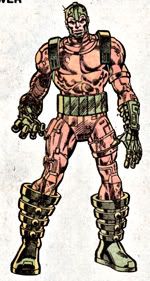
Photo Sharing and Video Hosting at Photobucket
Art by Kerry Gammill

When it comes to mythological resonance and sheer weirdness underlying symbolism, Wonder Woman is in a league of her own. Towards the end of the sixties Wonder Woman went through a "mod" period. Phase shift is not something that should be unexpected in a lunar goddess character named Diana. Wonder Woman revoked her godly powers and gained a spiritual martial arts mentor by the name of I Ching. The Wonder Woman adventures of this era were more espionage-adventure oriented, channeling elements of shows like "The Avengers" and the James Bond films. It was during this period, in "Wonder Woman" #179, November 1968 , that the super villain Doctor Cyber was introduced.

Photo Sharing and Video Hosting at Photobucket
Art by Mike Sekowsky

Created by Sekowsky with writer Dennis O'Neil, Doctor Cyber is the head of a SPECTER-like international crime cartel. Amongst their crimes was an attack on I Ching's monastery. During a plot involving an earth-quake making device as a means to blackmail the world, Doctor Cyber was severely disfigured by an urn of hot coals, which she naturally blamed on Wonder Woman. In a later storyline Wonder Woman and detective Jonny Double investigated an organization called The Tribunal, which was revealed as a cover for a scheme by Cyber to find a suitable woman into whom she could have her brain transplanted. In the course of this story she attempted to have the procedure performed on Wonder Woman with the assistance of the Batman criminal brain surgeon Doctor Moon (created by O'Neal and artist Irv Novick and first appearing in "Batman" #240, March 1972). I find the alchemical/astronomical connotations underlying this plot line, including the use of Jonny Double and Doctor Moon, to be quite obvious. As a super scientific international crime cartel ring leader Doctor Cyber has access to all the typical paraphernalia, from rocket sleds to mind control serum.

Photobucket
Art by Harry G. Peter

Another female comic book Doctor is the Wonder Woman villain Doctor Poison. First appearing in February 1942's "Sensation Comics" #2, Doctor Poison was the product of Wonder Woman creator Doctor William Moulton Marston (who was as strange as any of his characters) and illustrator Harry G. Peter. The alchemical connotations of evil chemist Doctor Poison are apparent on a surface level. She was introduced as an Axis spy in charge of the "Nazi Poison Division" with a plot to contaminate the U.S. Army's water supply with the chemical Reverso, which would cause the soldiers to do the opposite of what they were ordered. In 1943 she reemerged as the "Chemical Research Chief" of Japan. Dr. Poison's hood and mask hides not just her identity but her gender as well. It was eventually revealed that she was the beautiful Japanese Princess Maru. At one point Dr. Poison was sent to the Amazon penal colony Transformation Island, but it didn't take. She escaped and in 1948 teamed with seven other female villains to form Villainy Inc. in "Wonder Woman" #28.

Photobucket
Art by Harry G. Peter

What a wonderful team, a former gorilla turned giantess, an Atlantean Queen, a Snow Man, Dr. Poison, a hypnotic magician of the "Blue Ray", a Priestess of the "Crimson Flame" and the Dionysian split-personality sufferer Cheetah. The leader, unidentified in this panel, is Eviless, a slaver from (naturally) the planet Saturn. Including Dr. Poison, three members of the team were women disguised as men.

Photobucket
Art by Harry G. Peter

Sticking with Golden Age Wonder Woman, Marston and Peter, we have the telepathic dwarf Doctor Psycho who first appeared in "Wonder Woman" #5, July 1943. Psycho was presented as a sociopathic, misogynistic con-artist occultist. He is originally employed by The Duke of Deception.

Photobucket
Art by Harry G. Peter

The Duke was a minion of the war god Mars. Mars blamed women for preventing the world from completely engulfing in endless warfare (this was during World War II). Doctor Psycho was wrongly convicted of a robbery due to the testimony of his former fiancee, Marva Jane Gray. This led to him developing a psychopathic hatred of all women. After his release Psycho tortured and brainwashed Marva and utilized her as his guinea pig for occult experiments. He discovered he could use Marva to produce "ectoplasm" which Psycho could mentally shape. In a plot to remove women from the war effort Psycho generated a false spirit of George Washington as part of a highly bizarre smear campaign.

In Part One of this series I discussed Doctor Who's connection to the Marvel Universe and the company's propensity at one time to include licensed properties they published titles about within the confines of their super hero reality. This was the case with Marvel's late seventies series "Godzilla, King of the Monsters" which ran for 24 issues. During this run Godzilla encountered the Fantastic Four, the Avengers, and Spider-Man. There was even a branch of SHIELD developed specifically to deal with Godzilla. Apparently a "mutated" version (due to the licensing agreement long expiring) of the monster appeared in a Marvel publication as recently as last year. As with Doctor Who, characters that started in the Godzilla series had further lives beyond the parent title including the manga-inspired giant robot Red Ronin and the super villain Doctor Demonicus.

Photobucket
Art by Tom Christopher

Obviously influenced by Doctor Doom, Doctor Demonicus, with his Toho monster movie trappings, is also very similar to Doctor Cyber. He was introduced in "Godzilla, King of the Monsters" #4, November 1977 as a doctor specializing in genetic engineering, Douglas Birley purposefully exposed himself to radiation in an attempt to induce mutation and generate super powers. It didn't work, instead giving him severe skin cancer, a condition he controled with his costume, naturally. He later acquired a radioactive meteor called "the Lifestone" that he utilized to transform animals into giant monsters. He crafted the Lifestone into a transport as a mobile power source for his creations. While Godzilla fought the monsters SHIELD agent Gabriel Jones subdued Doctor Demonicus.

Later Demonicus worked with the alien sorceror Maur-Kan against another Marvel licensed property, the Shogun Warriors. Years later he showed up in "West Coast Avengers" where he created his own volcanic island which he named Demonica and won UN membership. During this time he was under the control of a demon called Raksasa, named for demons from Hindu mythology.

Wednesday, December 19, 2007

Mystos Mustela

Photobucket
Diego Velázquez, "Los Borrachos" c. 1620. I think the character at far upper right may be the Fourth Doctor.

In this blog from time to time I make use of the philosophical and literary concept of the dichotomy between Apollonian and Dionysian elements. It was famously invoked by Friedrich Nietzsche in "The Birth of Tragedy". I picked it up from Stephen King's 1981 nonfiction work "Danse Macabre". King utilized the term to discuss the archetypical horror character who undergoes a transformation from normal, cultured or in some cases highly reasoned, to a feral, animalistic state. The clearest examples of this are probably the 1886 Robert Louis Stevenson novella "Strange Case of Doctor Jekyll and Mister Hyde" and the ancient legends of werewolves and other shape changers.

I've used the term to describe the Incredible Hulk from Marvel Comics. The pattern is quite clear in the Hulk. It is truly the prehistoric occult legend with modern era nuclear science and radiation fulfilling the role of magical curse. Apollonian physicist Bruce Banner was caught in the blast of his own gamma bomb. The bombardment of gamma rays caused periodic transformation into the Dionysian Hulk.

But this article is not primarily about the Hulk or the Apollo/Dionysus dichotomy. Recently several factors have caused me to take consideration of the purely Dionysian character.

Photobucket
Art by John Byrne

The myth of Dionysus is ancient, complex, and vitally important at the heart of matters as we discuss the esoteric Underground Stream and the Invisible College. There is evidence suggesting the existence of Dionysian Mystery Schools in Greece as early as 6,000 BC with the original import of wine. It likely was transmitted from the area between Mesopotamia and Persia, or Northern Africa. The Dionysian Mysteries were a precursor to the Eleusian Mysteries, Orphism and Gnosticism.

Dionysus/Bacchus is of course the god of wine, agriculture and theater. His patronage of theater is a vital point. It is Bacchus who oversees the allegorical tale, the Spoonful of Sugar that helps the Medicine go down. This displays the inherent relationship between popular entertainment and the initiatory rites of the Mystery Schools. Comic books are a form of theater, the writer is the play write, the illustrator the director and all of the actors. As a figure who passes into the Underworld and back again Dionysus further carries connotations of the links between the living and the dead.

He is Dionysus Dimetor because he has two Mothers. He is a son of Zeus and the mortal woman Semele. Semele was the daughter of the hero Cadmus, credited as the creator of the Phoenician alphabet. Cadmus, following the guidance of Athena, sowed the teeth of a dragon which grew into soldiers. Teeth, crops, soldiers and letters all stand in rows. Semele was a priestess of Zeus and the god seduced her in the form of an Eagle, a solar symbol and Scorpio emblem. When Hera learned Semele was pregnant she disguised herself as a crone and befriended Semele, casting doubts in the priestess' mind that the Eagle formed Zeus was truly who he claimed to be. Semele demanded Zeus to reveal to her his true form, but her mortal eyes could not look upon his glory. She was wreathed in holy lightning and incinerated. Zeus saved his unborn child by sewing him into his thigh. Dionysus Eriaphiotes is Dionysus Insewn.

Dionysus is also Zagreus. Orphic tradition describes Zeus, in the form of a Snake (again a Scorpio emblem), impregnating either the mother Demeter or the daughter Persephone, producing the infant Zagreus. Hera coerced the Titans into dismembering Zagreus, but Athena rescued his still beating heart and returned it to Zeus. Zeus produced mead from the heart and gave it to Semele to drink, impregnating her with Dionysus Dimetor. The name Zagreus was utilized in the Doctor Who radio dramas as a legendary entity of Gallifrey who lived at the end of time.

The adult Dionysus, like Doctor Doom (and note the similarity to Orpheus and Dante), entered Hades and rescued Semele from the Underworld, making her a goddess of Olympia, where she resided over the ecstatic frenzies generated by her son. These divine states of madness, the bakcheia, are central to the Dionysus Mysteries. The Dionysian Mysteries included ceremonial rites to achieve these trance states through intoxication through wine (and possibly other substances), rhythmic chanting, drumming and dancing. Indeed it is quite clear that Dionysus is the patron deity of sex, drugs and rock and roll. This is something Jim Morrison, for example, understood quite well.

Dionysus' resurrection traits are a factor he shares with many solar, agricultural deities, as is his description as androgynous. Called "the Lord of Beasts", he is depicted often in the company of satyrs, centaurs and other synthetic creatures representing "higher" human form combined with "lower" bestial attributes. Symbols of Dionysus include the bull, the serpent, cats (especially so big cats like leopards and panthers), swarms of bees (perhaps a holdover from earlier Mead Cults), the grape vine (naturally), ivy, figs, pine cones (attaching him to Cybele), and pomegranates (attaching him to Demeter and Persephone). In the Eleusian Mysteries he was Dionysus Iacchus, "the light bearing star of the nocturnal mysteries", associated with Sirius, the torch bearer who led the Eleusian procession.

Amongst his other many epithets are Aegobolus (the Goat-killer), Bromios (Thunderer/He Who Shouts), Dendrites (Of the Trees), Eleutherios (the Liberator), Enorches (With Testicles), and Sabazios (The Shatterer). There is a vital relationship between Dionysus and Hermes, beyond both being sons of Zeus. To keep Dionysus safe from the wrath of Hera he was put in the care of Hermes. In some versions Hermes gave Dionysus to King Athamas and Dionysus' aunt Queen Ino, instructing them to keep Dionysus hidden by raising him as a girl. Another version had Hermes placing Dionysus in the care of the rain nymphs the Nysa (Dio=Zeus, Nysus=the Nysa). As a reward for their nurturing (rain nurses grapes) the Nysa were catasterized as the Hyades.

The nature of Dionysus as an enlightener is encoded within his mythology. At one point he was driven mad by Hera and later cured by Cybele. He was then sent to Asia to teach grape culture and the wine cult and was said to have resided in India for many years. Another interesting episode involved Dionysus, disguised as a young beautiful mortal, being kidnapped and taken to sea by sailors intending to ransom the youth or sell him into slavery. However, Dionysus, the Liberator, can not be bound. He became a lion and unleashed savage fury on the ship's crew. Those sailors that chose to jump into the sea rather then be dismembered were transformed into dolphins. Another version of this story also featured the ship being overrun with snakes and ivy, and the sailors being driven mad by the sounds of flutes (a device utilized by Lovecraft).

Dionysus is indeed not known for his gentle or forgiving nature. In the Eurpides tragedy "The Bacchae" Dionysus traveled to Thebes to enact vengeance upon his aunts and his cousin, the king Pentheus, for denying his mortal mother's claims of Dionysus' divine parentage. To this end he inducted the Theban women as Maenads and drove them into an ecstatic frenzy, in which state they tore Pentheus to pieces.

Dionysus' primary consort was the mortal Ariadne, the Minoan princess who aided Theseus in the labyrinth with her magic ball of thread. He was also said to have fathered Nyx's son Phthonus, the embodiment of jealousy, and Aphrodite's children the Charities (the Roman Three Graces), Hymenaios, god of marriage, and the male fertility god Priapus. Dionysus as the father of Priapus is very interesting. Often when these mythological models transfer the relationships of the characters is altered. This seems to be the case with the Dionysian Wolverine, a character who was "born" in the pages of the Incredible Hulk.

Photobucket
Art by Herb Trimpe. Note how in this ad introducing Wolverine, binding chains leap from his form.

Yes, I did just say that about the Hulk. The sexual connotations of Wolverine are likewise readily apparent. If comic book super heroes represent the power fantasies of the disenfranchised, then surely the erectile, penetrating, untiring Wolverine is a male, adolescent personal virility fantasy come to life. Wolverine's claws are made out of an imaginary metal called adamantium, the hardest substance of the Marvel Universe. Wolverine's bones are likewise bonded with the metal, making them unbreakable. In the nineties Wolverine's origin was retconned. Previously the claws were described as bionic implants, separate from his mutant abilities. Now the retractable claws (which Wolverine "pops") are natural bone extrusions coated with adamantium. This reinforces the sexual symbolism to such a degree that one might think this alteration was performed tongue in cheek.

As seen in the Marvel house ad above, Wolverine was first introduced at the end of "The Incredible Hulk" #180, October 1974, with his first full appearance in the following issue. He was created by writer Len Wein and illustrators John Romita and Herb Trimpe. The character next appeared in May, 1975's "Giant-Size X-Men" #1, which was also written by Wein and illustrated by Dave Cockrum. He appeared thereafter as one of the "New" X-Men starting with "X-Men" #94. Beginning with that issue the X-Men title was written by Chris Claremont for 16 consecutive years, making him largely responsible for shaping the character into the highly popular franchise he is for Marvel Comics today.

Wolverine, also known as Logan (a Scottish name meaning "little hollow", which could be extrapolated to mean "vessel"), resonates Dionysus on several levels. Besides his claws his powers include animal-like heightened senses, enhanced physicality and a "healing factor" that allows him to heal any wound, injury or poisoning almost instantaneously. It is worth noting that while Wolverine is clearly an animalistic character, the regeneration ability is more naturally a vegetative attribute.

Another key Wolverine characteristic is his propensity to go into what is termed a "beserker rage" in which he turns into a furious, indiscriminate killing machine. This is easily comparable to the violent, ecstatic states of the Maenads. Often described as an anti-hero, Wolverine was the rare comic book super hero who smoked cigarettes and drank alcohol on a regular basis. But he was not just an indiscriminate death-dealer. When handled properly there is reason and justice underlying his actions, making him something of a prototype of Dexter. Like Dexter, Wolverine is cognizant of his dark nature. His most embelmatic line is "I'm the best there is at what I do, but what I do best isn't very nice". As the character developed over the years he was shown to contain a sense of honor and code of ethics like a feudal samurai.

Photobucket
Art by Frank Miller

There is an Apollonian/Dionysian dichotomy associated with the character, but in the case of the X-Men it is a struggle between two separate figures, Wolverine and the solar powered, beam emitting, highly rational Cyclops. Immediate sexual tension was generated between Wolverine and Cyclops' long-time girlfriend Jean Grey, the all-important Marvel Girl and future Phoenix, who can be said to be the High Priestess of the Marvel Mysteries.

Photobucket
Art by John Bolton

Another long-running feature of Wolverine was his state of amnesia. His past was a mystery, and his earliest memories involved the laboratory procedures in which the adamantium was "insown" to his skeleton. Thus he could be said to be "twice born". This portion of Wolverine's story was beautifully presented in 1991 in Marvel's anthology series "Marvel Comics Presents" #s 72-84 by the great Barry Windsor-Smith.

Photobucket
Note the vine-like forms in this image of Wolverine's second womb.

While in the early years of his term as an X-Men Wolverine was a wild card who didn't follow orders, he developed into a mainstay of the team. He developed a particularly strong relationships with Nightcrawler, the blue, devil-like teleporter, and Kitty Pryde, to whom he became a surrogate father. The 1984-85 limited series "Kitty Pryde and Wolverine" essentially depicted Wolverine initiating the novice hero Kitty Pryde into a dangerous combatant with ninja-level skills. Indeed Wolverine has strong ties to several female characters. His relationship with Kitty was reproduced with Jubilee, and with Rogue in the first X-Men film. When Wolverine was finally given a full origin (I personally preferred him without it, but then I like the mystery), his true name was revealed as James Howlett. Compare this to the Dionysian epithet Bromios, "He Who Shouts".

Like many of the X-Men characters, Wolverine seems difficult for many writers to get a proper handle on. This, combined with his vast marketability, has made for literally hundreds of wholly unreadable comic books featuring the character. As a fan of the classic X-men (for me the issues from 1963-1987) there is much for me to dislike about the X-Men movies. But something they did right was casting the perfect actors to play some of the key roles. Patrick Stewart as Professor X, Ian McKellen as Magneto and Hugh Jackman as Wolverine. Jackman brought the requisite attitude and surliness to the screen, and more so then anything else, the character's charisma, which is often painfully lacking in Wolverine's appearances.

Photobucket

To seal the deal on the Wolverine/Dionysus parallel I'm going to include two images from the beginning and end of the 1987 "Uncanny X-Men Annual" #11 which display the character at the two polar extremes of Dionysian characteristics.

Photobucket

Photobucket
Art by Alan Davis

Don't listen to him. He is a god. The evidence is overwhelming. Want one more item of pure synchronicity? I got one. Wolverine is an anagram of Wine Lover.