Showing posts with label DC Comics. Show all posts

Sunday, October 6, 2013

Legerdemain of the Dark Knight IV - Coin Tricks and Cartomancy


"- but his face deep scars of thunder had entrenched-"
-John Milton describing Lucifer in Paradise Lost

This article is a continuation of the Legerdemain series and benefits from reading the previous three installments. You might also want to read Bat Time, Bat Channel and This Joke Isn't Funny parts 1 and 2.  It has been five years since The Dark Knight was released, so I have no qualms about spoiling this movie.  It's not a synopsis anyway, but still, if you haven't seen The Dark Knight then you really have missed one of the greatest achievements of film making and performance of , well, of all time really.  Go watch it right now.  If you have already seen it, you probably should see it again.

I could talk about this movie forever and I probably will be.  It is deep and it is great and there is much, much for consideration here.  Seriously, fantasy film is the art form of the masses of the early 21st century, and there are few works that achieve these heights.  I called Batman Begins "Batman Sublime," and The Dark Knight Rises is excellent as well.  But The Dark Knight?  This is a different animal altogether.  If those other films are angels in the form of films, The Dark Knight is an archangel.  One with deep scars of thunder.  Let's take a look at some of what lies beneath the top level of this particular magic trick.


The Dark Knight is about duality, hoax building, initiatory process, sovereignty personification, and more than anything, sacrifice, on many, many levels.  This promotional piece featuring the three main figures quite overtly broadcasts an occult manifesto.  Totemic items are displayed obscuring one eye.  Odin, the Norse equivalent of Thoth/Mercury/Hermes, sacrificed an eye for a drink from the well of knowledge.  Horus, the avenging, solar messiah of ancient Egypt, lost his left eye in battle with Set.  When his eye was later restored he sacrificed it again in hopes of restoring Osiris to life.  You might be thinking now that these characters are covering their right eyes, and that's true, if we are a spectator looking them in the face.  But might we be being cast in a reflective position (correcting, of course, the lettering on the pin and card)?  That would be a more interesting view point for these psychological portraits after all.  Note how this image equivilates these three rather than differentiates.

That there is a sacrificial theme to this story is inherent in the title alone.  The Knight is a very common motif representing a transformative ordeal, a quest, that leads towards a perfected state.  Just think of the Knights questing for the Holy Grail.  It hardly needs explaining then that the Knight partaking in this quest represents the initiate.  A Dark Knight symbolizes expiation and sacrifice, tribulations of sin and periods of obscurity on the path towards heightened consciousness or a higher level of being.  This is an important concept to keep in mind.  The White Knight, by contrast, stands for purity and illumination.  The White Knight is the "Chosen One."  Harvey Dent is presented and even described in the film as a "White Knight" as opposed to Batman's Dark Knight.  But, huh, which of the major figures of this movie is overtly white?  One of Heath Ledger's early major roles was in the 2001 film A Knight's Tale.  The strangely anachronistic  A Knight's Tale is overtly initiatory.  It is also about the perpetuation of a hoax, as Ledger's character is a commoner masquerading as a noble.

Yes, the real star of The Dark Knight is Heath Ledger's Joker.  It is very interesting to see how much charisma this villain of villains exudes, especially in comparison to Bale's Batman.  Don't get me wrong.  Bale produces charisma on command at the necessary story beats.  Certainly the lack of personality is a storytelling, character-driven choice, representing the insular nature of an armored, hoax perpetuator operating as a living symbol.   At any rate, the Joker steals the show.  It's kind of what he does.
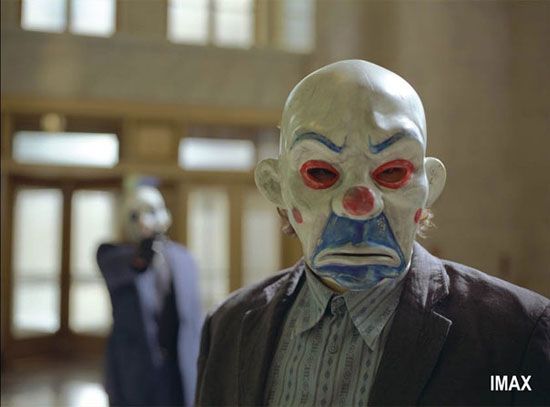

The movie begins with a brazen bank heist orchestrated by the Joker.  And its done so with very deliberately utilized masks, which of course, as a Batman film, is a major symbolic item.  A mask in a visual work represents illusion and concealment, key components to magic tricks and sleights of hand.  It also stands for transformation, being equivalent to the chrysalis, and it confers a magical character.  Of course metaphorical masks are necessary for the performance of con-jobs and hoaxes.  The use of masks in plays evolved from activities of the ancient Dionysian Mysteries.  This led to their use in sacred plays as representing the supernatural forces of deities and the inner psychology of characters normally hidden.  And they still do.  The origins of theater seem to stem from the worship of Dionysus.  There's a long but direct stream (an Underground Stream) through history to every item of contemporary popular culture.  Just think of how important the Mask is to the comic book hero, particularly the Batman.  This is a Dionysian device.  These works, whether they know it or not, are an expression of his Mystery.

And these masks are clowns because this is a Joker operation.  The Joker is a clown.  The Clown is the equivalent of the Fool, and of course the modern playing card Joker is the equivalent of the Tarot trump The Fool.  The Fool is the initiate's card, the status of the seeker at the onset of his/her process of enlightenment.  The Fool is the Ain Soph of the Kabbala, the unknowable, primary cause.  The Clown/Fool is the opposite of the King (keeping in mind that Batman is the self-described King of Clubs).  The King represents order and the Fool represents chaos, and this is very apparent in the presentation of these characters.  This is the essential duality of this story, and one represented in many ways throughout the film.  The Clown/Fool is also emblematic of unregenerate man, and this is an aspect certainly readable in this presentation of the Joker.  Most importantly, the Fool is a symbol of sacrifice.  In past cultures where the sovereignty of the king was felt to have direct correlation to the fecundity of the land, there were times when it was deemed necessary to sacrifice him for the common good.  Kings don't like to be sacrificed, of course, and a system developed wherein the lowest member of the court was substituted.  Or so the mechanism is described.  Heath Ledger's first listed role on Wikipedia is a 1991 Australian film called Clowning Around.

It is not overtly presented in the film but reading the Nolan brothers' script for The Dark Knight reveals an interesting aspect of the bank heist.  The assumed identities of these hired criminals, obviously strangers to one another in the manner of Resevoir Dogs, are Bozo (that's the Joker seen above), Chuckles, the unnamed bus driver, and then Dopey, Grumpy and Happy.  The use of the Disney dwarf names might seem a simple throw away, but it is suggestive of a system of seven.  Seven is a complete cycle, the days of the week and the days of Creation, both of which derive from the seven observable planets in a geocentric model.

But wait.  There's only six actual robbers involved. Yes and no.  The robbers don't realize that Bozo is the Joker.  They talk about the Joker as the mastermind of the operation and as an additional share.  So an alter-ego, a duality, a hoax, a trick, creates the extra figure.  The bus driver is unnamed and unseen, and so he must be Bashful.  The brains of the outfit, the obvious leader?  That sounds like Doc.
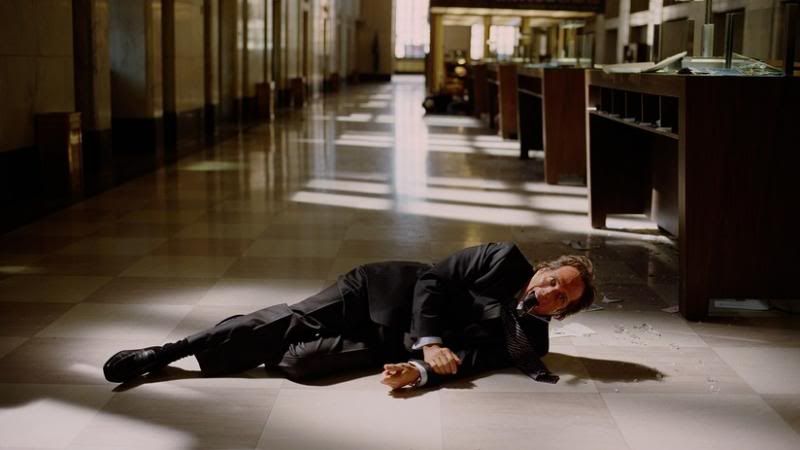

Here is Doc Joker teaching the mob-tied, criminal bank manager a lesson.  Note the checkerboard floor.  The Nolan films are rife with this symbol of initiatory process (I discuss checkerboard symbolism to great extent in Illuminating Harry Potter I: Romancing the Stone amongst other articles).  Put simply, it is the interplay of dualities, positive and negative, night and day, solar and lunar, male and female.  The tensions of these polarities controls the inherent irrationality by placing it within a strict, governed order.  We see these interplays throughout this movie in many different forms, obvious and covert.  The actual bi-colored grid is in place at very key moments that I will point out as this article progresses.  They are all directly related to initiatory steps enacted by the Joker.  This bank heist, the first step in the Joker's elaborate, criminal act of performance magic, is stage one.  The subject is Gotham City.  Note that the Harlequin, which is the exact equal of the Clown and the Fool, is traditionally garbed in a checker-pattern.

Is a Tarot analogy a stretch?  Even if it weren't deliberate, a perceived symbolic content carries meaning even without the author's intent.  This is one of the major themes of this blog.  In this case I am certain the Tarot is being utilized quite purposefully as the story tellers tip their hat to this fact at the end of the scene (and far more overtly further on).  The Joker makes a clean get away driving a bus marked "District 22."  There are 22 Tarot trump cards.  At the outset The Dark Knight is slyly declared as a work of cartomancy.
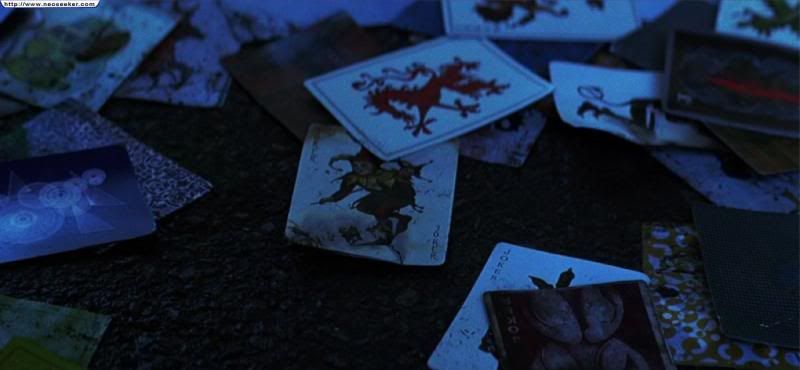

Let's talk a little bit about cards.  The above still is a shot of the hundreds of Joker cards that litter the street after he blows up the judge's car.  Note the geometric circles and triangles on the card to your far left.  Without being able to specifically identify it, it looks like alchemical or Rosicrucian diagrams.  The kind of thing you might find in a Manly P. Hall book.  Hall was a genius of card (symbolism) tricks.  Hall points out that in the two color scheme of cards we again find our dualistic patterning.  There are thirteen cards of each suit which represent the thirteen lunar months of the year.  That the 52 cards equal 52 weeks is easy enough to see.  If you count the Jacks, Queens and Kings as 11, 12 and 13 then all the pips equal 364.  If you add the Joker you get 365.  The twelve court cards stand for the zodiac, which is always about time and timing.  Timing is key to magic.  Note how integral proper timing is to every major action enacted by the Joker throughout this film.  This magician characteristic is not hidden.
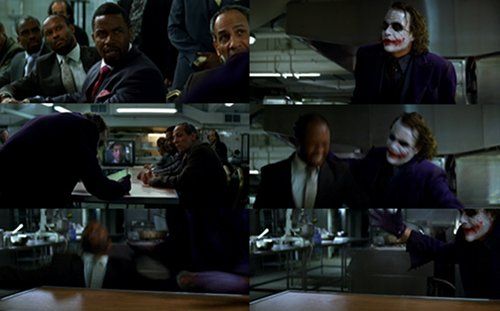
 
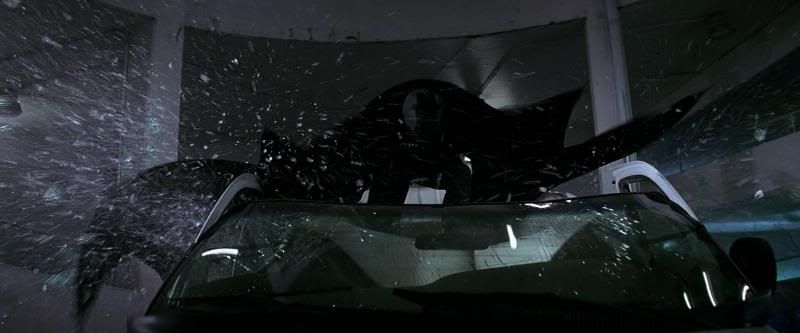
Ta da!  The disappearing pencil trick.  The Joker is very much presented as a Magician in this film.  And Batman has already been presented as a Magician.  They are hoax builders at war.  This is the same central core as The Prestige. A striking example of the importance of timing in Batman's actions occurs in his first scene in this film, when he jumps down the spiral ramp of the parking garage onto the roof of a moving van. 
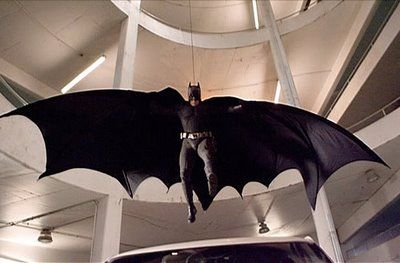

Let's take a moment to consider some of the connotations of the Bat.  As a double-natured entity, as a mouse/bird, the Bat's alchemical symbolism is related to that of the androgyne. It's the Two-in-One, a duality personified.  In many cultures the Bat has stood for Vigilance, and that's fully appropriate here.  More commonly it represents superstition, fear, death and madness, something Francisco (that's fun to say, Francisco) Goya certainly understood.
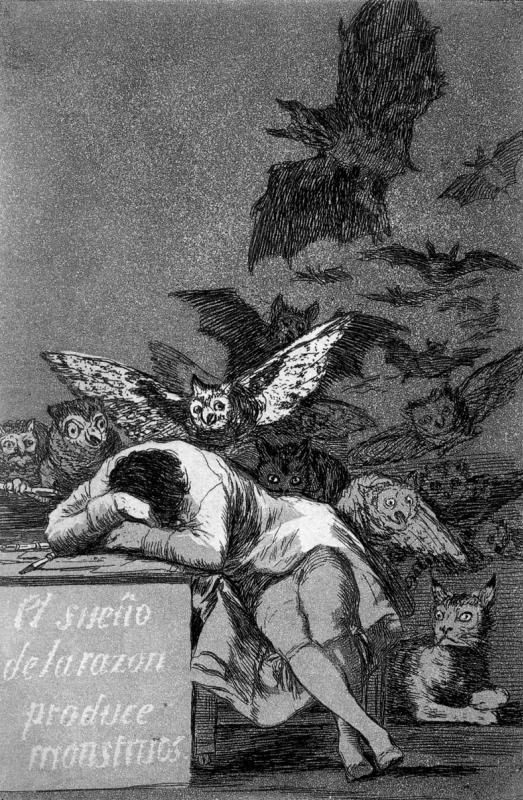
The Sleep of Reason Produces Monsters, Francisco Goya, c. 1799.


Which in its way depicts the essential plot of this film and the next one.  Bruce Wayne's dream of bringing rational order to Gotham results in a costumed psychopath arms race.  The full epigraph for this etching is really perfect: "Fantasy abandoned by reason produces impossible monsters: united with her, she is the mother of the arts and the origin of their marvels."  Testify Francisco.

The parking garage scene features a reappearance of Cillian Murphy's Scarecrow, a figure that is both Dionysiac and sacrificial (usually by fire, an important symbol set we'll return to).
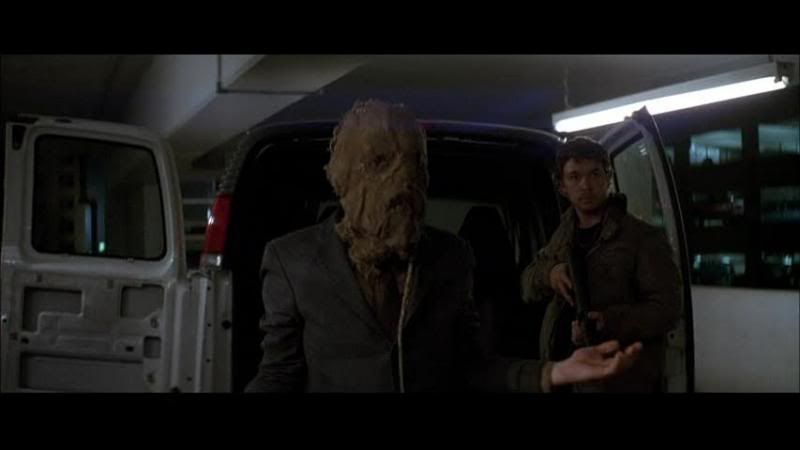

When criminally operative the Scarecrow appears masked.  I'm certain Dr. Crane, in this version of the character, could talk all about the psychological symbolism of the Mask.  Jungian archetypes, you know?  
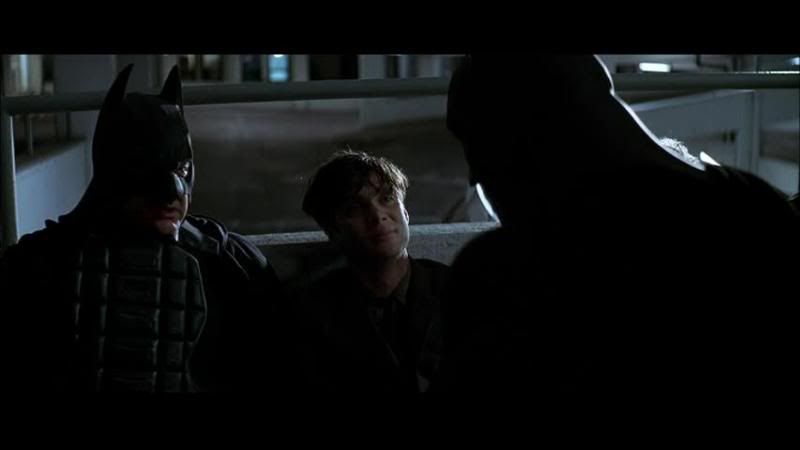

Once defeated his mask is removed.  Unmasking is is an integral aspect of this story, the undoing of all the symbolic connotations described above.  Unmasking is an unveiling, the exposure of the hoax, the undoing of the opponent's magic spells.  This still also shows the most prominent of the false Batmans that appear in this scene.  Duplicates, doubles, false figures.  Think about The Prestige.
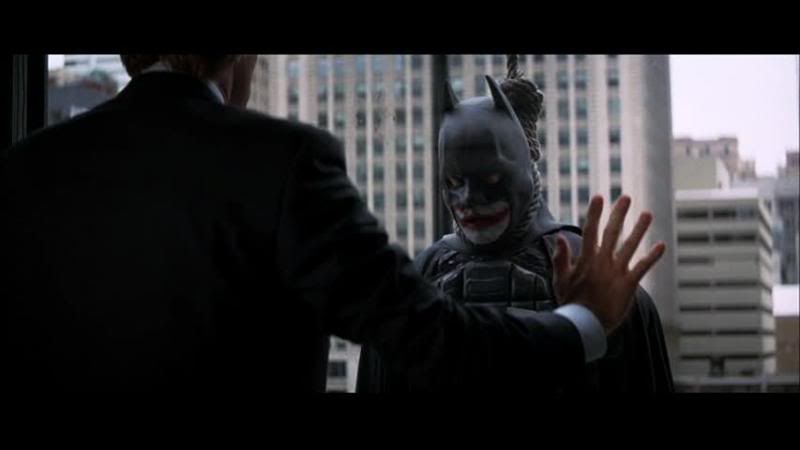

And about how these duplicate figures need to get sacrificed in magic acts.  We'll talk about the significance of the Hanged Man later.  Note how the Joker and Batman are combined here, the synthesis of opposites.
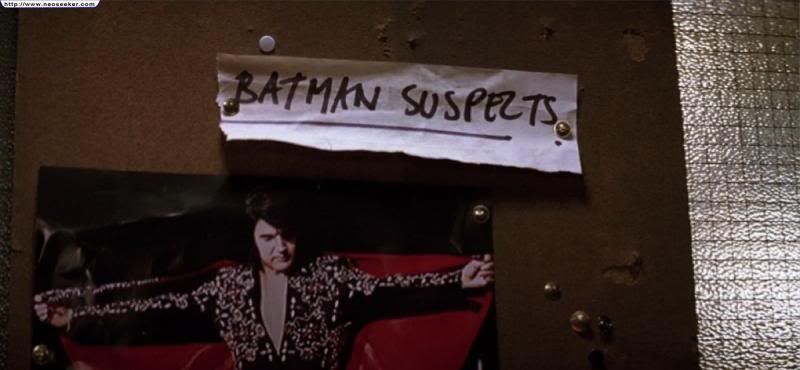

The hoaxing nature of the Batman is alluded to in the Gotham police department's joking bulletin board of Batman suspects.  Besides Elvis we see Bigfoot and Lincoln, all figures attached to hoaxes and conspiracies. Note the silver grid work.  We'll see this motif more prominently elsewhere. 


Speaking of grid work, the second example of the initiatory checkerboard pattern associated with the Joker's activities occurs when he pretends to be dead in order to get to Gambol.  The floor and the walls are all checkered.  You can see it better in the video then in any still I can find.  This Rising From the Dead scene is of course a major initiatory rite symbol, and one particularly tied to Dionysiac Mysteries.  Here we also have the first of the Joker's explanations for his Glasgow Smile, which is an aspect of his hoax building.  The scene ends with the Joker forcing Gambol's thugs to fight to the death for a position in the Joker's gang, emphasizing the sacrifice theme.  Also note how this is just one of the false deaths/rebirths in this film as James Gordon later fakes his own death to get the drop on the Joker.  What occurs after Gordon's "rebirth?"  He achieves a higher rank/reaches a more elevated position as he is named the new police commissioner of Gotham City.
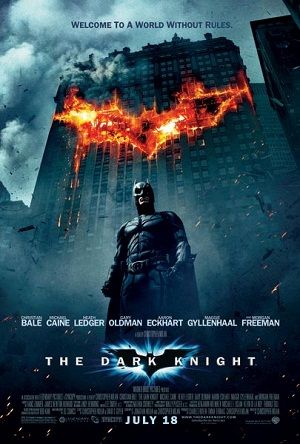

The primary poster for The Dark Knight combines two of the major symbolic devices of the film, those of Fire and the Tower.  Together they formulate a very clear depiction of Tarot Trump sixteen, the Tower Struck by Lightning, aka Le Feu du Ciel/The Fire of Heaven.  Seriously, if there were a Tarot deck combining popular super  heroes with modern day terror anxieties, this would be card sixteen.  Batman is positioned directly before the tower, like a column, repeating its format, identifying him with the structure of the city.  This is fully appropriate as the Tower of Trump sixteen is representative of  the human form.  The enigma of the Tower card relates to the fall of man and the devastating consequence of over confidence.  This happens to describe the Joker's objectives in this film.  "Welcome To A World Without Rules" is essentially a reading of the aftermath of Trump sixteen's symbolism.

The Tower is also quite overtly used as a symbol of Bruce Wayne/Batman in this movie.  His mansion having been destroyed by Ras al Ghul in Batman Begins, Batman is operating out of the tower of his corporate headquarters.  There's an implied movement here between the films from the maternal cave to the paternal tower (and back again in the third film).  The Cave is primordial shelter, and as an easy to read womb symbol representative of birth/rebirth.  It is emblematic of the unconscious mind and associated in many legends with gods and heroes.  The Tower is about ascent and vigilance, as well as the aristocratic nature Batman can never remove himself from, as it looms above the common level.  While it is overtly phallic it is yet another item of combined duality.  The protective nature of the Tower is a feminine quality, associating it with the Virgin.  This is seen in many stories and legends.  Just think about Rapunzel.
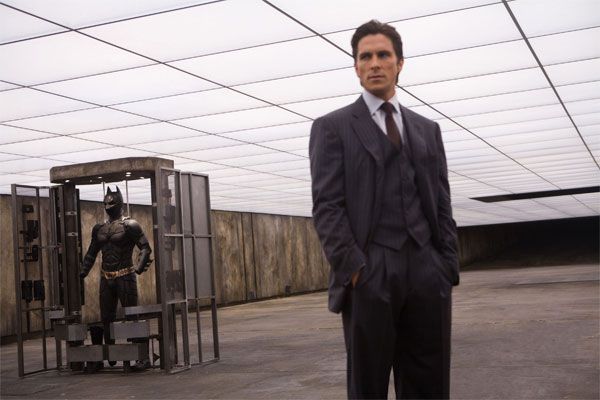

Here we see Bruce Wayne within a cave within his Tower.  The complex encasement of his costume is intriguing.  The arms of the Knight stand for symbolic potentialities.  There is an article unto itself in examining the symbolic significance in the equipment of Batman and the Joker.  But I include this still to display the striking ceiling used for Batman's secret headquarters.  Notice we again have a single-tone grid in place associated with Batman.  Its illuminated, as the grid on the police bulletin board is light reflective.  So this is a system, a grid work, implying activity and development, but its not dualistic in these instances.  Batman's essential initiation took place in Batman Begins.  He's acts in this movie from a more elevated status, with a level of enlightenment.  Note his desire to move up, and out, from this level and unite with Rachel Dawes, leaving it to Harvey Dent.   
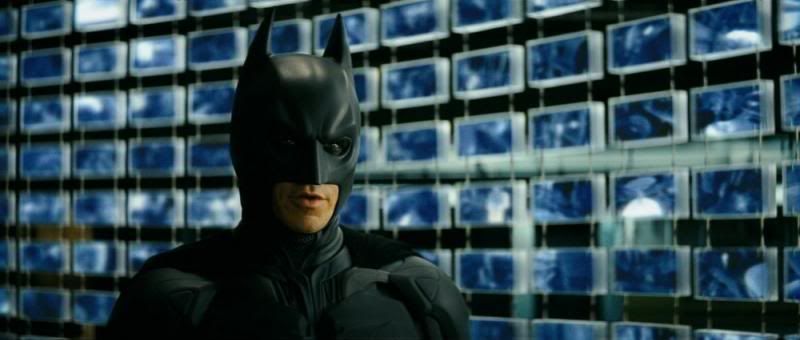
And another luminescent grid work associated with Batman/Bruce Wayne.  This one is crafted by Lucius Fox (the light-bringing Promethean) and confers upon Batman a heightened sensory awareness of his city, confirming his role of sovereignty figure.  This is truly what Batman and the Joker are fighting for in this story.  Harvey Dent as well.
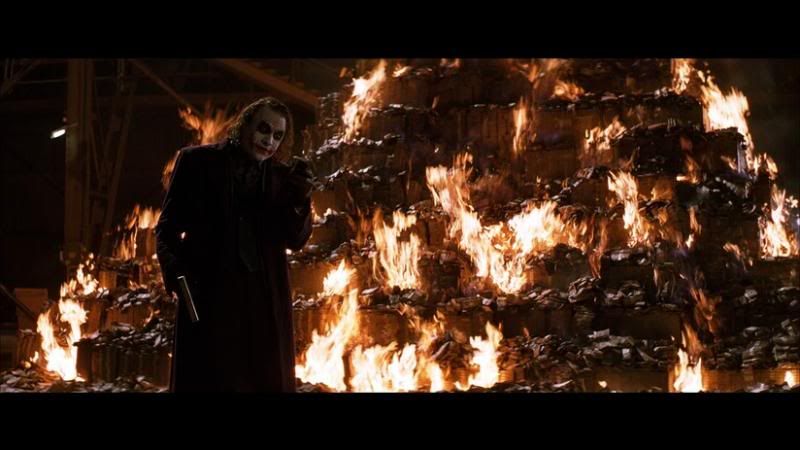

Here's another prominent combination of the Tower and Fire from the scene where the Joker demonstrates that his objectives are in no way material.  If I had to choose one symbolic device that was most relevant to The Dark Knight it would have to be Fire.  The first words of the Nolans' script are "Burning.  Massive Flames".  Interestingly the fire we see as the film opens are blue.  I used to keep a catalog of blue entities from popular culture here.  I did not bring that back with the resurrection of this blog, but the color Blue has a great deal of important connotations.  Blue represents the intellect and divinity (the latter the primary reason for all those blue people).  It is an attribute of Jupiter and Juno, and many other Sky Gods.  As a color used in the visual arts it is very functional as a visible darkness.  And while in ancient Egypt the color Blue represented Truth, it simultaneously represents Mystery and Deception.  The synthesis of opposites occurs here on many levels.

Fire is Divine Energy.  It is spiritual passion, purification, revelation, regeneration.  It is the medium for conveying messages to the heavens.  It is (again) dual natured, divine and demonic, creative and destructive, intellectual and emotional. It is a device of ritual sacrifice and a common means of Christian martyrdom.  It is the central element of alchemy.  Fire is traditionally associated with Trickster Gods like Prometheus and Loki. Let me underline here how this version of the Joker and Loki are the same figure.  There are many articles at this site delineating Promethean characters.  The Joker and Loki are in that camp, retrograde.

According to Gaston Bachelard's Psychoanalysis of Fire, it is "-the archetypal image of phenomena in themselves".  That's a bit of a hard concept to parse,  but the basic idea is that experiential existence is like the visible and tactile energy of something burning.  I'm still thinking about that one.  Existence is a kind of release of energies.  Think about the origins of the universe starting with a big explosion. 

Even more on target than Loki or Prometheus is the association  with Lucifer, as I suggest with the Milton quote at the top of the page.  Hall recounts a story told by 18th century alchemy scholar Georgius von Welling that the material universe was created accidentally by Lucifer's misuse of the Schamayim, the Divine Fire.  Here's the most prominent Joker card utilized in the film to hammer home this association.
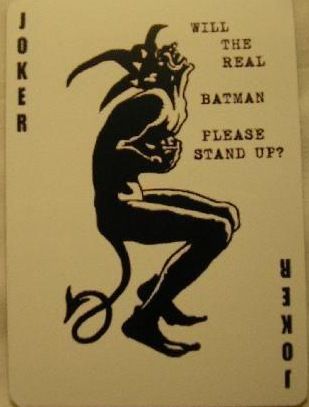

These cards are deployed to the potential victims of the Joker's triple murder plot.  The judge is killed by fire.  Fire in this context is about the Luciferian desire to annihilate time and bring all things to the end. This is what is meant by the key line of dialog for this film, when Alfred, speaking on how Wayne doesn't fully understand the Joker, states "Some men just want to watch the world burn".


It is by Fire that Rachel Dawes is murdered (sacrificed) and  Harvey Dent is turned into Two Face.  Note the floor Harvey's face is lying upon as it is half submerged in gasoline.
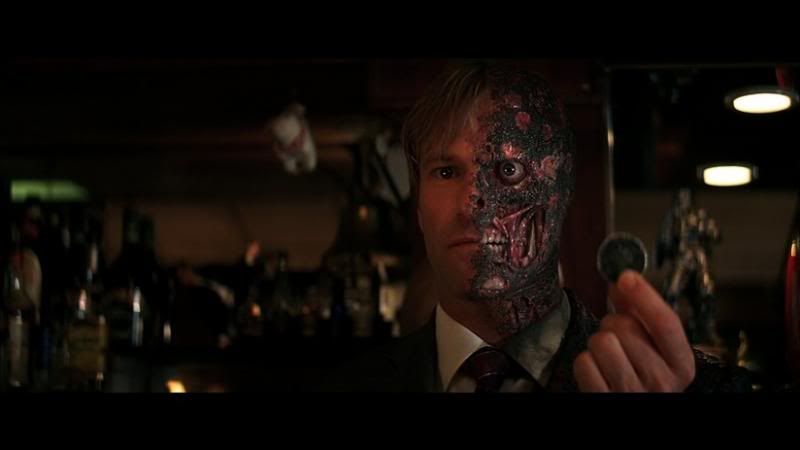

Here's Two-Face.  All this talk of duality and combined dualities?  That's overtly inherent in every iteration of this character.  I talk in Illuminating Harry Potter about the Roman god Janus (when discussing Prof. Quirrell and Voldemort).  Here he is again.  Janus is the god of thresholds and beginnings, exits and endings.  He is representative of acts of inversion and mutual sacrifice.  He is the transmitter of the knowledge of the law and of agriculture (that's sowing and reaping).
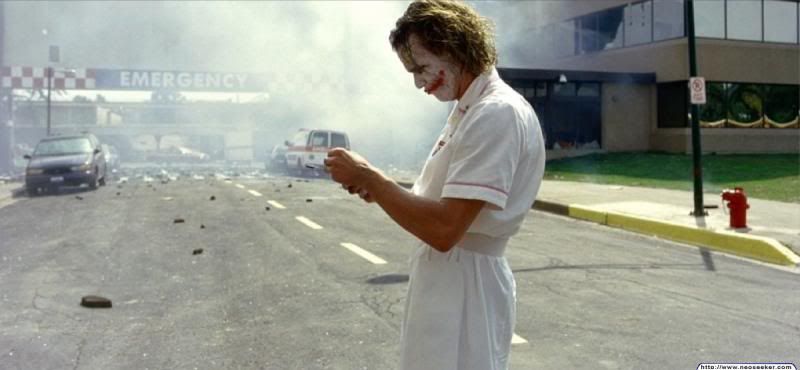

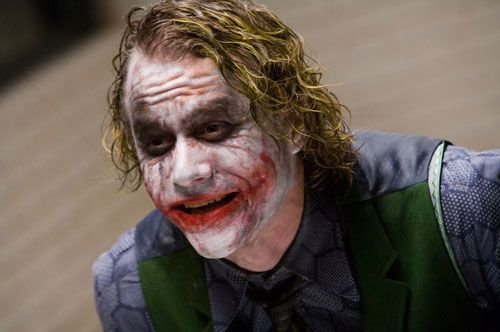
And when the Joker sets Two-Face, his initiate, loose on the city?  There's fire.  And there's a checkerboard.  And this vital stage of initiation involves a cross-dressing Joker, a synthesis of Randall Patrick McMurphy and Nurse Ratched, the union of opposites.  The androgyne or hermaphrodite is symbolically alchemy's coincidentia oppositorum, the incarnation of the Great Work.  It is the same meaning as a head with two faces, interestingly enough.  For this reason the androgyne is a common figure for conducting an initiation ceremony.  Now take a look at the very first image of this article and note the hexagon pattern of the Joker's shirt.  A hexagon is a six sided figure.  Six represents unity and equilibrium.  Why?  Because the hexagram is the combination of an upward pointing male triangle, and a downward pointing female triangle. It's an androgyne. 
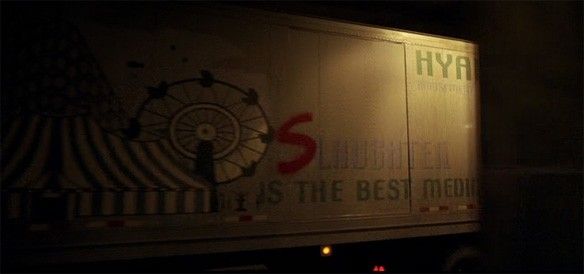

Here is the Joker's vandalized circus truck.  The word circus is related to the word circle, due to the shape of the performance area.  Circuses almost always involve animal acts.  A circle of animals is a manner of referring to the zodiac.  Every media use of circus can esoterically relate to the zodiac.  This is a key point.  The zodiac is important due to the precession of the equinox, a grand scale matter of astronomical timing, the shifting of ages (golden, silver, bronze, iron) which is allegorized in many, many places as stories about the end of the world.  We are living in the shifting from the Age of Pisces to the Age of Aquarius.  And think how popular apocalyptic stories are right now.  This harrowing scene starts with a burning fire truck, a pun by the Joker, and another deployment of Fire symbolism associated with him. 

Does this seem like a lot to extrapolate from the graphics on the side of a truck?  This is what esoteric symbolism is all about.  In this case the above is emphasized by the black and white  initiatory patterned tent, and the Ferris wheel, a circle, and one that looks like a sun burst and an eye.  A single eye emitting a black beam or sitting atop a column.  Now that I'm saying it, try not to see that Ferris wheel as a stylized Eye of Sauron.  Return, if you like, to the obscured eye image at the start of the article.  What is alchemy's Great Work?  Turning base metal into gold.  But that's an allegory.  The basis of mythology is astronomy.  It's time keeping.  It's a turning that's a returning, back to the start of the circle, iron into gold.
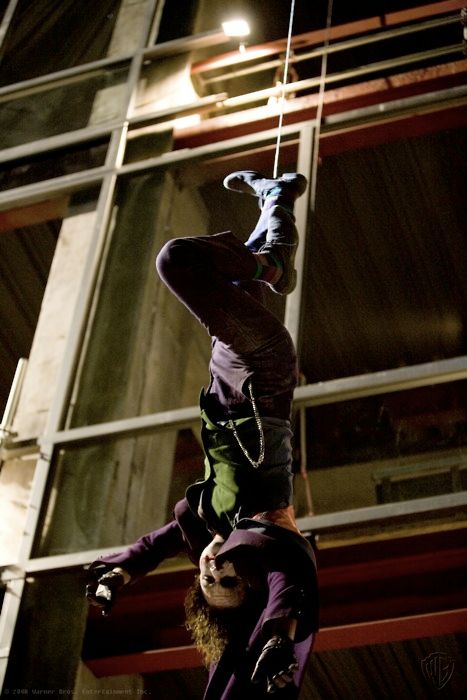

In his last act, the Joker has a failed use of fire involving the two ferries in a Prisoner's Dilemma  scenario, and creates a hoax that Batman uses his enlightened senses to see through involving masking hostages as Clowns and his thugs as Doctors.  As I contend in the Doctoring Art Gotic articles, Doctors are the teachers of the Invisible College.  Batman gets caught in a net (a grid-structure of the visible and invisible, and a symbol of magical authority) prior to the Joker being displayed as Tarot trump twelve, The Hanged Man.  The symbolism of this card is overtly sacrificial, and once again Odinic.  It represents expiation, inversion and realignment.  And what does The Hanged Man predict?  The elevated Batman's Fall, generating a new hoax wherein he takes responsibility for the murders committed by Two-Face, an act of expiation, and the Dark Knight entering into obscurity. 

How interesting that in the Tim Burton Batman movie the Joker also hangs before falling (from a tower, weighed down by a statue of the Devil).  In The Dark Knight the Joker lives but Two-Face dies in a Fall.  Joel Schumacher's Two-Face also dies from a Fall.  The Dark Knight is Ledger's last full role.  He half finished Terry Gilliam's The Imaginarium of Doctor Parnassus.  He enters that story as a hanged man, where his Joker role left off.  Inverted.
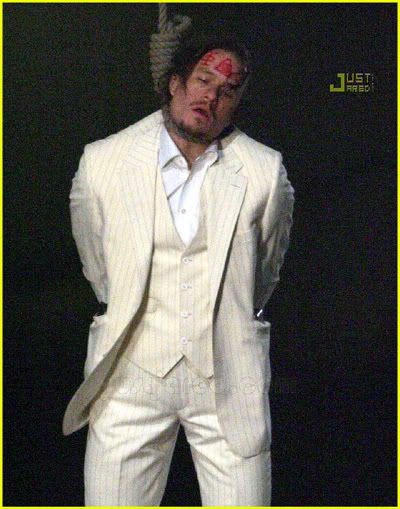


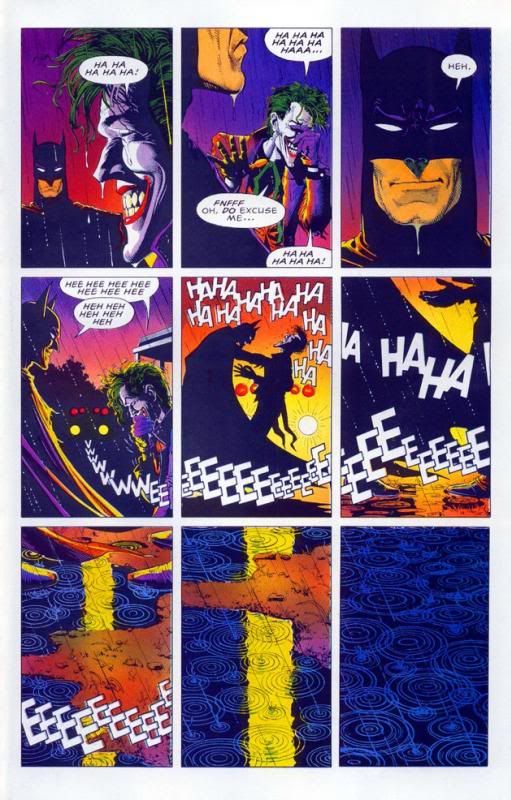
The Joker dies, the Joker lives, the Joker dies, the Joker lives.  The subject of this article is a few years gone by now.  This doesn't really make it more comfortable to talk about though.  And, though not nearly as prominently, this matter of the Joker's living and dying and living, and the questions about it all, have become topical again due to an interview comic book writer and so-called chaos-magician Grant Morrison gave to Kevin Smith where Morrison makes a claim regarding what is highly regarded as the best Joker comic book story ever produced, The Killing Joke.  The Killing Joke is by another self-professed comic book writer/magician, Alan Moore and the amazing Brian Bolland.  It involves the Joker shooting and paralyzing Barbara Gordon, who is secretly Batgirl, and photographing her naked, wounded body (and possibly raping her) with the intent of driving Commissioner Gordon insane.  It ends like this:

art by Brian Bolland


With the Batman and the Joker sharing a laugh at a joke as the police arrive.  Some comic readers find this scene, read straight, as touching, though I am not amongst their ranks. Morrison contends that it was Moore's intent to suggest, though not overtly, that Batman kills the Joker.  And I agree.  I always thought this was being suggested.  I mean, look, the light goes out in the last panel.  The line separating the two of them disappears.  Batman proves the Joker is right by breaking his cardinal rule and killing the Joker.  And this was really the Joker's purpose because his existence is a misery.  However, this is fiction.  It is only so much about the author's intent.  There is no inherent truth, which means that both endings are simultaneously true.  And false.  Morrison fully realizes this I'm sure.  Smith might as well.  Note that Morrison has in his recent career killed and resurrected Batman, killed the latest Robin who is the son of Batman and Talia al Ghul, not to mention killed and resurrected Superman as the heart of the sun.  What is death in comics?  It is a symbol system.  It is a motif of exit and entrance.  It is about resurrection.  Always. 

Tuesday, February 26, 2008

Mighty Tetramorphin' Power Rangers

One of my favorite and most cited resources is "A Dictionary of Symbols" by Juan Eduardo Cirlot. While researching Tiger symbolism for my "Night Watch" post Day Destroys The Night I came upon this intriguing piece of information:

"[In China] Five mythic tigers together constitutes a symbol which is invested with the same meaning as the tetramorphs in Christian tradition, in so far as they are the defenders of the spacial order against the forces of chaos. The Red Tiger reigns in the south, his season being summer and his Element fire; the Black Tiger reigns in the north-winter is his season, and his Element water; the Blue Tiger reigns in the East, in the spring and amidst vegetation; the White Tiger predominates in the west, in autumn and among the metals; and, finally, the Yellow Tiger (solar in colour) inhabits the earth and reigns supreme over all the other tigers. This Yellow Tiger is located in the 'Centre', as the Emperor was situated in the heart of China and as China lies at the centre of the world. This quaternary division plus the centre as the fifth Element is, as Jung has shown, of archetypal significance in the symbolism of situation."

If you lived through the '80s, especially if you grew up in the '80s like I did, then this description naturally brings this to mind:

Photobucket

Not exactly the pattern Cirlot describes, but pretty damn close. This is Voltron, of course, specifically Voltron III or Voltron of the Far Universe, the Lion Voltron based on and built out of the Japanese anime "Hyakujuu-ou Golion" (Hundred Beast King GoLion/FiveLion). Undoubtedly this makes Voltron the Quintessential giant mecha. Here's footage from "Voltron" of the four elemental Lions activating, note the locales they emerge from:


The Fifth Lion, in this case the Black Lion, representing the Center, emerges at the castle from within a statue of a Winged Lion. A Winged Lion is a direct reference to the occidental Tetramorph, specifically representing the constellation Leo/Fire. The pilot of the Black Lion likewise wears a Red uniform, which further would associate with Fire. I'd like to think in this we can see how complex these symbol systems can be in their presentation, with the information perhaps distorted in synchronistic translation, or even purposefully rearranged. I believe it demonstrates how, as is the case with Lyra's Alethiometer, the information is multi-layered. Sara Lee symbolism.

We in fact see this elemental patterning to such a degree in Japanese anime, manga, video games, etc., that it is clearly traditional iconography. There are probably hundreds if not thousands of examples. As the title of this article implies, we clearly see it in play in many of the Japanese Super Sentai series (like "Golion", Toei/Bandai productions), which have been reworked and translated for American children as "The Mighty Morphin Power Rangers", and its antecedents.

This is not an unusual practice whatsoever, a cut and paste of anime for a Western audience. As a young child I was totally enthralled by "Battle of the Planets", about the super hero team "G-Force". I even had the lunch box. But of course I was too young to realize that this was a bastardized presentation of Kagaku ninja tai Gatchaman (Science Ninja Team Gatchaman). How could I not love this cartoon? The bad guy was a bat-like hermaphrodite, and the good guys were super science ninjas who dressed like Birds, for goodness sake, and they flew around in a space ship called "Phoenix" that burst into flame (on purpose) once per episode (as the ultimate resource of the team). Gatchaman is cited as the originator of the Five member team motif utilized in the Sentai works that followed.

Photobucket

The specific bird types their costumes represent are (l.-r.) Eagle, Owl, Swallow, Swan and Condor. I can't see a way to clearly relate these figures to Four or Five Elements, and I believe this is again due to complex symbol layering, but if I had to guess based on color schemes and predominant characteristics I would say Fire, Earth, Air, Ether and Water. While the Swan is certainly indicative of the element of Water, the status of the character as the sole female member (called "Princess" in "Battle of the Planets") differentiates her, and suggests the divinity of a Sovereignty figure (note the many, many Princesses in Japanese entertainment, Voltron being a ready example).

Heavily involved here is the interaction, the mutual influencing, of Eastern and Western artistic expression, a huge topic that I'm only going to nod to here. The Sentai genre inspiring Gatchaman is clearly inspired by American comic books, specifically animal based characters. Likewise I find some pretty clear examples of Japanese works that seem to have inspired Jack Kirby, for example. There is a great deal of Osamu Tezuka's atomic powered Pinocchio Astro Boy/Mighty Atom evident in Machine Man. And in terms of design, it's hard to imagine Kirby came up with the original look of Iron Man without any awareness of Mitsuteru Yokoyama's Gigantor, who is also known as Iron Man #28.

Photobucket

Photobucket


And if you're familiar with the Kirby designed Sentinels from the X-Men, you may agree with me that they bear a striking similarity to Japanese-style giant robots.

The Elemental pattern involving four or five is of course present in Western cartoons and comic books as well. I won't even get into Bill Willingham's "Elementals", too easy. I've brought this topic up before in Mercury Retrograde, making mention of the characters from the super hero films "The Incredibles" and "Zoom" (noting in both cases that Fire is specifically displaced) as extrapolations from the clearly elemental Fantastic Four created by Jack Kirby and Stan Lee.

Photobucket
Art by Jack Kirby

The Thing is Earth, the Human Torch is Fire, the Invisible Girl is Air and Mister Fantastic is Water. One could read the Cosmic Energy that generates their abilities as the Fifth Element, and the position eventually is characterized by the omni-powerful Franklin Richards, the son of Reed and Sue, the product of their Chemical Wedding.

More specific attention to the Tetramorph pattern was noted in The Great Marvel Mysteries Part Two when I discussed Jean Grey/Phoenix/Marvel Girl, who is Ether, with the solar powered Cyclops representing Fire, the Iceman Water, the flying Angel Air and the Beast Earth.

Photobucket
Art by Jack Kirby

Photobucket
Art by Jack Kirby

Photobucket
Art by Jack Kirby

Naturally the same elemental pattern was applied by Lee and Kirby to the FF's supposed opposite numbers, The Frightful Four. The Sandman is of course Earth, the anti-gravity expert Wizard is Air, the super-glue using Paste-Pot Pete is Water and the prehensile haired Medusa is Fire.

Photobucket
Art by Jack Kirby

How great that the issue introducing the elemental Frightful Four included a guest appearance by the Quintessential X-Men.

Photobucket
Art by Jack Kirby

And at an engagement party for the pending Chemical Wedding no less. The Avengers, however, are not Elemental. They're far more planetary, or the days of the week, if you include Captain America along with the original lineup, and count the Hulk twice. Because the Apollonian/Dionysian Hulk stands for Sunday and Monday, Mars signifying Iron Man is Tuesday, Hermes resonator Captain America is Wednesday, Thor is of course Thursday, the flirty, sole female, the Wasp (Bee) is Friday, and the Titanic Giant Man is Saturday. I'm not saying this particular pattern is purposeful, I'm just saying it is.

Kirby's Madame Medusa is far more then just a member of a team of second-string villains though. She's something very special, a variation of human even more specialized and exclusive, even more distinctly esoteric, then Marvel's mutants. She's the Queen of the Inhumans, making her another Sovereignty goddess figure.  I had to wonder if these elemental qualities relate to Kirby's Madame Medusa if there was an extension of the concept apparent in the rest of the Inhuman Royal Family. I think I can argue that there is.

Photobucket
Art by Jack Kirby

Medusa is still Fire, Gorgon (yes the group includes both a Medusa and a Gorgon) is Earth (very apparently given his Bull/Goat appearance), Black Bolt is Air (the sole flier, with super ultra-sonic powers), and Triton is Water (obviously). Crystal then is the Quintessence, as she controls the four Elements. This leaves Karnak out, but we might note that Karnak has no super powers. Instead he is a master of super-esoteric arts, a monk. Karnak is the high priest of the spatial order his compatriots represent. Also great is the Inhumans "dog" Lockjaw, a living Stargate, absolutely appropriate, a great item of surrealism on Kirby's part.

Given the major level of influence that Kirby has had on popular culture in general, and to super hero media in specific, I bet we could find all sorts of interesting expressions of this symbol system. I'm interested in hearing other people's observations. To demonstrate how far-ranging the expression of the elemental qualities can be, I direct you to my article Tetramorph(eus) and the Blue Illusions for a sneaky example from "Star Wars II: Attack of the Clones". Or how about Alex Toth's late 60's Hanna-Barbara cartoon "The Herculoids"?

Photobucket

Energy-rock shooter Tundro is Fire, flying dragon Zok is Air, shape-changers Gloop and Gleep are Water and the Rock Ape Igoo is obviously Earth. Plus I think Zandor, Tarro and Dorna are something of a Royal Family. At any rate Zandor as the leader of the Herculoids occupies the Quintessential position.

Another subtle application of the elemental pattern comes from Marvel's "Power Pack", created by writer Louise Simonson and illustrator June Brigman.

Photobucket
Art by June Brigman

Power Pack's powers relate to four fundamental scientific principles, gravity, light, mass and energy, but we can observe that Alex/Gee controls gravity (Earth), Julie/Lightspeed flies (Air), Jack/Mass Master becomes vaporous (Water) and Katie/Energizer disintegrates matter and emits explosions (Fire). Eventually Power Pack gained a fifth member, and we have no difficulty viewing him as the Fifth Element, because he's the aforementioned Franklin Richards.

Photobucket
Art by June Brigman

Dig the Moon Boots. Franklin's Power Pack emblem, its worth noting, is an Eye emitting a beam of Light.

Want one more? I got a good one, with a really sneaky application of the Elemental Pattern. I'm talking about the original Doom Patrol, created by writers Bob Haney and Arnold Drake and illustrator Bruno Premiani. Through what can only be considered sheer synchronicity DC's Doom Patrol debuted in "My Greatest Adventure" in the summer of 1963, just months before Marvel's "X-Men" hit the stands. Both titles featured a team of super heroes that felt ostracized by the outer world due to their freakish natures, and both were led by a wheelchair bound scientist. While it's not possible that Kirby's X-Men was a take off of the Doom Patrol, it is apparent that the Doom Patrol was directly influenced by the Fantastic Four and the Marvel comics style in general.

Now, the characters are not elemental in nature, not really. Cliff Steel/Robotman is a human brain implanted in a super strong robot body, Rita Farr/Elasti-Girl (note this name was used in "The Incredibles") can both shrink and grow, Larry Trainor/Negative Man could project an anti-energy being from his body, and Niles Caulder/the Chief was just very, very smart. I think arguments could be made that the powers and characteristics of the Doom Patrol do relate to the four elements, but there's a clearer indication of the pattern that comes in a different manner. Here are the origins of the Doom Patrol. All art that follows is by Bruno Premiani.

Photobucket

Photobucket

Photobucket

Photobucket

Photobucket

Photobucket

Photobucket

Photobucket

Is that great or what? The elemental indications come in the characters' origins, Rita in the Water, Larry in the Air, Cliff on the Earth, and the Chief had a bomb, Fire, implanted on his spine. Also note the use of the name R-2 for a faithful robot here in the mid-sixties (even better, he's also RA-2).

One more thing before I go. In Bat Time Bat Channel I included this work of Pop Art by Roy Lichtenstein:

Photobucket

That's quite clearly the helmet of Magneto depicted in the painting. The face underneath, however, actually was traced from an image of the Chief from an episode of the Doom Patrol, drawn by Premiani:

Photobucket

How strange. These characters are unrelated, being from different companies. The Chief pretty easily relates to Professor X, but what's really boggling is that both characters, Magneto and the Chief, had controversial reworkings by Chaos Magician comic book writer Grant Morrison. In both cases Morrison took good characters (Magneto having been reformed more or less at that time) and made them fundamentally evil, a little retrograde action. What does Grant Morrison knows about Roy Lichtenstein's Image Duplicator?

Tuesday, January 8, 2008

Doctoring Art Gotic Part IV

In this entry I'm dealing with more obscure Marvel and DC Comics Doctors and Professors in a somewhat random manner. This is really just a chunk, there's just too darn many of them. In this batch we find more full face masks hiding scarred visages, brain transplants, psychic twins, the Philosopher Stone directly and indirectly, demonic possession, the first Silver Age Marvel super hero, alchemical gender play and a very unexpected character named Marva Jane Grey. Oh, and Godzilla.
Before we start that though, here's Doctor Strange's Astrological Chart. Well I think it's interesting. I can't determine exactly who established Doctor Strange's date of birth. Maybe it was Stan Lee but my hunch is Steve Englehart who had a short but significant run on the title.

Photobucket

Rising Sign is in 08 Degrees Aquarius
Sun is in 25 Degrees Scorpio.
Moon is in 03 Degrees Scorpio.
Mercury is in 02 Degrees Sagittarius.
Venus is in 02 Degrees Sagittarius.
Mars is in 11 Degrees Leo.
Jupiter is in 20 Degrees Cancer.
Saturn is in 08 Degrees Capricorn.
Uranus is in 11 Degrees Aries.
Neptune is in 05 Degrees Virgo.
Pluto is in 20 Degrees Cancer.
N. Node is in 23 Degrees Aries.

So was this purposeful? I'm certain that making Doctor Strange a Scorpio was. Scorpio is the sign governing the occult. Though it may be accidental it is interesting that his Moon is also in Scorpio and that his Rising Sign is Aquarius.

When it comes to super hero comic book Doctor characters with esoteric significance it does not get much more blatant then the Silver Age Flash Rogue Doctor Alchemy, created by writer John Broome and illustrator Carmine Infantino. He first appeared as Mister Element in "Showcase" #13, March 1958. By his second appearance in issue #14 he had somehow made or gained possession of the Philosopher's Stone and changed his identity to Doctor Alchemy.

Photo Sharing and Video Hosting at Photobucket
Art by Mike Vosburg

Albert Desmond was described as having a multiple personality disorder, like the Batman villain Two Face, one a normal law abiding citizen and the other a grandiose, amoral super villain. This makes Doctor Alchemy another example of an Apollonian/Dionysian dichotomy figure as well as symbolically representing Mercury's periodic retrograde action. The identity issues are compounded for Albert Desmond. While in criminal mode he was prone to act as either of his identities, Doctor Alchemy or Mister Element. At one point the shift from mild-mannered Albert Desmond to Mister Element was induced through hypnosis by the Reverse Flash, Professor Zoom. It was discovered that the fluctuating personalities were being caused by the pulsations of a distant star called the Dragon's Eye, giving the character a very overt astrological connotation. At a later point it was revealed that Albert Desmond had a "psychic twin", a man who by chance was born at the exact same moment as Albert and was coincidentally named Alvin Desmond. The Gemini referential Twin symbol is a major esoteric element.

Inherently evil, Alvin Desmond felt his sinister urges wane during the periods of time when Albert Desmond was operating as Mister Element or Doctor Alchemy. When with the Flash's help Albert finally shed himself of his evil side, the sociopathic traits fully returned to Alvin. Through the psychic connection Alvin was able to locate the Philosophers Stone and became a new Doctor Alchemy.

The DC Comics' version of the Philosophers Stone is highly powerful, capable of transmuting any element into another, and in complex combinations. For example, at one time Doctor Alchemy was able to instantly transform all the elements composing the body of the Flash into water vapor (he got better).

Photo Sharing and Video Hosting at Photobucket
Art by Jack Kirby & Steve Ditko. Cool.

It is commonly presented that the Fantastic Four were the first Marvel super heroes of the Silver Age. In fact that honor belongs to yet another mystical Doctor, the character that would come to be known as Doctor Druid. In June of 1961, nearly half a year before the first issue of "The Fantastic Four", a Lee and Kirby character called Doctor Droom was introduced in "Amazing Adventures" #1. It is understandable that Druid/Droom is often overlooked. The character disappeared after six issues when the title was reformatted as "Amazing Adult Fantasy" and he did not resurface again until the '70s in the pages of "The Incredible Hulk". At that point the obscure Doctor Droom was rechristened Doctor Druid in order to avoid confusion with Doctor Doom.

Photo Sharing and Video Hosting at Photobucket
Art by Al Milgrom. The costume says it all.

Doctor Anthony Ludgate Druid (Lud = Light) was a psychiatrist and occult expert who was summoned by a Tibetan lama who had traveled to the United States seeking medical treatment. The lama put Druid through a spiritual test to ascertain his worthiness, and finding him so, untapped the potentials of his mind and trained him in mystic arts. Druid possessed telepathy and a degree of magical power with his primary ability being hypnosis and other feats of mesmerism. He was also described as being a descendant of the legendary Irish bard Amergin. Despite his place in the Marvel history books, Doctor Druid has been treated rather shabbily. He did serve as an Avenger for a short time in the mid-eighties, but he was mind controlled by Ravonna, at the time impersonating Nebula. When Ravonna was cast into Marvel's multi-functional Limbo Doctor Druid followed her (a rather tongue-in-cheek exit for the character). He later returned and headed a new group of Defenders, but was again brainwashed, this time by a demon called Slorioth. Druid went insane and was eventually killed by Daimon Hellstrom, the Son of Satan. He's still dead.

Professor Power first appeared in "Marvel Team-Up" #117, May 1982. Created by writer J. M. DeMatteis and illustrator Herb Trimbe, Anthony Power was a prominent historian, university professor and an adviser to four Presidents. Ultra-patriotic, Power was devastated when his son Matthew returned from Vietnam virtually brain dead. Power had an epiphany, deciding that the cure for America's social ills was for the nation to be ruled by by a single, worthy individual. He organized an underground network of like-minded individuals who funded Power's elaborate, high-tech plot. He further hired former agents of the CIA, FBI, SHIELD, and AIM to serve as his private army, arming them with lasers and flying chariots and dressing them like ancient Roman soldiers (making his organization very similar to the Golden Age Doctor Light's Roman criminal underground). In his first appearance Professor Power abducted and tested his soldiers and equipment against the Mugwump Spider-Man and the Dionysian Wolverine (see Mystos Mustela).

Photo Sharing and Video Hosting at Photobucket
Art by Herb Trimpe.

In issue #118 Professor Power was the villain in a team-up of Spider-Man and Professor X. A few months later, in a Marvel Team-Up between Spider-Man and the blue ape-man Beast, Professor Power clad his brain-dead son in a super suit of high-tech armor and transposed his own mind into his son's body, making him a very strange gestalt entity. Speaking of gestalts, I find the symbolic potential of team-up titles like "Marvel Team-Up", "Marvel Two-In-One", "DC Comics Presents", certain runs of "The Brave and the Bold" and even the singular teaming of Superman/Batman in "World's Finest" to have great symbolic potentials.

Photo Sharing and Video Hosting at Photobucket
Art by Kerry Gammill

When it comes to mythological resonance and sheer weirdness underlying symbolism, Wonder Woman is in a league of her own. Towards the end of the sixties Wonder Woman went through a "mod" period. Phase shift is not something that should be unexpected in a lunar goddess character named Diana. Wonder Woman revoked her godly powers and gained a spiritual martial arts mentor by the name of I Ching. The Wonder Woman adventures of this era were more espionage-adventure oriented, channeling elements of shows like "The Avengers" and the James Bond films. It was during this period, in "Wonder Woman" #179, November 1968 , that the super villain Doctor Cyber was introduced.

Photo Sharing and Video Hosting at Photobucket
Art by Mike Sekowsky

Created by Sekowsky with writer Dennis O'Neil, Doctor Cyber is the head of a SPECTER-like international crime cartel. Amongst their crimes was an attack on I Ching's monastery. During a plot involving an earth-quake making device as a means to blackmail the world, Doctor Cyber was severely disfigured by an urn of hot coals, which she naturally blamed on Wonder Woman. In a later storyline Wonder Woman and detective Jonny Double investigated an organization called The Tribunal, which was revealed as a cover for a scheme by Cyber to find a suitable woman into whom she could have her brain transplanted. In the course of this story she attempted to have the procedure performed on Wonder Woman with the assistance of the Batman criminal brain surgeon Doctor Moon (created by O'Neal and artist Irv Novick and first appearing in "Batman" #240, March 1972). I find the alchemical/astronomical connotations underlying this plot line, including the use of Jonny Double and Doctor Moon, to be quite obvious. As a super scientific international crime cartel ring leader Doctor Cyber has access to all the typical paraphernalia, from rocket sleds to mind control serum.

Photobucket
Art by Harry G. Peter

Another female comic book Doctor is the Wonder Woman villain Doctor Poison. First appearing in February 1942's "Sensation Comics" #2, Doctor Poison was the product of Wonder Woman creator Doctor William Moulton Marston (who was as strange as any of his characters) and illustrator Harry G. Peter. The alchemical connotations of evil chemist Doctor Poison are apparent on a surface level. She was introduced as an Axis spy in charge of the "Nazi Poison Division" with a plot to contaminate the U.S. Army's water supply with the chemical Reverso, which would cause the soldiers to do the opposite of what they were ordered. In 1943 she reemerged as the "Chemical Research Chief" of Japan. Dr. Poison's hood and mask hides not just her identity but her gender as well. It was eventually revealed that she was the beautiful Japanese Princess Maru. At one point Dr. Poison was sent to the Amazon penal colony Transformation Island, but it didn't take. She escaped and in 1948 teamed with seven other female villains to form Villainy Inc. in "Wonder Woman" #28.

Photobucket
Art by Harry G. Peter

What a wonderful team, a former gorilla turned giantess, an Atlantean Queen, a Snow Man, Dr. Poison, a hypnotic magician of the "Blue Ray", a Priestess of the "Crimson Flame" and the Dionysian split-personality sufferer Cheetah. The leader, unidentified in this panel, is Eviless, a slaver from (naturally) the planet Saturn. Including Dr. Poison, three members of the team were women disguised as men.

Photobucket
Art by Harry G. Peter

Sticking with Golden Age Wonder Woman, Marston and Peter, we have the telepathic dwarf Doctor Psycho who first appeared in "Wonder Woman" #5, July 1943. Psycho was presented as a sociopathic, misogynistic con-artist occultist. He is originally employed by The Duke of Deception.

Photobucket
Art by Harry G. Peter

The Duke was a minion of the war god Mars. Mars blamed women for preventing the world from completely engulfing in endless warfare (this was during World War II). Doctor Psycho was wrongly convicted of a robbery due to the testimony of his former fiancee, Marva Jane Gray. This led to him developing a psychopathic hatred of all women. After his release Psycho tortured and brainwashed Marva and utilized her as his guinea pig for occult experiments. He discovered he could use Marva to produce "ectoplasm" which Psycho could mentally shape. In a plot to remove women from the war effort Psycho generated a false spirit of George Washington as part of a highly bizarre smear campaign.

In Part One of this series I discussed Doctor Who's connection to the Marvel Universe and the company's propensity at one time to include licensed properties they published titles about within the confines of their super hero reality. This was the case with Marvel's late seventies series "Godzilla, King of the Monsters" which ran for 24 issues. During this run Godzilla encountered the Fantastic Four, the Avengers, and Spider-Man. There was even a branch of SHIELD developed specifically to deal with Godzilla. Apparently a "mutated" version (due to the licensing agreement long expiring) of the monster appeared in a Marvel publication as recently as last year. As with Doctor Who, characters that started in the Godzilla series had further lives beyond the parent title including the manga-inspired giant robot Red Ronin and the super villain Doctor Demonicus.

Photobucket
Art by Tom Christopher

Obviously influenced by Doctor Doom, Doctor Demonicus, with his Toho monster movie trappings, is also very similar to Doctor Cyber. He was introduced in "Godzilla, King of the Monsters" #4, November 1977 as a doctor specializing in genetic engineering, Douglas Birley purposefully exposed himself to radiation in an attempt to induce mutation and generate super powers. It didn't work, instead giving him severe skin cancer, a condition he controled with his costume, naturally. He later acquired a radioactive meteor called "the Lifestone" that he utilized to transform animals into giant monsters. He crafted the Lifestone into a transport as a mobile power source for his creations. While Godzilla fought the monsters SHIELD agent Gabriel Jones subdued Doctor Demonicus.

Later Demonicus worked with the alien sorceror Maur-Kan against another Marvel licensed property, the Shogun Warriors. Years later he showed up in "West Coast Avengers" where he created his own volcanic island which he named Demonica and won UN membership. During this time he was under the control of a demon called Raksasa, named for demons from Hindu mythology.