Showing posts with label Marvel. Show all posts

Saturday, September 27, 2014

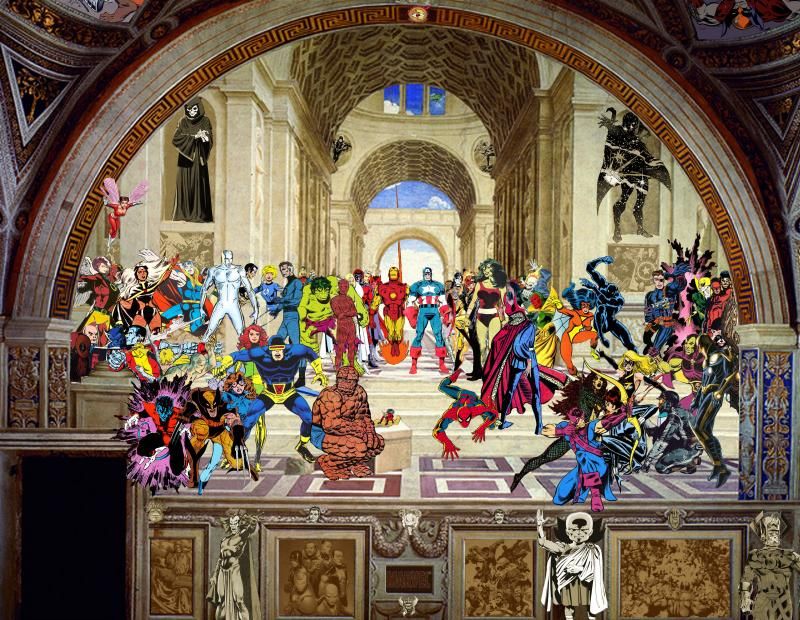
Marvel at the School of Athens


by Adam Ruvola
(Original art by Jack Kirby, George Perez, John Romita Sr., John Romita Jr., Werner Roth, Arthur Adams, Alan Davis, Dave Cockrum, Mike Mignola, Jim Starlin, Steve Ditko, Rick Leonardi, Paul Smith, John Byrne, Bob Layton, Neal Adams, Raphael Sanzio da Urbino, Jim Steranko, Dave Mazzuchelli, Gil Kane, Moebius, John Buscema, Daniel Acuna, Mike Zeck, Bill Sienkiewicz, and many more)
Click here for a full size version.

Tuesday, February 26, 2008

Mighty Tetramorphin' Power Rangers

One of my favorite and most cited resources is "A Dictionary of Symbols" by Juan Eduardo Cirlot. While researching Tiger symbolism for my "Night Watch" post Day Destroys The Night I came upon this intriguing piece of information:

"[In China] Five mythic tigers together constitutes a symbol which is invested with the same meaning as the tetramorphs in Christian tradition, in so far as they are the defenders of the spacial order against the forces of chaos. The Red Tiger reigns in the south, his season being summer and his Element fire; the Black Tiger reigns in the north-winter is his season, and his Element water; the Blue Tiger reigns in the East, in the spring and amidst vegetation; the White Tiger predominates in the west, in autumn and among the metals; and, finally, the Yellow Tiger (solar in colour) inhabits the earth and reigns supreme over all the other tigers. This Yellow Tiger is located in the 'Centre', as the Emperor was situated in the heart of China and as China lies at the centre of the world. This quaternary division plus the centre as the fifth Element is, as Jung has shown, of archetypal significance in the symbolism of situation."

If you lived through the '80s, especially if you grew up in the '80s like I did, then this description naturally brings this to mind:

Photobucket

Not exactly the pattern Cirlot describes, but pretty damn close. This is Voltron, of course, specifically Voltron III or Voltron of the Far Universe, the Lion Voltron based on and built out of the Japanese anime "Hyakujuu-ou Golion" (Hundred Beast King GoLion/FiveLion). Undoubtedly this makes Voltron the Quintessential giant mecha. Here's footage from "Voltron" of the four elemental Lions activating, note the locales they emerge from:


The Fifth Lion, in this case the Black Lion, representing the Center, emerges at the castle from within a statue of a Winged Lion. A Winged Lion is a direct reference to the occidental Tetramorph, specifically representing the constellation Leo/Fire. The pilot of the Black Lion likewise wears a Red uniform, which further would associate with Fire. I'd like to think in this we can see how complex these symbol systems can be in their presentation, with the information perhaps distorted in synchronistic translation, or even purposefully rearranged. I believe it demonstrates how, as is the case with Lyra's Alethiometer, the information is multi-layered. Sara Lee symbolism.

We in fact see this elemental patterning to such a degree in Japanese anime, manga, video games, etc., that it is clearly traditional iconography. There are probably hundreds if not thousands of examples. As the title of this article implies, we clearly see it in play in many of the Japanese Super Sentai series (like "Golion", Toei/Bandai productions), which have been reworked and translated for American children as "The Mighty Morphin Power Rangers", and its antecedents.

This is not an unusual practice whatsoever, a cut and paste of anime for a Western audience. As a young child I was totally enthralled by "Battle of the Planets", about the super hero team "G-Force". I even had the lunch box. But of course I was too young to realize that this was a bastardized presentation of Kagaku ninja tai Gatchaman (Science Ninja Team Gatchaman). How could I not love this cartoon? The bad guy was a bat-like hermaphrodite, and the good guys were super science ninjas who dressed like Birds, for goodness sake, and they flew around in a space ship called "Phoenix" that burst into flame (on purpose) once per episode (as the ultimate resource of the team). Gatchaman is cited as the originator of the Five member team motif utilized in the Sentai works that followed.

Photobucket

The specific bird types their costumes represent are (l.-r.) Eagle, Owl, Swallow, Swan and Condor. I can't see a way to clearly relate these figures to Four or Five Elements, and I believe this is again due to complex symbol layering, but if I had to guess based on color schemes and predominant characteristics I would say Fire, Earth, Air, Ether and Water. While the Swan is certainly indicative of the element of Water, the status of the character as the sole female member (called "Princess" in "Battle of the Planets") differentiates her, and suggests the divinity of a Sovereignty figure (note the many, many Princesses in Japanese entertainment, Voltron being a ready example).

Heavily involved here is the interaction, the mutual influencing, of Eastern and Western artistic expression, a huge topic that I'm only going to nod to here. The Sentai genre inspiring Gatchaman is clearly inspired by American comic books, specifically animal based characters. Likewise I find some pretty clear examples of Japanese works that seem to have inspired Jack Kirby, for example. There is a great deal of Osamu Tezuka's atomic powered Pinocchio Astro Boy/Mighty Atom evident in Machine Man. And in terms of design, it's hard to imagine Kirby came up with the original look of Iron Man without any awareness of Mitsuteru Yokoyama's Gigantor, who is also known as Iron Man #28.

Photobucket

Photobucket


And if you're familiar with the Kirby designed Sentinels from the X-Men, you may agree with me that they bear a striking similarity to Japanese-style giant robots.

The Elemental pattern involving four or five is of course present in Western cartoons and comic books as well. I won't even get into Bill Willingham's "Elementals", too easy. I've brought this topic up before in Mercury Retrograde, making mention of the characters from the super hero films "The Incredibles" and "Zoom" (noting in both cases that Fire is specifically displaced) as extrapolations from the clearly elemental Fantastic Four created by Jack Kirby and Stan Lee.

Photobucket
Art by Jack Kirby

The Thing is Earth, the Human Torch is Fire, the Invisible Girl is Air and Mister Fantastic is Water. One could read the Cosmic Energy that generates their abilities as the Fifth Element, and the position eventually is characterized by the omni-powerful Franklin Richards, the son of Reed and Sue, the product of their Chemical Wedding.

More specific attention to the Tetramorph pattern was noted in The Great Marvel Mysteries Part Two when I discussed Jean Grey/Phoenix/Marvel Girl, who is Ether, with the solar powered Cyclops representing Fire, the Iceman Water, the flying Angel Air and the Beast Earth.

Photobucket
Art by Jack Kirby

Photobucket
Art by Jack Kirby

Photobucket
Art by Jack Kirby

Naturally the same elemental pattern was applied by Lee and Kirby to the FF's supposed opposite numbers, The Frightful Four. The Sandman is of course Earth, the anti-gravity expert Wizard is Air, the super-glue using Paste-Pot Pete is Water and the prehensile haired Medusa is Fire.

Photobucket
Art by Jack Kirby

How great that the issue introducing the elemental Frightful Four included a guest appearance by the Quintessential X-Men.

Photobucket
Art by Jack Kirby

And at an engagement party for the pending Chemical Wedding no less. The Avengers, however, are not Elemental. They're far more planetary, or the days of the week, if you include Captain America along with the original lineup, and count the Hulk twice. Because the Apollonian/Dionysian Hulk stands for Sunday and Monday, Mars signifying Iron Man is Tuesday, Hermes resonator Captain America is Wednesday, Thor is of course Thursday, the flirty, sole female, the Wasp (Bee) is Friday, and the Titanic Giant Man is Saturday. I'm not saying this particular pattern is purposeful, I'm just saying it is.

Kirby's Madame Medusa is far more then just a member of a team of second-string villains though. She's something very special, a variation of human even more specialized and exclusive, even more distinctly esoteric, then Marvel's mutants. She's the Queen of the Inhumans, making her another Sovereignty goddess figure.  I had to wonder if these elemental qualities relate to Kirby's Madame Medusa if there was an extension of the concept apparent in the rest of the Inhuman Royal Family. I think I can argue that there is.

Photobucket
Art by Jack Kirby

Medusa is still Fire, Gorgon (yes the group includes both a Medusa and a Gorgon) is Earth (very apparently given his Bull/Goat appearance), Black Bolt is Air (the sole flier, with super ultra-sonic powers), and Triton is Water (obviously). Crystal then is the Quintessence, as she controls the four Elements. This leaves Karnak out, but we might note that Karnak has no super powers. Instead he is a master of super-esoteric arts, a monk. Karnak is the high priest of the spatial order his compatriots represent. Also great is the Inhumans "dog" Lockjaw, a living Stargate, absolutely appropriate, a great item of surrealism on Kirby's part.

Given the major level of influence that Kirby has had on popular culture in general, and to super hero media in specific, I bet we could find all sorts of interesting expressions of this symbol system. I'm interested in hearing other people's observations. To demonstrate how far-ranging the expression of the elemental qualities can be, I direct you to my article Tetramorph(eus) and the Blue Illusions for a sneaky example from "Star Wars II: Attack of the Clones". Or how about Alex Toth's late 60's Hanna-Barbara cartoon "The Herculoids"?

Photobucket

Energy-rock shooter Tundro is Fire, flying dragon Zok is Air, shape-changers Gloop and Gleep are Water and the Rock Ape Igoo is obviously Earth. Plus I think Zandor, Tarro and Dorna are something of a Royal Family. At any rate Zandor as the leader of the Herculoids occupies the Quintessential position.

Another subtle application of the elemental pattern comes from Marvel's "Power Pack", created by writer Louise Simonson and illustrator June Brigman.

Photobucket
Art by June Brigman

Power Pack's powers relate to four fundamental scientific principles, gravity, light, mass and energy, but we can observe that Alex/Gee controls gravity (Earth), Julie/Lightspeed flies (Air), Jack/Mass Master becomes vaporous (Water) and Katie/Energizer disintegrates matter and emits explosions (Fire). Eventually Power Pack gained a fifth member, and we have no difficulty viewing him as the Fifth Element, because he's the aforementioned Franklin Richards.

Photobucket
Art by June Brigman

Dig the Moon Boots. Franklin's Power Pack emblem, its worth noting, is an Eye emitting a beam of Light.

Want one more? I got a good one, with a really sneaky application of the Elemental Pattern. I'm talking about the original Doom Patrol, created by writers Bob Haney and Arnold Drake and illustrator Bruno Premiani. Through what can only be considered sheer synchronicity DC's Doom Patrol debuted in "My Greatest Adventure" in the summer of 1963, just months before Marvel's "X-Men" hit the stands. Both titles featured a team of super heroes that felt ostracized by the outer world due to their freakish natures, and both were led by a wheelchair bound scientist. While it's not possible that Kirby's X-Men was a take off of the Doom Patrol, it is apparent that the Doom Patrol was directly influenced by the Fantastic Four and the Marvel comics style in general.

Now, the characters are not elemental in nature, not really. Cliff Steel/Robotman is a human brain implanted in a super strong robot body, Rita Farr/Elasti-Girl (note this name was used in "The Incredibles") can both shrink and grow, Larry Trainor/Negative Man could project an anti-energy being from his body, and Niles Caulder/the Chief was just very, very smart. I think arguments could be made that the powers and characteristics of the Doom Patrol do relate to the four elements, but there's a clearer indication of the pattern that comes in a different manner. Here are the origins of the Doom Patrol. All art that follows is by Bruno Premiani.

Photobucket

Photobucket

Photobucket

Photobucket

Photobucket

Photobucket

Photobucket

Photobucket

Is that great or what? The elemental indications come in the characters' origins, Rita in the Water, Larry in the Air, Cliff on the Earth, and the Chief had a bomb, Fire, implanted on his spine. Also note the use of the name R-2 for a faithful robot here in the mid-sixties (even better, he's also RA-2).

One more thing before I go. In Bat Time Bat Channel I included this work of Pop Art by Roy Lichtenstein:

Photobucket

That's quite clearly the helmet of Magneto depicted in the painting. The face underneath, however, actually was traced from an image of the Chief from an episode of the Doom Patrol, drawn by Premiani:

Photobucket

How strange. These characters are unrelated, being from different companies. The Chief pretty easily relates to Professor X, but what's really boggling is that both characters, Magneto and the Chief, had controversial reworkings by Chaos Magician comic book writer Grant Morrison. In both cases Morrison took good characters (Magneto having been reformed more or less at that time) and made them fundamentally evil, a little retrograde action. What does Grant Morrison knows about Roy Lichtenstein's Image Duplicator?

Thursday, January 24, 2008

What's the Story? Mourning Glory

This article follows a thread originally spun in Tingly Intuition where I mentioned my interest in the casting of Bryce Dallas Howard in the role of Gwen Stacy in "Spider-Man 3" due to her role as the water nymph Story in M. Night Shyamalan's "Lady In The Water". A spider's web is an appropriate metaphor for this matter. The closer we look the more intertwined threads of information and symbolism we discover. Also apt is the concept of the Cretan Labyrinth which Theseus navigated thanks to the magical string of Ariadne, a goddess figure whom Spider-Man inherently resonates.

Photobucket

The character of Gwen Stacy holds perhaps more significance then any other non-powered or otherwise super character in American comic book history. While she lacks the longevity and name recognition of Lois Lane and the prominence of Mary Jane Watson, she holds the distinction of marking the end of the Silver Age of comic books. The boundary between the Silver and Bronze Ages is the hardest to easily determine, and it is a contended matter. I've come to view the Silver Age as ending with the death of Gwen Stacy in 1973, and the Bronze Age properly starting with the introduction of the New X-Men in 1975, but that's just my opinion.

Gwendolyn Stacy is a creation of Stan Lee and Steve Ditko, first appearing in "Amazing Spider-Man" #31 in December, 1965. She is considered to be the first true love of Peter Parker. Given my contention of Spider-Man as an esoteric initiatory figure embodying concepts of higher states of consciousness and goddess worship, this can not help but be a significant matter. Peter and Gwen were both students at Marvel's fictional New York City college Empire State University. This important local was the school for much of the Spider-Man cast, as well as being the alma mater of Mister Fantastic, the Thing and Doctor Doom. Metro College, another fictional Marvel New York City college, was attended by Jean Grey and the Silver Age Human Torch. It was at Metro College that Johnny Storm (the Torch) met his friend Wyatt Wingfoot, a name clearly referencing Hermes/Mercury. It is easy to see how an imaginary school with this nature of students can reference the Invisible College.

At its heart the Spider-Man story is a romantic melodrama emphasized by super heroic allegory. The Parker/Stacy romance was on-again/off-again for a very long time, with several bizarre love triangles involving Mary Jane Watson, Flash Thompson and Harry Osborn. Peter and Gwen's relationship was further strained when her father, police Captain George Stacy (played in "Spider-Man 3" by James Cromwell) was accidentally killed by falling debris dislodged during a battle between Spider-Man and Doctor Octopus (see Doctoring Art Gotic Part II).

After nearly eight years as a Spider-Man cast member the decision was made to kill off the character. The story, "The Night Gwen Stacy Died", was presented in "Amazing Spider-Man" #s 121 & 122.

The plot involves Spider-Man's archnemesis, the Green Goblin, who was aware of Spider-Man's secret identity, kidnapping Gwen and holding her captive on a New York City bridge tower. He threw her from the bridge. Spider-Man managed to snag her leg with a web as she fell, but the sudden stop apparently snapped her neck and she died.

Photobucket
Art by Gil Kane and John Romita

Photobucket
Art by Gil Kane and John Romita

In the subsequent battle Spider-Man nearly killed the Goblin in a fit of rage but stopped himself. The Goblin, however, did himself in when he accidentally was impaled by his own glider. This portion of the story was recreated in "Spider-Man 1", minus the underlying pathos.

Photobucket
Art by John Romita

The Green Goblin is a Lee/Ditko character first introduced in "Amazing Spider-Man" #14, July 1964. His identity remained a secret until issue #39, where it was revealed that he was industrialist Norman Osborn (Oz-Born), the father of Peter Parker's best friend Harry. We learn that Norman Osborn ingested a serum (an alchemical detail) that granted him super-human strength and intelligence but also drove him insane. He became a super-villain with a Halloween theme, equipping himself with high-tech weapons like his pumpkin bombs and his glider. Initially the Goblin's flying device was a rocket-powered flying broom.

Photobucket
Art by Steve Ditko

And this is why I emphasize the synchronicity of the last name Oz-Born. The Goblin shares clear characteristics with the Wicked Witch of the West, particularly the green-skinned version popularized by the 1939 film. Thus both Spider-Man and the Green Goblin are male characters representing iconic female figures. Note the presence of the green-skinned, Apollo/Dionysus/Priapus Hulk in this issue. The Goblin next appeared in "Amazing Spider-Man" #17, which guest starred the Promethean Human Torch.

Photobucket
Art by Steve Ditko

Interesting that Spider-Man, the Human Torch and the Hulk are the three headliners presented in the original run of "Marvel Team-Up" as discussed in my article Marvel Alchemy.

After several defeats at the hands of Spider-Man, the Goblin developed a gas that suppressed Spidey's Spider-Sense (his key ability, his Intuition). This allowed the Goblin to follow Spider-Man undetected, and he was able to learn Spidey's secret identity. He captured Spider-Man, and during the course of his super-villain taunt/rant, revealed his own identity as Harry's father. In the subsequent fight the Goblin suffered a convenient head injury that caused an amnesia of his Goblin identity. For a time the Goblin was another Apollo/Dionysus split-personality sufferer, with the Goblin identity occasionally resurfacing. This was the status quo until the events of "The Night Gwen Stacy Died" storyline.

Photobucket

Much of this is brought into the portrayal of the Green Goblin in the first Spider-Man movie. The Goblin was of course portrayed by Willem Dafoe. In Tingly Intuition I mentioned the interest in Dafoe's roles as Jesus in the highly controversial "The Last Temptation of Christ" and as Max Schreck in "Shadow of the Vampire". This is just the beginning of the synchronistic interest we can find by inter-associating Dafoe's various roles. To keep things as brief as possible I'll merely mention his part in "The Life Aquatic with Steve Zissou" which stars Bill Murray (see Bill Luminati) and resonates Submariner symbolism and the Beatles' Yellow Submarine. Most pertinent to this conversation is Dafoe's role as the sociopath Bobby Peru in David Lynch's masterpiece "Wild at Heart", a film that overtly refers to "The Wizard of Oz" in several significant ways. The name Peru is of high interest in major matters involving the Mayan Calender, the Precession of the Equinox/Age Shift, and as the potential location of ancient Atlantis.

That the death of Gwen Stacy occurs on a structure that is both a Tower and a Bridge is important symbolism at a level that is self-evident. The Tower is of course one of the many symbolic structures that can be utilized as a reference to the Axis Mundi, the imaginary column extending from the Earth to the pole star. Due to the tilt of the Earth's axis the pole star periodically shifts, an action again associated with the Precession of the Equinox/Age Shift. The Bridge naturally is a transformative symbol, implying the movement from one state to another, one world to another, one life to another, etc. It is in nearly all cases related to Water symbolism, which includes passage into Otherworlds and the esoteric Underground Stream. In this instance the dark goddess figure of the Green Goblin tosses Gwen towards the Water. The light goddess figure of Spider-Man catches her with his magic thread, but while he halts her literal fall he fails to prevent her figurative plunge.

The name Gwen can easily be read as a reference to the important esoteric figure of Queen Guinevere from the Arthurian Grail Romances. This is no minor detail. Guinevere is an ideal example of a Sovereignty Goddess, where a female figure represents a kingdom or country (as Britannia represent Great Britain, Erin represents Ireland, Columbia represents America, etc.). The King must be wed to the goddess representing his territory. The betrayal of Guinevere with Lancelot is the impetus leading to the waning power and illness of King Arthur, the degradation of his kingdom into the Wasteland, and the subsequent need for the Knights of the (zodiacal) Round Table to Quest for the Holy Grail (returning the blessing of the Goddess to the Kingdom). Wikipedia suggests the name Guinevere may derive from the Welsh Gwenhwyfar, meaning "the White Fay/Fairy" or "the White Ghost". It is "Gwen" that means "White". "Stacy" derives from "Anastasia", the feminine form of "Anastasius", which means "Resurrection " (from Greek, "Ana" is "Up" and "Stasis" is "Standing").

Another key Goddess figure in the Arthurian Legends is the Lady of the Lake. Note that the Lady of the Lake, a water fairy or nymph, grants Arthur his kingship by supplying him with Excalibur. Noteworthy is the comparison between the Lady of the Lake and the Greek mythological water nymph Thetis who raised the hero Achilles. This concept of a supernatural, feminine Water entity inspiring a great leader or hero is highly pertinent.

Photobucket

All of these factors make consideration of Shyamalan's "Lady in the Water" very interesting. This is a much maligned film. Personally I loved it. No matter your opinion though, the movie is undoubtedly swimming in esoterica (pun intended). In fact it is esoterica that is not hard to read, a rare gift that Shyamalan should be thanked for.

The movie tells the tale of Cleveland Heep, the caretaker of an apartment complex who discovers a strange woman named Story who was living in the swimming pool. Heep finds there is more to Story then meets the eye when she is attacked by a wolf-like creature with a grass-like coat. Story describes herself as something called a Narf, and the creature that attacked her a Scrunt.

Photobucket

Photobucket

Note the grid/chess board patterning in both of these images, a major initiatory symbol utilized throughout the film. Heep learns from a tenet that Narfs and Scrunts are figures from a Korean fairy tale. The legend states that periodically Narf's, a type of Water Nymph or Fairy, journey from "The Blue World" in order to enlighten a human being termed a "vessel" (the Grail is a vessel). The vessel then will be able to in some way change the world for the better. Scrunts, enemies of the Narfs, and apparently mankind, try to kill any Narf that takes this action, however, strict laws govern these events, upheld by a trio of ape/tree like creatures called Tartutic. Story informs Heep that the vessel she seeks is a writer living in the building. Once she fulfills her mission she would be able to return to her home world via a giant eagle termed the Great Eatlon. A giant eagle relates to solar symbolism, Zeus/Jupiter, the punishment of Prometheus, the constellation Scorpio, John the Evangelist, etc. It is also a device utilized in the works of J.R.R. Tolkien, most significantly at the end of "The Return of the King" when Sam and Frodo were rescued from Mount Doom.

Heep figures out that the vessel is a tenant named Vick (played by Shyamalan), an unpublished author in the process of writing a book on political philosophy titled "The Cook Book", but suffering from writer's block. When he meets Story he experiences what he terms "an awakening" allowing him to return to his important work. Story is then free to return to the Blue World, but when she tries she is again attacked by the Scrunt, and is nearly killed. Heep learns further details of the fairy tale and determines that Story is a Madame Narf, a future Queen of the Blue World, a figure whom the Scrunts would willingly break the law in order to eliminate. He further learns that there should be humans capable of assisting the Madame Narf unconsciously drawn to her location, residents of the apartment building, a Guardian, a Healer, a Symbol Interpretor, and a Guild.

I don't wish to spoil this film too much for those who haven't seen it, but I want to point out a couple of interesting synchronicities surrounding the role of the Interpretor. Initially Cleveland Heep believes the Interpretor is Mr. Dory (Door-y and also related to the Greek "doron" meaning "gift"), played by Jeffrey Wright. The "instrument" Mr. Dory seems to draw his insight from are crossword puzzles. It turns out, however, that Heep was wrong and the true Interpretor is Mr. Dory's son Joey. Joey is portrayed by Noah Gray-Cabey, the young actor who plays Micah Sanders on "Heroes". Joey draws his insights from studying cereal boxes. This is a clever bit of esoteric symbolism, maybe beyond even Shyamalan's intent. Cereal refers to Ceres, the central figure of the Greater Eleusinian Mysteries. There is also the pun (which I frequently utilize) between Ceres' cereal and the term serial, for anything that occurs in a series, from TV shows to murders. Magazines and comic books are also normally serial in nature. The prophetic comic books created by Isaac Mendez are an important plot device in "Heroes". Micah Sanders is one of the characters who draws knowledge from Isaac's comic books. Amazingly "Heroes" also utilized the crossword puzzle as a symbolic device.

"Lady in the Water" is highly criticized (something Shyamalan is well used to, and bitingly refers to in this movie) but I find it to be an important statement about the necessary role of art in our culture. It is no mistake that the water nymph is named Story. Mythologies of course have anthropomorphized abstract concepts for longer then our species can remember. It is perhaps the oldest Story in the book, the Queen Story if you will. This is why I'm so taken with the incidental connections between Story, Gwen Stacy and Guinevere. Very interesting that as the film progresses, Story's hair gradually shifts from dark, to red, to blond, to white as the need for her to return to her own world increases. Guinevere is the White Fairy or Ghost. A similar process is seen with E.T., another inspirational/initiating figure with a vital need to return to his home.

Cleveland Heep was played by the gifted Paul Giamatti significant in many of his roles, including Miles Raymond in the Dionysian "Sideways" with Thomas Haden Church. How very interesting then that Church was also in "Spider-Man 3", playing the part of Sandman.

Photobucket

But the accounting of the Sandmen of the comic book world is a bedtime Story for another day.

Bonus synchronistic detail. The next Bryce Dallas Howard movie due for release is "The Loss of a Teardrop Diamond", based on a screenplay written by American theater genius Tennessee Williams. The item I find of interest is her character's name, Fisher Willow. Howard's father is the actor/director Ron Howard. He directed "Willow", a fairy tale centered around the female messiah Elora Danan (which had sequels in the form of novels written by X-Men/Marvel Team-Up guru Chris Claremont. Book one of the trilogy is "Shadow Moon") and of course "The Da Vinci Code", a Grail quest. Grail symbolism is inherently tied to the term Fisher due to the important symbolic figure of the Fisher King.

The films of Ron Howard are a matter of great interest. Bryce Dallas Howards' first film role was in her father's "How the Grinch Stole Christmas" about another diabolical green man. Christmas was also stolen by by the White Witch in C.S. Lewis' "The Lion, the Witch and the Wardrobe". If you agree with my observations, you perhaps may find the underlying concept of stealing Christmas not so far removed from the murder of Gwen Stacy.

Sunday, January 20, 2008

Marvel Alchemy

Photobucket
Art by John Byrne and Terry Austin

I grew up in a household where at least a few comic books were usually around. This is the first comic book I remember really noticing. I must have been around six or seven years old since the book was originally published in December of 1978. I'm not surprised this issue was in my household because my parents were Doctor Strange fans. It was the cover that most captured my young attention. The story it contained, the first chapter of a two-parter, was beyond me. But I was as familiar with the symbolic figures of the Rider-Waite Tarot deck as a seven year old could be maybe. Even then I knew I was looking at something interesting. The presence of this comic book as a young child might explain a lot. It doesn't get much more blatant then this.

Looking at this cover now I'm struck by several factors. It is an illustration by the eighties powerhouse team of John Byrne and Terry Austin. I have great respect for Byrne's artwork (though not so much as a writer, where I find his approach to be callow and destructive) and his pencils always looked their best inked by Austin. The issue was written by Chris Claremont. Claremont, Byrne and Austin were the team responsible for classic X-Men epics like "The Dark Phoenix Saga" and "Days of Future Past".

The image itself is very powerful and the symbolism it invokes entirely apt. Marvel's major initiatory character Spider-Man (see Tingly Intuition) is depicted bursting forth from Doctor Strange's Orb of Agamotto, an artifact related to the Doctor's All-Seeing Eye of Agamotto, and a literal and figurative stargate. A magician's crystal ball is for certain a Looking Glass. Spider-Man as the Fool too is absolutely appropriate. The Fool is the initiate's card. They say wisdom begins with accepting one's own foolish nature. With great power comes great responsibility. Doctor Strange (see Doctoring Art Gotic Part II) is a natural as the Magician, adept in all the elements of the Minor Arcana. Ms. Marvel is The Star (see The Great Marvel Mysteries Part Three), connected to Virgo and the Goddess.

That's Clea on the High Priestess card and this is completely appropriate as well, especially within the context of this storyline. Clea is Doctor Strange's student and lover, and the niece of the god-like Dormammu. The figure on the Death card is a fairly obscure Doctor Strange villain, Silver Dagger. Here is perhaps the only real miscast, though it is understandable why Byrne made this choice. The symbolism of the Tarot plays a key role in the storyline, including Doctor Strange as the Magician and Clea as the High Priestess but reversed. Spider-Man as the Fool and Ms. Marvel as the Star are not specified, but in the story the card representing Silver Dagger is the Hierophant reversed. This is much more appropriate as Silver Dagger, a character created by Steve Englehart, is a fanatical Catholic driven mad by reading a book of magic called "The Shiatra Book of the Damned", an item clearly inspired by Lovecraft's Necronomicon (Doctor Strange refers to the Shiatra Book inspiring the Necronomicon in part two of this storyline, reversing the relationship). Reading the Shiatra Book conveyed great sorcerous power to Silver Dagger, which he utilized to hunt down and murder other spell-casters who he considered to be sinners and heretics. He is literally a Hierophant reversed.

In a previous encounter in Doctor Strange's own title, Silver Dagger became trapped within the Orb of Agomotto, in an Otherworld termed an "Unreality". The "Marvel Team-Up" issues relate his escape, achieved by drawing the astral bodies of Clea and Doctor Strange in so that he could exit. Within the Orb Doctor Strange faced Clea at her full and darkest potential, very similar in fact (but far less involved) to the Dark Phoenix Saga Claremont and Byrne presented a couple of years later. Naturally, as this is a team-up title, all would have been lost if fate had not delivered both Spider-Man and Ms. Marvel to the scene to lend Doctor Strange assistance. Of great interest here is the depiction of the Unreality within the Orb.

Photobucket
Art by Howard Chaykin

The Land Inside the Looking Glass. According to a flashback this continued the model established by Englehart in Silver Dagger's original appearance in the Doctor Strange series, which I have never read, but would love to get my hands on. It seems that the Orb's Unreality is one and the same as Wonderland. It also appears to be highly plastic, confirming at one point to the home dimension of Clea (the Dark Dimension) and then to the inner-world of Spider-Man. The hookah-smoking, mushroom-perched Caterpillar of Wonderland is remarkably similar to the initiatory, Mugwump Spider-Man.

In Doctoring Art Gotic Part IV I mentioned the symbol combining potential of the big two comic book publishers' various team-up titles. For a long span of issues DC's "The Brave and the Bold" involved primarily Batman teaming up with random characters of the DC pantheon. The same was done in "DC Comics Presents" with Superman pre-Crisis, and again by Byrne for a little over a year in "Action Comics" post-Crisis. There is certainly pure Gold created in some of these serial, chemical weddings. "DC Comics Presents" notably includes a visit by Superman to Eternia where he met He-Man and the Masters of the Universe during a time when DC held a license for that property. The long-running "World's Finest Comics" featured the singular pairing of Batman and Superman, who shared many weird adventures.

Besides "Marvel Team-Up", Marvel also had "Marvel Two-In-One" which featured pairings with the Thing from the Fantastic Four. There was even a couple of Giant Size issues and a regular series titled "Marvel Super-Villain Team-Up" in the late seventies, featuring Doctor Doom mostly with the Submariner except in the last few issues where Doom worked with Magneto and the Red Skull. Most of these titles, including "World's Finest" which started in 1941, lasted no later then 1988, and that was Byrne's take on "Action", a title which continued but in the form of a weekly (very weakly) anthology series. The rest had all been canceled by late 1986. This coincides with what I consider to be the Iron Age of American comic books. Interestingly all of these titles have been revived recently in one way or another.

"Marvel Team-Up" is of particular interest given recent topics on Spider-Man, Doctor Strange, and the X-Men. Spider-Man was the primary figure of the title. The few issues that did not have Spider-Man featured either the Hulk or the Promethean Human Torch (see The Life Pyrotic), and in one case the two together. The initial three issues were in fact all team-ups between Spider-Man and the Human Torch. A panel from the first issue, March 1972, speaks volumes.

Photobucket
Art by Ross Andru

The villain they faced in issue #1 was Marvel's Sandman, an enemy shared by Spider-Man and the elemental Fantastic Four. The name "Sandman" alone refers to initiation patterns, the altered-state of consciousness achieved while sleeping, and also a Man of the Earth, an Adam. In "Marvel Team-Up" #2 Spidey and the Torch again fought Sandman as well as two other members of The Frightful Four. The wonderful Frightful Four are every bit as elemental as the Fantastic Four. The anti-gravity expert the Wizard is Air, Paste-Pot Pete is Water, and the Inhuman Medusa is Fire. Interesting here that the element missing from the Frightful Four in this issue is the single one present from the Fantastic Four. The issue also features the extra-dimensional, Cosmic Rod wielding Annihilus. In this case Annihilus is the fifth element, the ether or astral substance associating with Kiby's universal Cosmic Energy.

In issue #3 the Torch and Spider-Man faced the vampire Morbius. Vampires inherently embody life-after-death initiation rites. The story continued into issue four which featured Spider-Man and one of the last appearances of the original X-Men before the second generation was introduced in 1975. The adventure ended with Spider-Man planting a kiss on Jean Grey/Marvel Girl/Phoenix, the true High Priestess of the Marvel Mysteries.

Photobucket
Art by Gil Kane

Interesting that without knowing the context one might naturally assume Spider-Man was kissing Mary Jane Watson in the panel above. Depending on who is rendering them, they are more or less identical in appearance. Claremont, Byrne and Austin did an interesting story with Mary Jane in "Marvel Team-Up" #79. Unearthed artifacts from the Hyborian Age (described as the Age following the fall of Atlantis, c. 10,000 years ago) were on display in a New York City museum, including an amulet that possessed a hapless night watchmen. His physical form was taken over by the wizard Kulan Gath. Spider-Man naturally got involved but he was overpowered by Gath's demonic minions. Mary Jane tagged along to the scene with Peter Parker and was herself possessed by the sword of Red Sonja who reincarnated in Mary Jane's form. Unfortunately Spidey and Red still got captured and hung on X-crosses above a dimensional portal.

Photobucket
Art by John Byrne and Terry Austin

Kulan Gath returned several years later in a two-issue multi-character team-up in "Uncanny X-Men" #190-191. This time Gath managed to transform the island of Manhattan into a city out of the Hyborian Age, including everyone on the island. Due to the spell they had no memory of their normal reality. The spell affected the X-Men, the New Mutants, and the Avengers. Unaffected were Spider-Man and Doctor Strange. Issue 191 opened with Spider-Man crucified again, this time in the traditional form, and it was apparent that he had been heavily tortured. Many of the characters die in the course of the story, but all was resolved when Doctor Strange combined his abilities with those of Illyana Rasputin to reverse time and erase Kulan Gath's spell from existence. This represents one of the more significant examples of Marvel's licensed properties being directly folded into the Marvel Universe, in this case the pulp, fantasy sword and sorcery realms of Robert E. Howard. Spider-Man also met King Kull in "Marvel Team-Up" #112.

Photobucket
Art by Sal Buscema and Mike Esposito

I've been thinking about "Marvel Team-Up" since I mentioned it in Doctoring Part IV. Then Christopher Knowles of the Secret Sun posted Silver Star, part 5- Iran, the CIA and the Lord of Light where I learned for the first time about Jack Kirby's role in a proposed film based on the 1967 novel "Lord of Light" by Roger Zelazny. Be sure to read Chris' article if you haven't yet for an amazing "truth is stranger then fiction" CIA involvement in the project. The "a-ha" moment for me in this came because amongst the many gems amidst the run of "Marvel Team-Up" is "Marvel Team-Up Annual" #1 from 1976, featuring Spider-Man's first meeting with the full New X-Men team, "The Lords of Light and Darkness", undoubtedly inspired by Zelazny's works, primarily "Lord of Light" due to its Hindu mythological structure, but also the 1969 Egyptian pantheon based "Creatures of Light and Darkness". In the splash above the heroes are before what Zelazny might term "the tall man of smoke who wears a wide hat". Note in this image how the various figures are mostly balanced in pairs, Storm and Banshee, Wolverine and Nightcrawler, and Cyclops and Colossus. This by default leaves key initiator Spider-Man in association with Phoenix, the Goddess herself. I have not read "Lord of Light", or any of Zelazny's novels besides a few of the "Amber" series many years ago, but even the cursory, Cliiff-notes treatment on Wikipedia makes the source material for the Team-Up annual readily apparent.

The plot involves a top-secret government installation called "The Nest" working to solve the energy crisis through use of secret method of irradiating common minerals. A team of eight international scientists were at the Nest working on the project. The developer of the method, Araman Nila, was a devout Hindu. An earthquake struck the underground complex while Nila was performing a delicate procedure, causing the unstable, radioactive compounds to explode.

As chance would have it Peter Parker was part of a press junket following American and Soviet scientists and politicians going to visit the Nest. Even more amazing was the presence on this flight of Professor Xavier and his students, as stand-ins for Reed Richards, Mister Fantastic, who was unable to attend. The plane carrying the visitors flew into the path of the smoke from the destroyed Nest and the controls went haywire due to the radiation. It was then attacked by a squadron of flying robots called Rakks, security droids for the Nest, named for the Hindu demonic entities Rakshasas, here described by Peter Parker as "Guardians of the Gates of Hell". The Rakks cut the nose off the plane with lasers and it dropped into a nosedive. Spider-Man averted disaster by quickly weaving a giant web-parachute to slow the plane's descent.

On the ground the heroes soon discovered the former site of the Nest shielded by a rainbow hued radiation field. The crack in the earth leading to the underground complex was termed a "Hellpit", highly similar to the "Hellwell" of "Lord of Light". The heroes were then attacked by entities calling themselves Yama Dharma and Kali. Kali wields an item called "the Chaos Wheel" that emits maddening, hyper-sonic frequencies, seemingly identical to the skull-wheel used by the Kali in "Lord of Light". The self-styled gods revealed that they brought the plane down in order to capture an individual on board that they term "the One". The One, as you may expect, is Jean Grey/Phoenix.

Photobucket
Art by Sal Buscema and Mike Esposito

In this scene Wolverine's claws revealed Yama Dharma's transcendental nature. My god, he's full of stars! Following the proper super hero comic book formula, all the heroes were instantly knocked out by Kali's powerful Chaos Wheel. They awakened suspended and immobile in a force field. This was the perfect moment for some comic book exposition. Spider-Man and the X-Men learned that the powerful explosion filtered through the mind of the Hindu Araman Nila, transforming himself and his fellow scientists into god-like entities based on the templates of Nila's faith.

Photobucket
Art by Sal Buscema and Mike Esposito

Note the caduceus styling of Shiva's trident. They further explained that they sensed Jean's great power as the plane approached, and they required her to become their ninth member, completing their ennead. They furthered that their corporeal forms were unstable, in danger of disruption. They needed to transcend or die. To this end they were drawing in "stellar energy" and when they had absorbed enough they would leave the planet. However, this process would leave the Earth a "dying husk", a fact the Lords of Light and Darkness were completely indifferent to. Phoenix was needed to "bind their energies" and stabilize their "path to godhood".

Before this could happen Nightcrawler deduced that the stasis fields were particularly attuned to each captive, so while they couldn't free themselves they could use their powers to free one another. Once Spider-Man and the X-Men were free they quickly subdued the Lords, who were apparently not all that tough as far as godlike beings go. The Lords began to dissolve. Unfortunately, for some reason, their dissolution would also cause the Earth to die. Spider-Man deduced that the only solution was to get the Lords off the planet before it was too late. Cyclops devised a plan to accomplish this, that naturally involved coordinating several of the X-Men's powers.

Photobucket
Art by Sal Buscema and Mike Esposito

This involved the many characters forming a circle, a Magic ring. The end result was the Lords transforming into energy and traveling deep into space on one of Cyclops' optic beams, where they finished their evolution, combining to become a new star. "Marvel Team-Up Annual" #1 is not a classic by most standards. Neither writer Bill Mantlo nor artist Sal Buscema are largely considered to be top talents in the field (unfairly in the case of Buscema). However, I find the issue delightful as modern super heroes are brought into conflict with (somewhat) mythological entities, more or less on equal terms, blurring the distinctions between them. In fact, these gods were created in exactly the manner of many if not most of the "science" based super heroes (like Spider-Man, the Hulk, the Flash, etc.). And it is the symbolism of the art of alchemy that underlies this story of transmutation from mortal, to divine, and ultimately to stellar, the ultimate source of all mythologies.

The "Marvel Team-Up" Volume 1 series was a monthly alchemical formula, the chemical wedding of symbolic entities, and primarily initiatory in format. This is apparent by the major use in the title of Spider-Man as well as the Promethean Human Torch. We find synchronistic confirmation of this concept through a very unusual issue, "Marvel Team-Up" #74, published in October of 1978, which featured a meeting of Spider-Man and "Saturday Night Live's" Not Ready For Prime-Time Players, including Bill Murray (see Bill Luminati), again written by Chris Claremont.

Photobucket
Art by Bob Hall and Marie Severin

That's Jane Curtin and Gilda Radner in this scene with Murray and Spidey. The issue also includes Dan Aykroyd, Laraine Newman (dressed as Ms. Marvel), Garrett Morris (dressed as Thor!), and John Belushi in a samurai duel with the mutant Silver Samurai. The plot involves Belushi accidentally receiving a ring in the mail that he tried on and couldn't remove. The Silver Samurai wanted the ring and hired a group of goons to take over the "Saturday Night Live" studio. As chance would have it Peter Parker and Mary Jane Watson had tickets for that night's show. The host of the show was Stan Lee (the most unlikely element of the issue). Interestingly the Samurai kind of wins this encounter.

This is far from the only instance when Marvel characters encounter real world celebrities. The Human Torch and the Thing once met the Beatles, Kirby once had Captain America and the Falcon taking orders from a dead-ringer for Kissinger, Daredevil had a team-up with Uri Geller and I've mentioned Doctor Strange's friendship with Tom Wolfe, and there are many more. In this instance the Promethean/initiatory character of the roles of Bill Murray intersect with Spider-Man, Mary Jane, and the alchemical qualities symbolized with Silver based characters. Plus the all important Magic Ring. Clearing away all doubt is the magical ability the ring is revealed to confer:

Photobucket
Art by Bob Hall and Marie Severin

Hiyo Silver away!

Thursday, January 17, 2008

A Magic Blue-Elf Theory

Photobucket
Fictional circus poster from "X2"

I rewatched "X2/X-Men United" recently and an interesting detail struck my attention. I'm still not quite sure what to make of it. The movie begins with an assassination attempt on the U.S. President by a brainwashed Nightcrawler. As an X-Men fan I was not totally enchanted by all the choices they made for the character, though Alan Cumming was excellently cast (speaking of interesting effects of casting, how great that Kitty Pryde of "X-Men 3" is played by Ellen Page, who is also "Juno"). There is a very interesting allusion director Bryan Singer made just as the Nightcrawler character was introduced.

Photobucket

Prior to his attack on the Secret Service and the President, a disguised Nightcrawler was part of a White House tour group. IMDb's "X2" trivia listing notes that in this scene, portraits of assassinated Presidents Lincoln, McKinley and Kennedy are prominently displayed (and also Washington, of interest maybe to Washington/Weishaupt theorists). This makes easy enough sense for the scene that follows, however, the interesting thing was a decision to feature the famous 1970 Aaron Shikler "Oil Portrait of John F. Kennedy" with Nightcrawler beside it displaying a highly similar posture as Kennedy in the portrait. This was undoubtedly done purposefully.

Photobucket

I find this brief moment one that resonates on more then one level. We quickly learn that Nightcrawler was under the mind control of the mutant hating army Colonel William Stryker (played by Brian Cox). Nightcrawler is a mutant Manchurian Candidate. Thus this visual connotation between the character and a posthumous portrait of JFK seems a very economic manner in which to make a subtle statement about Lee Harvey Oswald.  Mind control is one of the major themes of "X2" and a point I'll be returning to in the course of this article.

But I don't think that's quite the sum of what is being said with the Nightcrawler/JFK shot. It is not Lee Harvey Oswald whom Nightcrawler is being paralleled to, it in Kennedy himself. This certainly does not make a lot of immediate sense, and the typical reaction, if a viewer were to note this subtle symbol-play at all, would be to make the leap to Oswald. If I was forced to make a bet I would say that was the film maker's intent. However, synchronistically it says something else about the Nightcrawler character and the X-Men franchise in general.

My intent with writing on the X-Men comics was to start at the beginning and work my way through to my terminus point as a regular reader in the late '80s. I did not intend to 'port about randomly, but there's something here I can't ignore or store away for the moment when my organization catches up to my intentions. So let's talk about Nightcrawler.

Photobucket
Art by Dave Cockrum

The name, Nightcrawler, has the connotation of one who moves through the darkness, thus an adept of the Mysteries/Occult. The character's real name is Kurt Wagner, which I've always assumed was a reference to German composer Richard Wagner. Note the yonic, or grail-like shapes of Nightcrawler's costume. This is in fact a trait shared by most of the costumes of the second generation of X-Men. The sole exception was the hold over from the original team, the linear Cyclops.

Photobucket
Art by Dave Cockrum

As the story goes, Nightcrawler was originally designed by illustrator Dave Cockrum as a character for DC's Legion of Super-Heroes (due primarily to Cockrum's important tenure on both titles there are several links between the Legion and the X-Men). According to Wikipedia the design was rejected, oddly, for being "too alien". When Cockrum moved from DC to Marvel the character was redeveloped by Cockrum and writer Len Wein as one of the second generation X-Men. His first published appearance in May 1975's "Giant-Size X-Men" #1.

A mutant from Germany, the infant Kurt Wagner was described as being found abandoned in the Bavarian Alps by a gypsy/sorceress named Margali Szardos. His supposed father Eric Wagner was found nearby dead from a heart attack. Margali made a living as a fortune-teller for a small circus, and she brought the infant to them. The circus folk accepted his freakish appearance and he was raised as one of their own. Margali acted as his foster mother and his best friends were her son Stefan and her daughter Jimaine. Kurt trained and worked as an acrobat and aerialist at the circus. As I've said before, the circus always makes a nice reference to the zodiac.

As a young adult Kurt quit the circus when it was bought by a Texas millionaire who planned to move the best acts to the United States, and intended Kurt be moved to the freak show. Kurt then made his way to the village of Winzeldorf where his foster brother Stefan was living. Kurt found that Stefan had gone mad and murdered several children. During a violent confrontation Stefan died when his neck was accidentally broken. Based on his demonic appearance, the villagers assumed Kurt was the one who murdered the children, and he was attacked by an angry, torch-wielding mob. He was rescued by Professor X who then recruited Kurt as one of the New X-Men.

Later, as depicted in 1980's "X-Men King-Size Annual" #4, Margali cast Kurt into a facsimile of Dante's Inferno as punishment for Stefan's death, for which she mistakenly held Kurt responsible. With the help of Doctor Strange the X-Men rescued Nightcrawler and the truth was revealed to Margali by Strange's All-Seeing Eye of Agamotto. At this time Kurt also learned that his foster-sister Jimaine, a sorceress like her mother, had been posing as his girlfriend, Amanda Sefton. It is one of the X-Men's stranger adventures, which is really saying something. In a story titled "Nightcrawler's Inferno", Amanda/Jimaine is then a subtle Beatrice. There is a further, more complicated Dante connection in this equation as well.

Eventually Nightcrawler learned that his birth-mother is the mutant, terrorist leader of the second Brotherhood of Evil Mutants, the blue Mystique. At a later point, in an unpopular storyline, Nightcrawler's true birth father was revealed as the demonically named Azazel, an evil warlord from a race of demon/mutants. Originally long-time X-Men writer Chris Claremont intended a very different, and far more intriguing parentage for Nightcrawler. Claremont's concept was for Nightcrawler to have been the son of Mystique and her long-time female companion, the precognitive Destiny. The shape-shifting Mystique would have taken male form and impregnated Destiny, making Mystique Kurt's female father. This concept was nixed as too controversial. That's a shame, but I rather like this detail as part of the esoteric origin of Nightcrawler, the offspring of Mystery and Fate. Between Mystique, Destiny and the green-skinned, ram-horned Margali, Nightcrawler has three mothers, all of whom resonate aspects of the Goddess. Tripartite depictions of the Goddess are to be expected.

This combines with Nightcrawler's powers to make a character of high intrigue. Nightcrawler is of course a teleporter, a living stargate. He shares Spider-Man's ability to walk on walls and his super-human agility. The two male, goddess resonating figures hold much in common. Another ability of Nightcrawler's, one erratically presented, is his shadowy nature. Even in normal lighting Nightcrawler is typically depicted as being partially in shadows. At one point he learns (from leprechauns no less) that he not only blends into the shadows, he becomes completely invisible in darkness.

But what does all of this have to do with JFK? One factor is that Nightcrawler is depicted as a Catholic, and of course Kennedy was the first and so far only Catholic U.S. President. In another relatively recent storyline Nightcrawler nearly became a Catholic priest and in a convoluted storyline was almost made the Pope of the Marvel Universe. In "X2", after Nightcrawler fled the White House, he hid out in an abandoned church in Boston. There's no real reason for the use of Boston in this movie and I wonder if it was utilized as a further synchronization to Kennedy.

The other shared detail of Nightcrawler and Kennedy is as targets of assassination. Nightcrawler is one of the many Marvel characters who was killed prior to the events presented in the monumental X-Men storyline "Days Of Future Past". Details of his death in this alternate time line were later revealed when Rachel Summers escaped her own dystopian reality and joined the cast of the X-Men. We learn the dominance of the Sentinels was preceded by an assault on Xavier's School For Gifted Youngsters. As Nightcrawler and his (in that reality) wife Amanda Sefton walked Illyana Rasputin, the younger sister of Colossus, to meet her school bus, all three were gunned down by unseen snipers. Another assassination victim in this attack was Professor X, who is frequently compared to the Reverend Martin Luther King, Jr.

Photobucket
Art by Bill Sienkiewicz

"X2" includes a prominent, though far less dramatic or devastating, military assault on Xavier's School. It is safe to say that Singer was aware of the source material of this plot point. The primary comic book source for the story of "X2/X-Men United", however, is not "Days of Future Past", but rather the exceptional 1982 Marvel Graphic Novel #5, "God Loves, Man Kills".

Photobucket
Art by Brent Anderson

Like "X2", "God Loves, Man Kills" featured the X-Men teaming with Magneto to stop a plot by anti-mutant activist William Stryker. One of the major differences, however, is that Stryker, rather then being an Army colonel, was a fundamentalist Christian televangelist whose ministry was spreading a message that mutants were the product of Satan. As in "X2", Professor X was abducted and brainwashed by Stryker into a telepathic weapon of mass destruction, hooked up to a machine that enhanced his abilities to the point where he could murder every mutant on the planet simultaneously. In the graphic novel the brainwashing involved a series of induced hallucinations, including a nightmare where Xavier was crucified by the X-Men. For some reason this was depicted as taking place atop one of the towers of the World Trade Center.

And these are not the only times when the Nightcrawler character has been presented in assassination themed storylines. I mentioned the similarities between Nightcrawler and Spider-Man and indeed the two have been depicted on cordial terms, for the most part, since early in Nightcrawler's existence. Of course when they first met they mistook one another as enemies and fought for awhile, but that's to be expected of super heroes. They became friends afterwards. The two first met in October 1976's "The Amazing Spider-Man" #161, the first part of a two-issue story, written by Nightcrawler co-creator Len Wein and illustrated by Ross Andru.

Photobucket
Art by Gil Kane and John Romita

A string of sniper shootings leads to Spider-Man and Nightcrawler mistaking one another for the killer. The shooter is actually purposefully impersonating the Templar resonating vigilante Punisher, and is eventually revealed to be a plot by the Punisher's archenemy, the Dick Tracy-esque Jigsaw (Jigsaw Killer, did you see "Saw"?). I am highly intrigued lately by the connotations of team-up comics, particularly involving Spider-Man and the X-Men, and it's a topic I'll be returning to, I believe in my next post.

If all of that's not confusing enough here's another rather convoluted connection between Nightcrawler and Dante Alighieri and the "Inferno" portion of "The Divine Comedy". Bear with me. Back in the Golden Age of comics when Marvel was Timely, one of their first characters was the Tarzan-clone jungle lord Ka-Zar (as such a definite Dionysus resonator). Ka-Zar actually first appeared as a text character in a pulp magazine in 1936. In the Silver Age the name was reused by Lee and Kirby for a character who debuted in "X-Men" #10, March of 1965. This Ka-Zar was still a jungle lord, but the world he occupied was the "lost world" The Savage Land hidden in Antarctica, populated by dinosaurs and other prehistoric creatures. Ka-Zar's constant companion is the saber-tooth tiger Zabu and he later marries the leopard-skin clad Shanna the She-Devil a jungle heroine in her own right, both of whom reemphasize Ka-Zar's Dionysian nature.

Ka-Zar subsequently appeared several times in the pages of the X-Men and other Marvel titles and starred in several short-lived series of his own. In "Ka-Zar the Savage" #11, February 1982, the demonic sorcerer Belasco was introduced. Belasco was created by writer Bruce Jones and illustrator Brent Anderson, the artist of "God Loves, Man Kills".

Photobucket
Art by Brent Anderson

As the story goes, the Savage Land was created millions of years in the past by an alien race called the Beyonders (entities separate from the Cosmic Cube born/Secret Wars causing Beyonder) as a kind of zoo. The Savage Land was discovered during the days of ancient Atlantis, and they built a kind of amusement park there, one with a strong resemblance to Hell. In the 13th century Belasco, a Florentine alchemist, made a pact with a race of Lovecraftian "Elder Gods" (a nod no doubt to the Antarctica based "At The Mountains of Madness"). They made him immortal and a powerful sorcerer. In return the now demonic Belasco was to sire a race of Earth-born demons.

He kidnapped Beatrice, the true love of Dante Alighieri, and fled with her to Antarctica, raping and impregnating her on the way. He was pursued by Dante. The chase led them to the Atlantean amusement park in the Savage Land. Dante arrived but was too late to save Beatrice who died in childbirth. Dante and Belasco fought and during their combat a pipe containing some kind of liquid coolant was burst and Belasco was frozen solid, and subsequently buried in an earthquake. Dante returned to Florence and loosely recounted the tragic adventure as part of his epic poem (in which Lucifer is depicted frozen in the bottom Circle of Hell).

Hundreds of years later Ka-Zar and his companions discovered the amusement park while exploring the Savage Land, and found the immortal Belasco had revived. Belasco determined that Shanna was the reincarnation of Beatrice and decided to make her his new bride. Ka-Zar, of course, managed to save Shanna. For his failure, Belasco was punished by the Elder Gods, cast into the timeless dimension called the Otherplace or Limbo. Belasco next appeared in the pages of the X-Men when he kidnapped the aforementioned Illyana Rasputin, seemingly because her mutant ability allowed her to directly enter and exit Limbo. The X-Men pursued through circular portals between worlds.

Apparently X-Men from more then one reality did this and one group became lost in Limbo for many years, during which time Wolverine and Colossus were killed. Nightcrawler was eventually corrupted by Belasco and became the sorcerer's lackey. The X-Men from the "regular" continuity managed to escape however (with the help of the alternate Storm who had become a powerful sorceress in her own right), but lost hold of Illyana just as they were exiting Limbo. They managed to grab hold of her again but when they did they found that she had aged several years. In that time she had been trained as an apprentice of Belasco, eventually overthrowing him and becoming the new ruler of Limbo.

This story was further related to Nightcrawler years later in the pages of "Excalibur", involving his foster mother Margali and his girlfriend Amanda/Jimaine in overtly complicated ways (Winding Ways). Then in Alex Ross and Jim Kreuger's alternate Marvel future story line Earth X, which is not considered canonical, Belsaco was revealed to have originally been a time-displaced Nightcrawler who had lost his memory and morality, and gained a similar but different hued form, due to a deal he made with Mephisto (the same devilish entity with whom Marvel had Spider-Man recently make a deal). So again we have the pure-hearted Nightcrawler turned into a tool for an evil plot. In this case a Mephistian Candidate.