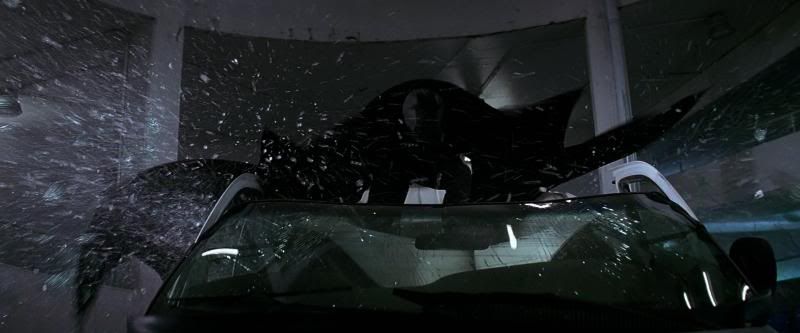
Showing posts with label The Prestige. Show all posts

Sunday, October 6, 2013

Legerdemain of the Dark Knight IV - Coin Tricks and Cartomancy


"- but his face deep scars of thunder had entrenched-"
-John Milton describing Lucifer in Paradise Lost

This article is a continuation of the Legerdemain series and benefits from reading the previous three installments. You might also want to read Bat Time, Bat Channel and This Joke Isn't Funny parts 1 and 2.  It has been five years since The Dark Knight was released, so I have no qualms about spoiling this movie.  It's not a synopsis anyway, but still, if you haven't seen The Dark Knight then you really have missed one of the greatest achievements of film making and performance of , well, of all time really.  Go watch it right now.  If you have already seen it, you probably should see it again.

I could talk about this movie forever and I probably will be.  It is deep and it is great and there is much, much for consideration here.  Seriously, fantasy film is the art form of the masses of the early 21st century, and there are few works that achieve these heights.  I called Batman Begins "Batman Sublime," and The Dark Knight Rises is excellent as well.  But The Dark Knight?  This is a different animal altogether.  If those other films are angels in the form of films, The Dark Knight is an archangel.  One with deep scars of thunder.  Let's take a look at some of what lies beneath the top level of this particular magic trick.


The Dark Knight is about duality, hoax building, initiatory process, sovereignty personification, and more than anything, sacrifice, on many, many levels.  This promotional piece featuring the three main figures quite overtly broadcasts an occult manifesto.  Totemic items are displayed obscuring one eye.  Odin, the Norse equivalent of Thoth/Mercury/Hermes, sacrificed an eye for a drink from the well of knowledge.  Horus, the avenging, solar messiah of ancient Egypt, lost his left eye in battle with Set.  When his eye was later restored he sacrificed it again in hopes of restoring Osiris to life.  You might be thinking now that these characters are covering their right eyes, and that's true, if we are a spectator looking them in the face.  But might we be being cast in a reflective position (correcting, of course, the lettering on the pin and card)?  That would be a more interesting view point for these psychological portraits after all.  Note how this image equivilates these three rather than differentiates.

That there is a sacrificial theme to this story is inherent in the title alone.  The Knight is a very common motif representing a transformative ordeal, a quest, that leads towards a perfected state.  Just think of the Knights questing for the Holy Grail.  It hardly needs explaining then that the Knight partaking in this quest represents the initiate.  A Dark Knight symbolizes expiation and sacrifice, tribulations of sin and periods of obscurity on the path towards heightened consciousness or a higher level of being.  This is an important concept to keep in mind.  The White Knight, by contrast, stands for purity and illumination.  The White Knight is the "Chosen One."  Harvey Dent is presented and even described in the film as a "White Knight" as opposed to Batman's Dark Knight.  But, huh, which of the major figures of this movie is overtly white?  One of Heath Ledger's early major roles was in the 2001 film A Knight's Tale.  The strangely anachronistic  A Knight's Tale is overtly initiatory.  It is also about the perpetuation of a hoax, as Ledger's character is a commoner masquerading as a noble.

Yes, the real star of The Dark Knight is Heath Ledger's Joker.  It is very interesting to see how much charisma this villain of villains exudes, especially in comparison to Bale's Batman.  Don't get me wrong.  Bale produces charisma on command at the necessary story beats.  Certainly the lack of personality is a storytelling, character-driven choice, representing the insular nature of an armored, hoax perpetuator operating as a living symbol.   At any rate, the Joker steals the show.  It's kind of what he does.
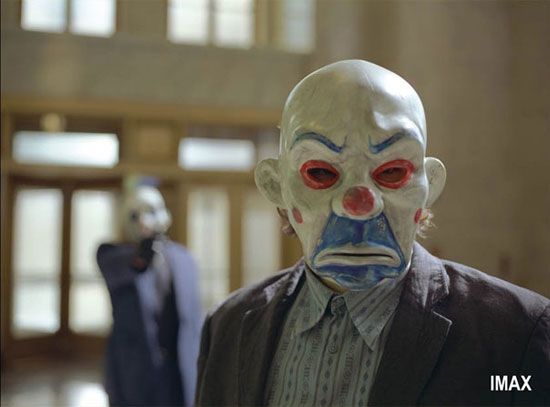

The movie begins with a brazen bank heist orchestrated by the Joker.  And its done so with very deliberately utilized masks, which of course, as a Batman film, is a major symbolic item.  A mask in a visual work represents illusion and concealment, key components to magic tricks and sleights of hand.  It also stands for transformation, being equivalent to the chrysalis, and it confers a magical character.  Of course metaphorical masks are necessary for the performance of con-jobs and hoaxes.  The use of masks in plays evolved from activities of the ancient Dionysian Mysteries.  This led to their use in sacred plays as representing the supernatural forces of deities and the inner psychology of characters normally hidden.  And they still do.  The origins of theater seem to stem from the worship of Dionysus.  There's a long but direct stream (an Underground Stream) through history to every item of contemporary popular culture.  Just think of how important the Mask is to the comic book hero, particularly the Batman.  This is a Dionysian device.  These works, whether they know it or not, are an expression of his Mystery.

And these masks are clowns because this is a Joker operation.  The Joker is a clown.  The Clown is the equivalent of the Fool, and of course the modern playing card Joker is the equivalent of the Tarot trump The Fool.  The Fool is the initiate's card, the status of the seeker at the onset of his/her process of enlightenment.  The Fool is the Ain Soph of the Kabbala, the unknowable, primary cause.  The Clown/Fool is the opposite of the King (keeping in mind that Batman is the self-described King of Clubs).  The King represents order and the Fool represents chaos, and this is very apparent in the presentation of these characters.  This is the essential duality of this story, and one represented in many ways throughout the film.  The Clown/Fool is also emblematic of unregenerate man, and this is an aspect certainly readable in this presentation of the Joker.  Most importantly, the Fool is a symbol of sacrifice.  In past cultures where the sovereignty of the king was felt to have direct correlation to the fecundity of the land, there were times when it was deemed necessary to sacrifice him for the common good.  Kings don't like to be sacrificed, of course, and a system developed wherein the lowest member of the court was substituted.  Or so the mechanism is described.  Heath Ledger's first listed role on Wikipedia is a 1991 Australian film called Clowning Around.

It is not overtly presented in the film but reading the Nolan brothers' script for The Dark Knight reveals an interesting aspect of the bank heist.  The assumed identities of these hired criminals, obviously strangers to one another in the manner of Resevoir Dogs, are Bozo (that's the Joker seen above), Chuckles, the unnamed bus driver, and then Dopey, Grumpy and Happy.  The use of the Disney dwarf names might seem a simple throw away, but it is suggestive of a system of seven.  Seven is a complete cycle, the days of the week and the days of Creation, both of which derive from the seven observable planets in a geocentric model.

But wait.  There's only six actual robbers involved. Yes and no.  The robbers don't realize that Bozo is the Joker.  They talk about the Joker as the mastermind of the operation and as an additional share.  So an alter-ego, a duality, a hoax, a trick, creates the extra figure.  The bus driver is unnamed and unseen, and so he must be Bashful.  The brains of the outfit, the obvious leader?  That sounds like Doc.
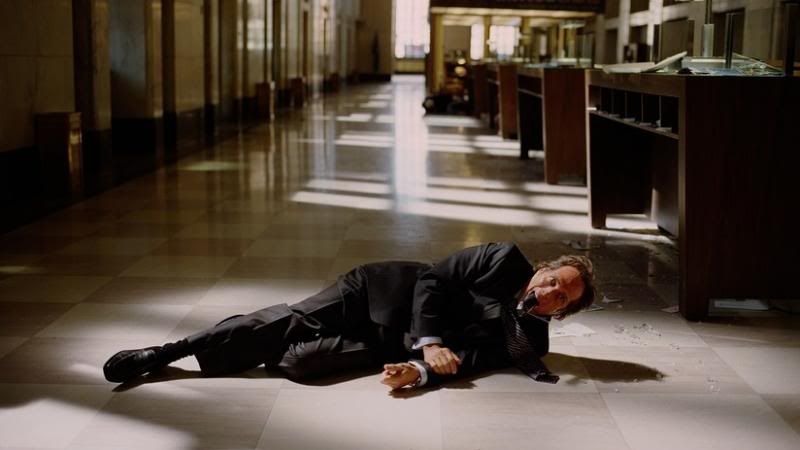

Here is Doc Joker teaching the mob-tied, criminal bank manager a lesson.  Note the checkerboard floor.  The Nolan films are rife with this symbol of initiatory process (I discuss checkerboard symbolism to great extent in Illuminating Harry Potter I: Romancing the Stone amongst other articles).  Put simply, it is the interplay of dualities, positive and negative, night and day, solar and lunar, male and female.  The tensions of these polarities controls the inherent irrationality by placing it within a strict, governed order.  We see these interplays throughout this movie in many different forms, obvious and covert.  The actual bi-colored grid is in place at very key moments that I will point out as this article progresses.  They are all directly related to initiatory steps enacted by the Joker.  This bank heist, the first step in the Joker's elaborate, criminal act of performance magic, is stage one.  The subject is Gotham City.  Note that the Harlequin, which is the exact equal of the Clown and the Fool, is traditionally garbed in a checker-pattern.

Is a Tarot analogy a stretch?  Even if it weren't deliberate, a perceived symbolic content carries meaning even without the author's intent.  This is one of the major themes of this blog.  In this case I am certain the Tarot is being utilized quite purposefully as the story tellers tip their hat to this fact at the end of the scene (and far more overtly further on).  The Joker makes a clean get away driving a bus marked "District 22."  There are 22 Tarot trump cards.  At the outset The Dark Knight is slyly declared as a work of cartomancy.
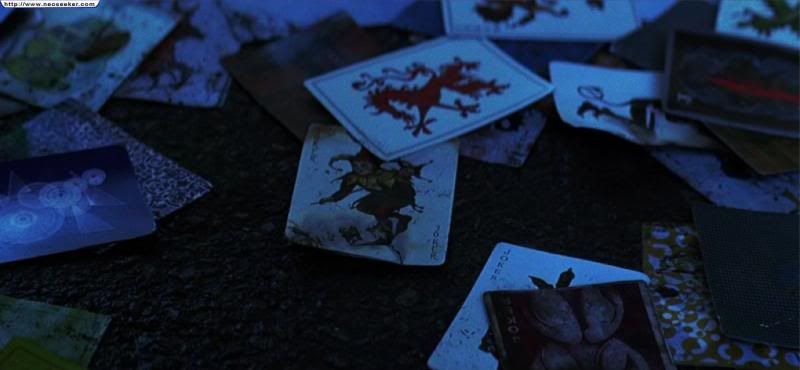

Let's talk a little bit about cards.  The above still is a shot of the hundreds of Joker cards that litter the street after he blows up the judge's car.  Note the geometric circles and triangles on the card to your far left.  Without being able to specifically identify it, it looks like alchemical or Rosicrucian diagrams.  The kind of thing you might find in a Manly P. Hall book.  Hall was a genius of card (symbolism) tricks.  Hall points out that in the two color scheme of cards we again find our dualistic patterning.  There are thirteen cards of each suit which represent the thirteen lunar months of the year.  That the 52 cards equal 52 weeks is easy enough to see.  If you count the Jacks, Queens and Kings as 11, 12 and 13 then all the pips equal 364.  If you add the Joker you get 365.  The twelve court cards stand for the zodiac, which is always about time and timing.  Timing is key to magic.  Note how integral proper timing is to every major action enacted by the Joker throughout this film.  This magician characteristic is not hidden.
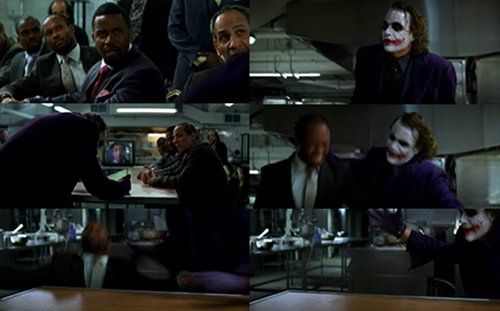
 
Ta da!  The disappearing pencil trick.  The Joker is very much presented as a Magician in this film.  And Batman has already been presented as a Magician.  They are hoax builders at war.  This is the same central core as The Prestige. A striking example of the importance of timing in Batman's actions occurs in his first scene in this film, when he jumps down the spiral ramp of the parking garage onto the roof of a moving van. 
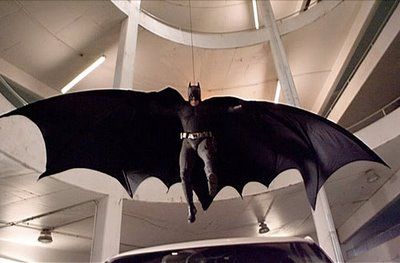

Let's take a moment to consider some of the connotations of the Bat.  As a double-natured entity, as a mouse/bird, the Bat's alchemical symbolism is related to that of the androgyne. It's the Two-in-One, a duality personified.  In many cultures the Bat has stood for Vigilance, and that's fully appropriate here.  More commonly it represents superstition, fear, death and madness, something Francisco (that's fun to say, Francisco) Goya certainly understood.
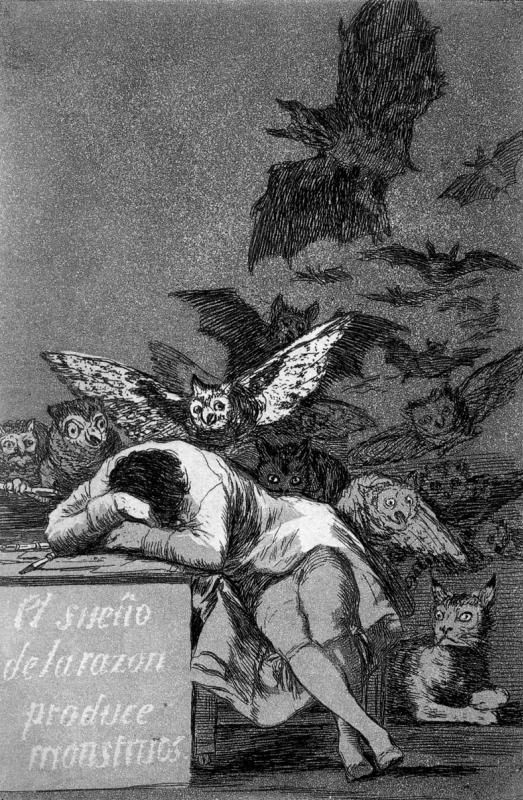
The Sleep of Reason Produces Monsters, Francisco Goya, c. 1799.


Which in its way depicts the essential plot of this film and the next one.  Bruce Wayne's dream of bringing rational order to Gotham results in a costumed psychopath arms race.  The full epigraph for this etching is really perfect: "Fantasy abandoned by reason produces impossible monsters: united with her, she is the mother of the arts and the origin of their marvels."  Testify Francisco.

The parking garage scene features a reappearance of Cillian Murphy's Scarecrow, a figure that is both Dionysiac and sacrificial (usually by fire, an important symbol set we'll return to).
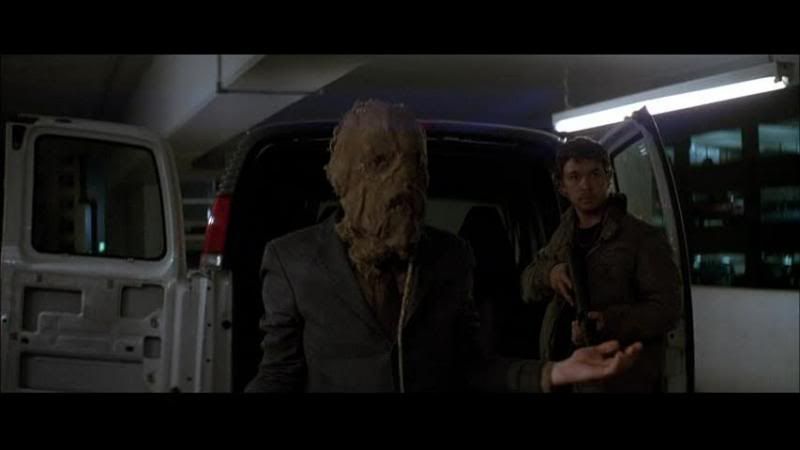

When criminally operative the Scarecrow appears masked.  I'm certain Dr. Crane, in this version of the character, could talk all about the psychological symbolism of the Mask.  Jungian archetypes, you know?  
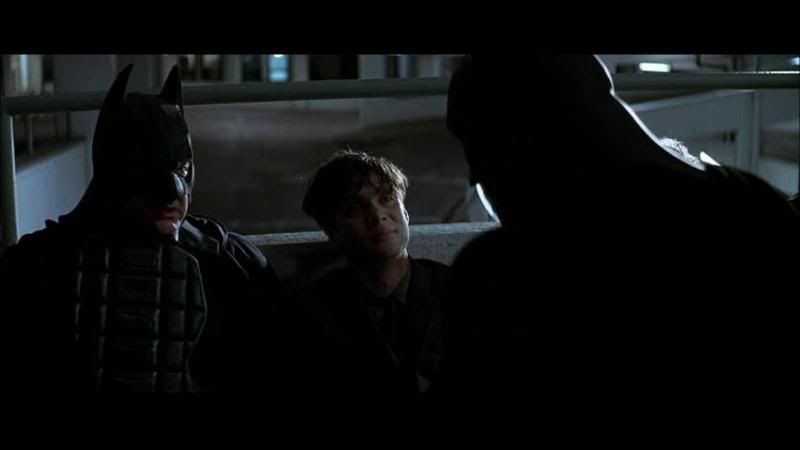

Once defeated his mask is removed.  Unmasking is is an integral aspect of this story, the undoing of all the symbolic connotations described above.  Unmasking is an unveiling, the exposure of the hoax, the undoing of the opponent's magic spells.  This still also shows the most prominent of the false Batmans that appear in this scene.  Duplicates, doubles, false figures.  Think about The Prestige.
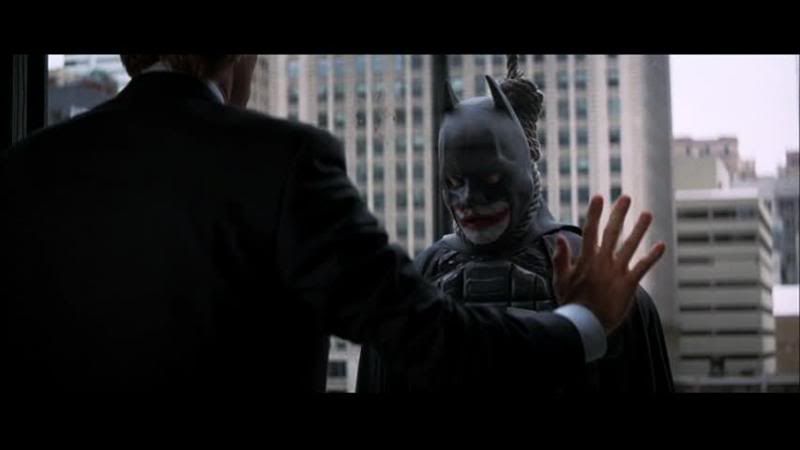

And about how these duplicate figures need to get sacrificed in magic acts.  We'll talk about the significance of the Hanged Man later.  Note how the Joker and Batman are combined here, the synthesis of opposites.
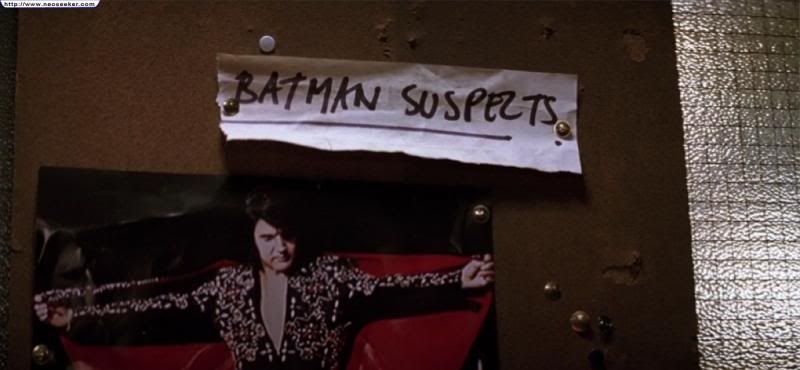

The hoaxing nature of the Batman is alluded to in the Gotham police department's joking bulletin board of Batman suspects.  Besides Elvis we see Bigfoot and Lincoln, all figures attached to hoaxes and conspiracies. Note the silver grid work.  We'll see this motif more prominently elsewhere. 


Speaking of grid work, the second example of the initiatory checkerboard pattern associated with the Joker's activities occurs when he pretends to be dead in order to get to Gambol.  The floor and the walls are all checkered.  You can see it better in the video then in any still I can find.  This Rising From the Dead scene is of course a major initiatory rite symbol, and one particularly tied to Dionysiac Mysteries.  Here we also have the first of the Joker's explanations for his Glasgow Smile, which is an aspect of his hoax building.  The scene ends with the Joker forcing Gambol's thugs to fight to the death for a position in the Joker's gang, emphasizing the sacrifice theme.  Also note how this is just one of the false deaths/rebirths in this film as James Gordon later fakes his own death to get the drop on the Joker.  What occurs after Gordon's "rebirth?"  He achieves a higher rank/reaches a more elevated position as he is named the new police commissioner of Gotham City.
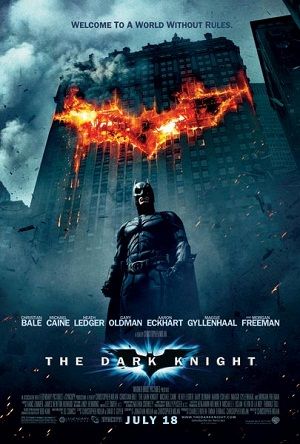

The primary poster for The Dark Knight combines two of the major symbolic devices of the film, those of Fire and the Tower.  Together they formulate a very clear depiction of Tarot Trump sixteen, the Tower Struck by Lightning, aka Le Feu du Ciel/The Fire of Heaven.  Seriously, if there were a Tarot deck combining popular super  heroes with modern day terror anxieties, this would be card sixteen.  Batman is positioned directly before the tower, like a column, repeating its format, identifying him with the structure of the city.  This is fully appropriate as the Tower of Trump sixteen is representative of  the human form.  The enigma of the Tower card relates to the fall of man and the devastating consequence of over confidence.  This happens to describe the Joker's objectives in this film.  "Welcome To A World Without Rules" is essentially a reading of the aftermath of Trump sixteen's symbolism.

The Tower is also quite overtly used as a symbol of Bruce Wayne/Batman in this movie.  His mansion having been destroyed by Ras al Ghul in Batman Begins, Batman is operating out of the tower of his corporate headquarters.  There's an implied movement here between the films from the maternal cave to the paternal tower (and back again in the third film).  The Cave is primordial shelter, and as an easy to read womb symbol representative of birth/rebirth.  It is emblematic of the unconscious mind and associated in many legends with gods and heroes.  The Tower is about ascent and vigilance, as well as the aristocratic nature Batman can never remove himself from, as it looms above the common level.  While it is overtly phallic it is yet another item of combined duality.  The protective nature of the Tower is a feminine quality, associating it with the Virgin.  This is seen in many stories and legends.  Just think about Rapunzel.
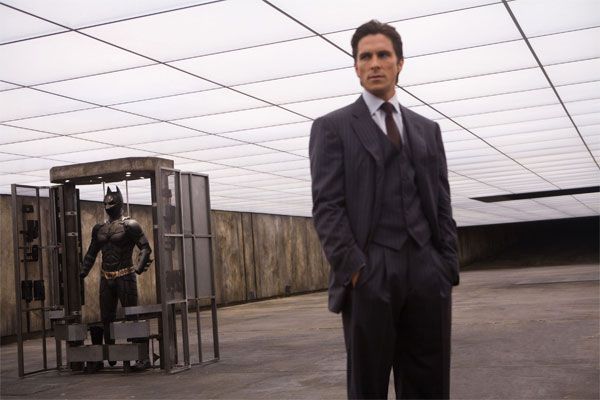

Here we see Bruce Wayne within a cave within his Tower.  The complex encasement of his costume is intriguing.  The arms of the Knight stand for symbolic potentialities.  There is an article unto itself in examining the symbolic significance in the equipment of Batman and the Joker.  But I include this still to display the striking ceiling used for Batman's secret headquarters.  Notice we again have a single-tone grid in place associated with Batman.  Its illuminated, as the grid on the police bulletin board is light reflective.  So this is a system, a grid work, implying activity and development, but its not dualistic in these instances.  Batman's essential initiation took place in Batman Begins.  He's acts in this movie from a more elevated status, with a level of enlightenment.  Note his desire to move up, and out, from this level and unite with Rachel Dawes, leaving it to Harvey Dent.   
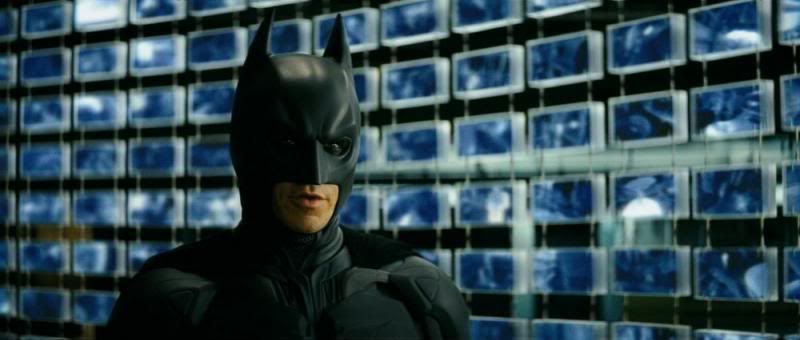
And another luminescent grid work associated with Batman/Bruce Wayne.  This one is crafted by Lucius Fox (the light-bringing Promethean) and confers upon Batman a heightened sensory awareness of his city, confirming his role of sovereignty figure.  This is truly what Batman and the Joker are fighting for in this story.  Harvey Dent as well.
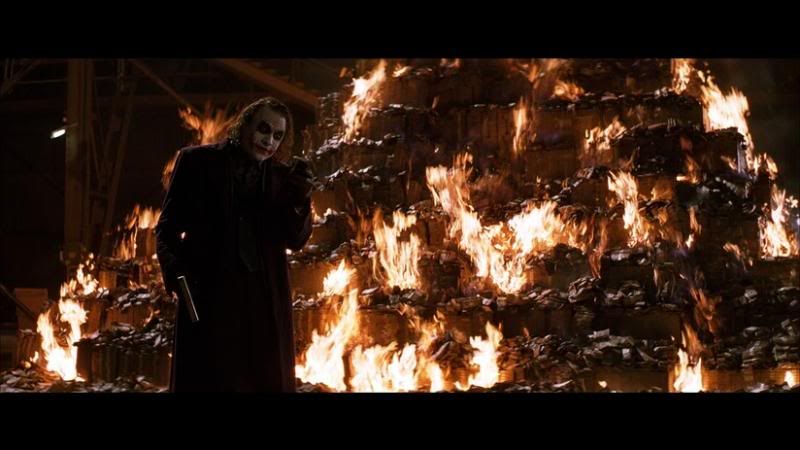

Here's another prominent combination of the Tower and Fire from the scene where the Joker demonstrates that his objectives are in no way material.  If I had to choose one symbolic device that was most relevant to The Dark Knight it would have to be Fire.  The first words of the Nolans' script are "Burning.  Massive Flames".  Interestingly the fire we see as the film opens are blue.  I used to keep a catalog of blue entities from popular culture here.  I did not bring that back with the resurrection of this blog, but the color Blue has a great deal of important connotations.  Blue represents the intellect and divinity (the latter the primary reason for all those blue people).  It is an attribute of Jupiter and Juno, and many other Sky Gods.  As a color used in the visual arts it is very functional as a visible darkness.  And while in ancient Egypt the color Blue represented Truth, it simultaneously represents Mystery and Deception.  The synthesis of opposites occurs here on many levels.

Fire is Divine Energy.  It is spiritual passion, purification, revelation, regeneration.  It is the medium for conveying messages to the heavens.  It is (again) dual natured, divine and demonic, creative and destructive, intellectual and emotional. It is a device of ritual sacrifice and a common means of Christian martyrdom.  It is the central element of alchemy.  Fire is traditionally associated with Trickster Gods like Prometheus and Loki. Let me underline here how this version of the Joker and Loki are the same figure.  There are many articles at this site delineating Promethean characters.  The Joker and Loki are in that camp, retrograde.

According to Gaston Bachelard's Psychoanalysis of Fire, it is "-the archetypal image of phenomena in themselves".  That's a bit of a hard concept to parse,  but the basic idea is that experiential existence is like the visible and tactile energy of something burning.  I'm still thinking about that one.  Existence is a kind of release of energies.  Think about the origins of the universe starting with a big explosion. 

Even more on target than Loki or Prometheus is the association  with Lucifer, as I suggest with the Milton quote at the top of the page.  Hall recounts a story told by 18th century alchemy scholar Georgius von Welling that the material universe was created accidentally by Lucifer's misuse of the Schamayim, the Divine Fire.  Here's the most prominent Joker card utilized in the film to hammer home this association.
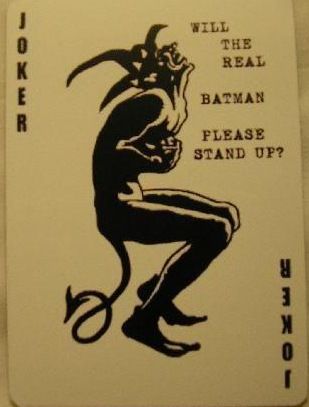

These cards are deployed to the potential victims of the Joker's triple murder plot.  The judge is killed by fire.  Fire in this context is about the Luciferian desire to annihilate time and bring all things to the end. This is what is meant by the key line of dialog for this film, when Alfred, speaking on how Wayne doesn't fully understand the Joker, states "Some men just want to watch the world burn".


It is by Fire that Rachel Dawes is murdered (sacrificed) and  Harvey Dent is turned into Two Face.  Note the floor Harvey's face is lying upon as it is half submerged in gasoline.
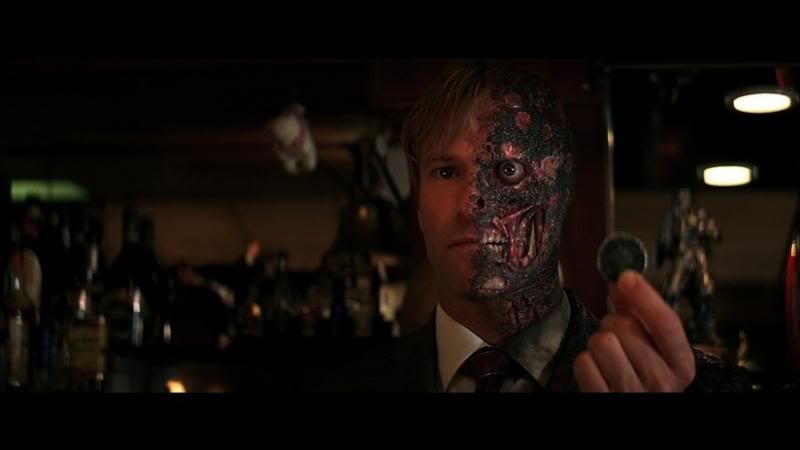

Here's Two-Face.  All this talk of duality and combined dualities?  That's overtly inherent in every iteration of this character.  I talk in Illuminating Harry Potter about the Roman god Janus (when discussing Prof. Quirrell and Voldemort).  Here he is again.  Janus is the god of thresholds and beginnings, exits and endings.  He is representative of acts of inversion and mutual sacrifice.  He is the transmitter of the knowledge of the law and of agriculture (that's sowing and reaping).
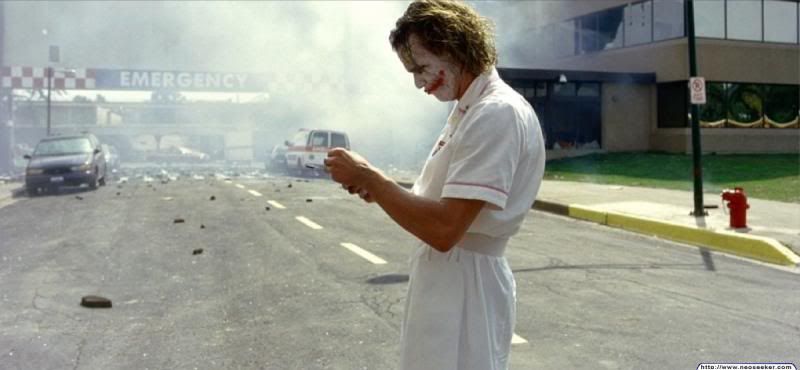

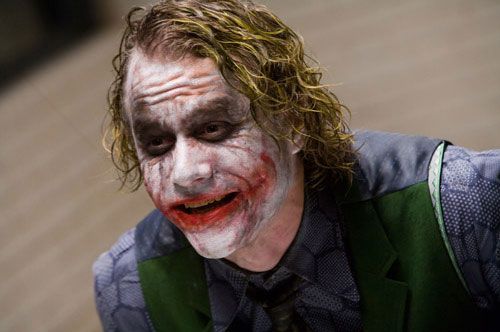
And when the Joker sets Two-Face, his initiate, loose on the city?  There's fire.  And there's a checkerboard.  And this vital stage of initiation involves a cross-dressing Joker, a synthesis of Randall Patrick McMurphy and Nurse Ratched, the union of opposites.  The androgyne or hermaphrodite is symbolically alchemy's coincidentia oppositorum, the incarnation of the Great Work.  It is the same meaning as a head with two faces, interestingly enough.  For this reason the androgyne is a common figure for conducting an initiation ceremony.  Now take a look at the very first image of this article and note the hexagon pattern of the Joker's shirt.  A hexagon is a six sided figure.  Six represents unity and equilibrium.  Why?  Because the hexagram is the combination of an upward pointing male triangle, and a downward pointing female triangle. It's an androgyne. 
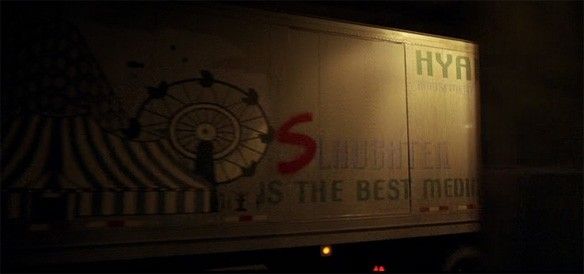

Here is the Joker's vandalized circus truck.  The word circus is related to the word circle, due to the shape of the performance area.  Circuses almost always involve animal acts.  A circle of animals is a manner of referring to the zodiac.  Every media use of circus can esoterically relate to the zodiac.  This is a key point.  The zodiac is important due to the precession of the equinox, a grand scale matter of astronomical timing, the shifting of ages (golden, silver, bronze, iron) which is allegorized in many, many places as stories about the end of the world.  We are living in the shifting from the Age of Pisces to the Age of Aquarius.  And think how popular apocalyptic stories are right now.  This harrowing scene starts with a burning fire truck, a pun by the Joker, and another deployment of Fire symbolism associated with him. 

Does this seem like a lot to extrapolate from the graphics on the side of a truck?  This is what esoteric symbolism is all about.  In this case the above is emphasized by the black and white  initiatory patterned tent, and the Ferris wheel, a circle, and one that looks like a sun burst and an eye.  A single eye emitting a black beam or sitting atop a column.  Now that I'm saying it, try not to see that Ferris wheel as a stylized Eye of Sauron.  Return, if you like, to the obscured eye image at the start of the article.  What is alchemy's Great Work?  Turning base metal into gold.  But that's an allegory.  The basis of mythology is astronomy.  It's time keeping.  It's a turning that's a returning, back to the start of the circle, iron into gold.
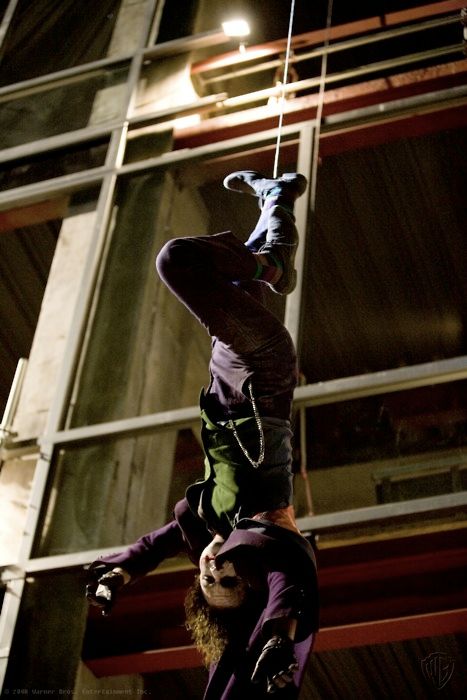

In his last act, the Joker has a failed use of fire involving the two ferries in a Prisoner's Dilemma  scenario, and creates a hoax that Batman uses his enlightened senses to see through involving masking hostages as Clowns and his thugs as Doctors.  As I contend in the Doctoring Art Gotic articles, Doctors are the teachers of the Invisible College.  Batman gets caught in a net (a grid-structure of the visible and invisible, and a symbol of magical authority) prior to the Joker being displayed as Tarot trump twelve, The Hanged Man.  The symbolism of this card is overtly sacrificial, and once again Odinic.  It represents expiation, inversion and realignment.  And what does The Hanged Man predict?  The elevated Batman's Fall, generating a new hoax wherein he takes responsibility for the murders committed by Two-Face, an act of expiation, and the Dark Knight entering into obscurity. 

How interesting that in the Tim Burton Batman movie the Joker also hangs before falling (from a tower, weighed down by a statue of the Devil).  In The Dark Knight the Joker lives but Two-Face dies in a Fall.  Joel Schumacher's Two-Face also dies from a Fall.  The Dark Knight is Ledger's last full role.  He half finished Terry Gilliam's The Imaginarium of Doctor Parnassus.  He enters that story as a hanged man, where his Joker role left off.  Inverted.
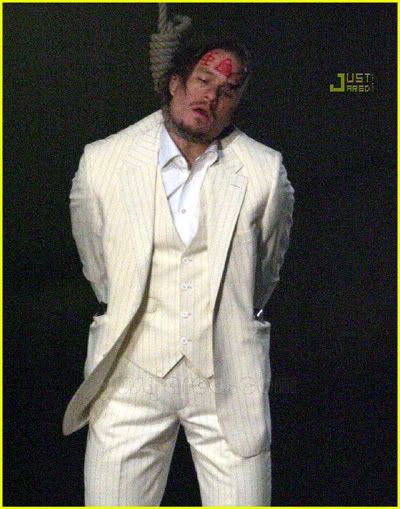


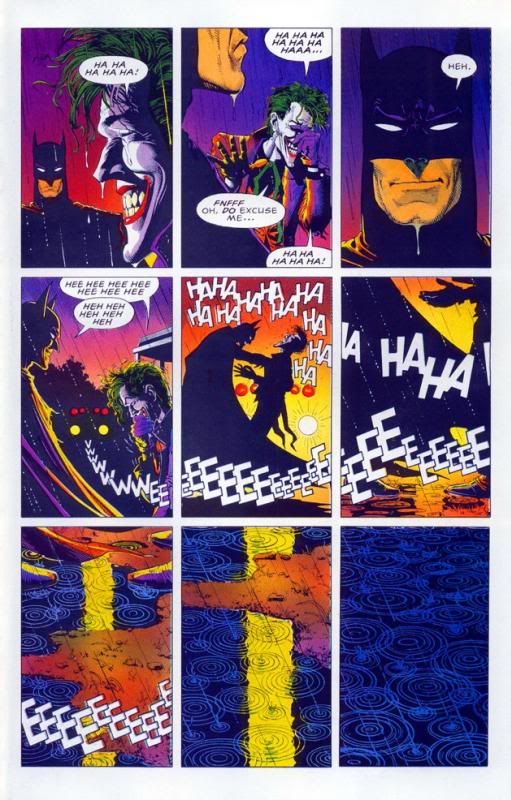
The Joker dies, the Joker lives, the Joker dies, the Joker lives.  The subject of this article is a few years gone by now.  This doesn't really make it more comfortable to talk about though.  And, though not nearly as prominently, this matter of the Joker's living and dying and living, and the questions about it all, have become topical again due to an interview comic book writer and so-called chaos-magician Grant Morrison gave to Kevin Smith where Morrison makes a claim regarding what is highly regarded as the best Joker comic book story ever produced, The Killing Joke.  The Killing Joke is by another self-professed comic book writer/magician, Alan Moore and the amazing Brian Bolland.  It involves the Joker shooting and paralyzing Barbara Gordon, who is secretly Batgirl, and photographing her naked, wounded body (and possibly raping her) with the intent of driving Commissioner Gordon insane.  It ends like this:

art by Brian Bolland


With the Batman and the Joker sharing a laugh at a joke as the police arrive.  Some comic readers find this scene, read straight, as touching, though I am not amongst their ranks. Morrison contends that it was Moore's intent to suggest, though not overtly, that Batman kills the Joker.  And I agree.  I always thought this was being suggested.  I mean, look, the light goes out in the last panel.  The line separating the two of them disappears.  Batman proves the Joker is right by breaking his cardinal rule and killing the Joker.  And this was really the Joker's purpose because his existence is a misery.  However, this is fiction.  It is only so much about the author's intent.  There is no inherent truth, which means that both endings are simultaneously true.  And false.  Morrison fully realizes this I'm sure.  Smith might as well.  Note that Morrison has in his recent career killed and resurrected Batman, killed the latest Robin who is the son of Batman and Talia al Ghul, not to mention killed and resurrected Superman as the heart of the sun.  What is death in comics?  It is a symbol system.  It is a motif of exit and entrance.  It is about resurrection.  Always. 

Saturday, September 14, 2013

Legerdemain of the Dark Knight III - The Prestige

I would have liked to have been able to write about "The Prestige" without spoiling it for individuals who have not yet seen the film, but to do so would mean dealing with the piece in the most cursory of ways, which wouldn't really do us any good. It's been out for a year and a half now, it's available on DVD for rental or purchase, and they're playing it regularly on Starz, so I figure it's in fair play. But if you haven't seen "The Prestige" yet, stop reading this article and watch it. Watch it Twice.
Photobucket

Of chief interest here is the relationship between "The Prestige", "Batman Begins" and the upcoming "The Dark Knight", envisioning this trio of Nolan/Bale/Caine films as a secret trilogy. When I first viewed "Batman Begins" I thought it was well done, but it was viewing "The Prestige" that made me realize just how sophisticated Nolan's treatment of Batman really was. Likewise, I'm theorizing that "The Prestige" equips us/sets us up for the next act of this presentation.

Part I of this article detailed the components utilized to synthesize the Nolan take on the Batman mythos, while Part II examined the presentation of the film itself, and its application of esoteric symbolism as a work about Mystery Initiation. As we should expect we find this pattern continue into "The Prestige", apparent in the poster above, which uses visual imagery in a manner that succinctly denotes the content of this film. The two magicians, mirror images of one another, positioned in opposition before an initiatory checkerboard pattern presented as a spiral, creating a work of Op Art. This is a very direct and simple statement of intent by the film makers, namely that they are purposefully playing tricks with your eyes. Note that this is a left-turning or downward spiral, an emblem of destruction.

There is a wonderful enigmatic quality to "The Prestige", leaving the final pieces of the puzzle to the viewer to fit into place. Naturally there was some debate over what was depicted in the film. Because, if the secret has been kept, the standard reaction to what we see is stunning, not because of its thematic implications, but because of the unexpected disruption of what we're conditioned to believe are the conventions of genre works. What seems to be a psychological thriller and a period piece, is suddenly resolved as a work of science fiction.

Of course debating the matter resolves absolutely nothing. There is no answer beyond what is presented on the screen. This is because of a simple matter that actually confirms the over riding point of this series of articles. Art is magic, and the execution of a work of art is a magic trick. In the supporting material included with the DVD of "The Prestige", director/co-writer Christopher Nolan states that "The Prestige" is "-about film making". It could not be stated any more plainly then that. With "The Prestige" Nolan is identifying film with illusionistic magic/sleight-of-hand/prestidigitation/legerdemain. Naturally this is an attitude that must extend to his other works, including the films that bookend this movie, "Batman Begins" and "The Dark Knight". Here's the more familiar poster of the film, Bale and Jackman facing away from one another, separated by Johannson as blue smoke.

Photobucket

"Are you watching closely?"

It's the first line of the film, a question asked of the viewer in a voice over by Christian Bale as Alfred Borden. Immediately following Michael Caine's character, John Cutter (a name suggestive of the story of John the Baptist) presents the three steps involved with the presentation, the selling, of an act of illusionistic magic, the Pledge, the Turn and the Prestige as we've already discussed. Further, these three steps work nicely as a reference to a three step initiation process, as the art of stage magic is utilized as a metaphor for Mystery itself (and we could further muse that a story detailing the conflict between two individuals cognizant of a Secret Tradition says essentially the same thing as "Night Watch" in a different way).

As these voice overs take place we're presented with images from throughout the film that is to come, because this is the Pledge, and the magician is showing us the props he's going to use. Predominantly we see Cutter and a young girl to whom he's showing a disappearing Bird trick. The room is full of Birds, canaries in cages. If you've been reading this series on the esoteric Batman, and Inside The Cosmic Cube in general, you know how pertinent I find a film of this nature that opens with Birds. The Secret Language is being spoken, and of course it is in this movie. In "The Prestige" there is an exoteric symbolic association made between Caged Birds , certain characters within the film in specific instances, and in general to the "Man in the box", the figure or item in a magic trick who disappears as compared to that which the audience sees reappear, the subject of the Prestige. Because it is the reappearance, the Prestige, that completes the equation, and allows the full emotional reaction of the viewer to be experienced. This is an artist/audience dynamic shared by legerdemain, theater and film, comic books, and sometimes music, as the process involves an experience through time. Also, we might note, that the Caged Birds further signify the audience itself, as the viewer's sensory experience is completely at the mercy of the presenter. We are Caged, our perspective is locked, and there's nothing we can do about it.

Photobucket

As Cutter presents his trick we see a man (Alfred Borden played by Christian Bale) sneaking backstage at a magic show, removing a Disguise along the way. False identities, alter egos and disguises are as important to "The Prestige" as they are to "Batman Begins". We see a Blind stagehand, a clever way to emphasize the preservation of a Secret as the detail of most fundamental importance, a literal device in the course of the story, and figurative, especially as an image emphasized here at the beginning, during the Pledge. We then follow Borden as he discovers another man (Robert Angier/Hugh Jackman) trapped in a water tank. Both men seemed surprised, but the tank is locked, and Angier drowns.

Photobucket

Note the strange interaction we find at a synchronistic level relating water and caskets between these works, the deadly Water Tank used throughout "The Prestige", the Coffin-shaped Batmobile from "Batman Begins" that enters the Underworld through a Waterfall (racing against the clock to save Rachel Dawes from Drowning in her fear), and even Morgan Freeman, at least thirty years ago, on "The Electric Company" (which is likewise oddly significant to "The Prestige" as you know because you've seen it, right?), playing a Vampire, a Dionysian Bat-Man, in the truly strange act of taking a Bath in a Casket. Is it just me? These symbols together are Birth and Death. Water of course is further symbolic of Rebirth. The combination of Death and Rebirth then emphasizes the Cycle of the process.

Borden is caught backstage on the scene by Cutter, who instantly accuses Borden of orchestrating Angier's death. Borden is tried and, largely on the testimony of Cutter, sentenced for the murder of Robert Angier to death by hanging. We then see Borden in Prison. Note how this parallels the opening sequence of "Batman Begins", both presented out of linear chronology, with characters played by the same actor. Borden, whose prison ID tag is labeled "D 23" for fans of the Law of Fives, meets with a lawyer representing a Lord Caldlow, who is interested in purchasing the condemned illusionist's secrets, specifically offering to provide for Borden's daughter's future in exchange. The lawyer, Owens (played by Roger Rees, who is perhaps most famous for his recurring role on the sitcom "Cheers" as the aristocratic Robin Colcord, and as the Sheriff of Rottingham in Mel Brooks' "Robin Hood: Men In Tights", primarily a parody of "Robin Hood: Prince of Thieves" which featured Morgan Freeman) suggests that Borden himself is "-no stranger to the Workhouse", meaning Borden is himself an orphan, another trait he shares with Bruce Wayne, and many other presentations of the Hero's Journey. Note here that just as in "Batman Begins", Bale's character is imprisoned, and in jail offered a bargain he can't refuse.

As a gesture of good faith Owens presents Borden with Angier's journal. This device, of narratives presented from portions of the characters' personal writings, is adopted from the novel the film is based upon by Christopher Priest, which is entirely epistolary. This allows for an unusual but potent storytelling technique for a movie, that the narrative, or portions of the narrative, is unreliable, especially so as Borden and Angier are engaged in their complex, long-term battle of wits, in which a false testimony might be planted in their writings to purposefully mislead their antagonist.

Borden reads Angier's journal, and the narrative follows, now a few years in the past as Angier travels by train to Colorado on a quest, in his own words, "-a cipher, an enigma, a search for answers". Angier is literally on a journey of Enlightenment in the Mountains. Note that Act I of "Batman Begins" likewise introduced imagery of Trains and a Mountain Quest. Angier's destination is Colorado Springs, with a Spring of course being the surfacing point of an Underground Stream. And Angier is in the right place, as the town itself is Illuminated, fully electrified, a quality that was magical in the 1890s. Angier is in Colorado Springs to meet with Nikola Tesla, and Angier must specifically climb up a mountain to meet the real life wizard. At the electrified gate, again an item of magic in this setting and period, Angier meets Tesla's apparently sole assistant, the impish Mr. Alley, played by Andy Serkis. Serkis has played many interesting roles, most notably providing the motion for the computer animated King Kong and Gollum in "The Lord of the Rings" trilogy.

Photobucket

And note how the Gate Keeper, Mr. Alley (an Alley being a way through), is first presented behind an initiatory grid (a magical one at that). Appropriate for his role, he recognizes Angier by his stage name, the Great Danton. Alley states that he saw Danton's act Seven times, and was impressed that Danton could guess every object in the audience's pockets. Interesting that this is the question that Golem could not answer when he and Bilbo played Riddles in the Dark in "The Hobbit", in a maze-like Underworld shared with the Goblin King. "What have I got in my pocket?", asked Bilbo. Golem couldn't guess, but the answer was of course the Ring. Alley denies Angier entrance to Tesla (cast perfectly with David Bowie, the Goblin King of "Labyrinth"). As Angier leaves Alley asks Angier to guess what he's holding. Angier correctly answers that it is Alley's Watch. Time and timing are fundamental to this and all acts of magic.

Back at his hotel Angier reads from Borden's encoded journal, and the narrative shifts back once more, several years this time, to when Borden and Angier were both working as ringers for Milton the Magician during his performances in London at the Orpheum Theater. The Orpheum is a very common and traditional name for a theater, and is of course a reference to of Orpheus, a major Mystery Rite figure with key decapitation symbolism associated with his mythology.

We see Milton performing his top act, the Crystal Water Cage, before a backdrop featuring the image of a Triumphal Arch on the stage backdrop. This is a form seen throughout the film in various places, and an interesting device as a symbol of royalty and triumph in war, and a simple form composed of Twin Columns.

Photobucket

The Twin symbolism is repeated in the stage decoration, which features a pair of water tanks with twin mannequins on either side of the stage, reemphasizing the key nature of the Water Tank trick in Milton's act and to the film in general.

Milton announces the Water Tank trick and calls for volunteers from the audience. The chosen volunteers are of course the ringers, Borden and Angier. Milton's assistant, Judith (Piper Perabo), the woman being placed within the water tank, the actual performer of the trick, is married to Angier. We also see Cutter, at this time Milton's ingénure, in the wings, holding an ax in preparation for something going wrong. Because while this is an illusion there is still inherent danger involved. Borden's job is specifically to tie Judith's hands with a knot she'll be able to slip underwater.

Photobucket

Note the Blue Butterfly Judith wears in her hair for this performance. This is a key indicator of Transformation, and a reference to the story of Psyche. Judith is lowered into the tank, a curtain drops, and Cutter starts a stop watch timing the stunt. The curtain falls to the grounds, and Judith is revealed freed from her bonds and standing beside the tank, the trick a success.

Backstage Cutter, Borden, Angier and Judith discuss Milton and the act, which quickly turns into a philosophical debate between Borden and Angier, specifically regarding dedication and personal sacrifice by the magician for the sake of the act. During this conversation Borden claims to have a trick that can't be topped. Cutter directs the two of them to view the magic show of Chung Ling Soo, and offers the one of them that can determine how Soo pulls off his gold fish bowl trick a meeting with a theater promoter to whom they could pitch an act of their own. It is Borden who is able to see through the mystery, deducing that the feeble, elderly appearance of Chung Ling Soo is a disguise, masking the high level of physicality it would take to pull off his tricks. It is an illusion that Soo must dedicate his entire life to, an alter-ego he must maintain at all times to protect his "secret identity". Borden stresses that maintaining a Secret is the only means to escape solid reality, suggestive that his concept of true magic is transcendence.

This attitude coincides with Borden's working class background, his desire to rise above his station. And this is the key dichotomy presented between Borden and Angier. Following his viewing of Chung Ling Soo we see Angier and Judith, and it is revealed that Robert Angier is itself an assumed name, another secret identity, which he took on in order not to embarrass his family with his theatrical endeavors, suggestive of an upper class background.

Cutter states that Borden also works moving props for a magician named Virgil, and that Cutter hired Borden to steal Virgil's "Orange Trick". Though this trick is never shown or further described its noteworthy that the movie "The Illusionist", the rival 2006 Victorian-era stage magic drama, featured a prominent Orange Trick. We see Virgil perform a disappearing Bird trick, which greatly upsets a young boy in the audience, who believes the bird has been killed. He remains convinced even after the bird is made to reappear. Borden brings the bird to the boy to show him that it is okay, but the boy sees through the trick and asks, "What about his brother?".

This is when Borden meets Sarah (Rebecca Hall), his future wife, the caretaker of the child. Borden calms the boy down by teaching him an act of sleight of hand, a way to make a coin appear to have Two heads, stressing to never let anyone know the Secret, because once you do you're nothing. Later we see Borden removing the carcass of a crushed canary from a hidden panel of Virgil's performance platform. The boy was correct, the disappearing act requires a sacrifice. This is an important statement, demonstrating that the Prestige, the reappearance, can be as much an illusion as the Turn, the disappearance. Virgil's stage set features an Egyptian motif, including a matching pair of pharaoh statues.

Now we see Milton's Crystal Water Cage trick again, but this time it is apparent that Borden ties a knot on Judith's wrists that Cutter was opposed to (though a sleight nod of the head indicates Judith's agreement to Borden's alternate knot). But she's unable to slip it, with her hands bound can't remove herself from the tank, and Judith drowns. At her funeral Borden states that he can't recall which knot he tied, that he's been fighting with himself over the matter, but remains uncertain. This piece of information pushes the already grief stricken Angier over the edge.

One of the consequences of Judith's death on stage is the end of Milton's career. A short time later, after Borden and Sarah have married, we see Borden working small, rowdy venues under the stage name "The Professor", like Doctor, a title that can be utilized in fictional settings to indicate Secret Teachings, as it is the name of an educator of the Invisible (abstract) College. This especially so as this is a stage name only, a false identity. The Professor's top trick is a bullet catch. In Borden's workshop we're introduced to the silent and obscure Mr. Fallon, Borden's Ingénure, and learn that Sarah is pregnant. Borden then demonstrates to Sarah the illusion behind the Bullet Catch trick. The bullet only appears to be placed in the gun, but is actually palmed, the catch entirely mimed. When she expresses disappointment in just how simple it really is, he points out that the trick is still dangerous as the audience member who fires the gun might stick an object or even a real bullet in the gun. In this scene Sarah also states that sometimes Alfred loves her and sometimes he does not, and that she can tell the difference. Note that if the following shot of Borden in his workshop were set in a cave it could be a still from "Batman Begins".

Photobucket

We see a performance of the Bullet Catch by The Professor, but the man chosen from the audience to fire the empty gun is Angier in disguise. He slips a bullet into the gun, points it at Borden and asks him again which knot he tied. Borden still can't answer. Angier fires but Fallon knocks the gun down, the bullet strikes Borden's left hand, ironically he really catches the bullet, and his ring finger and pinky are blown off.

Following this we see Cutter contact Angier, through the strange device of a miniature playing card stuck to the bottom of Angier's glass at a pub. It's hard to rationalize why he makes contact in this unusual manner rather then simply talking to Angier. It is communication through covert symbolism for the sake of covert symbolism. The card Cutter uses appears to be the King of Diamonds, which is also the King of Pentacles or Coins. Pentacles is the suit representing Earth. I find this communicates Cutter's more terrestrial, concrete motivation as compared to Angier and Borden, that of earning money. Cutter wants to get back in the business and needs to work with someone who realizes that the accident with Judith was not Cutter's fault.

The two set forth preparing the act of the Great Danton (a stage name Angier insists upon because it was suggested to him by Judith). They rent a space to use as a workshop, and Cutter hires Olivia (Scarlett Johansson) as Angier's assistant, stressing the important role of a beautiful assistant to act as a Distraction. As Olivia's training is shown we see Cutter place her in a box that would be used to make a magician's assistant disappear. We also see Cutter fitting Angier with a mechanized device to be worn under his clothing that would allow for a non-lethal version of the disappearing Bird trick.

Photobucket

Note the high similarity here to Act II of "Batman Begins" when Alfred and Bruce Wayne set up the Batcave and developed Batman's various devices. It is also interesting how, as seen in the still above, the workshop prominently displays silk flowers, obvious props from the Great Danton's act, that in this instance is suggestive of a False Garden.

Photobucket

Note the Romantic backdrop, columns and arches in ruin, and the Wheel of Fortune on the stage. Difficult to see is Olivia's Rose detailing on her costume and in her hair. Her character is depicted with floral, primarily Rose, emblems throughout the movie. This Disappearing Bird trick, as opposed to Virgil's, involves a Dove held suspended in a cage by two members of the audience. But on the first night of the Great Danton's performance Olivia happens to choose a disguised Borden out of the audience. Angier recognizes Borden too late, Borden springs the collapsible cage, which kills the Dove and breaks fingers of the other audience member. This event causes Angier's booking at the theater to be canceled.

With their top trick spoiled, Cutter sends Angier to a science expo to look for new angles or concepts for the act. Angier attends a lecture of Tesla, where the scientist's dramatic, but not dangerous Tesla coils are shooting electricity throughout the room. The demonstration is canceled due to the perceived, but non-existent danger. We see Tesla's assistant Alley loudly denouncing the cancellation as a part of Thomas Edison's smear campaign against Tesla, introducing the pattern of rivalry as existing between the true wizards as well as the illusionists. Angier sees Borden in the audience and as the hall is cleared out he covertly follows his enemy, witnessing Borden with his young wife and new born child, Jess. Angier sees this as Borden receiving the life that Borden stole from Angier.

Photobucket

Time then moves forward again to Angier's continued efforts to meet with Tesla. Bowie's Tesla is finally introduced, entering dramatically , magically, through a lightning storm of his own generation. Tesla and Angier shake hands, and Tesla demonstrates the human body's ability to act as a conductor, the two of them forming a circuit that lights a bulb, literally an Illuminated handshake, perhaps symbolic of the type of exchange that might take place between strangers who are both cognizant of the same Mysteries.

Photobucket

Tesla warns Angier of the cost of magic, something Angier believes he already knows about, but Tesla agrees to construct a machine for Angier, though it will take time and cost a great deal of money (a factor that is not a concern of the secretly aristocratic Angier). We can note how nicely the figure of Tesla, at this point in his life practically in exile, works as a Promethean character, his role comparable to that of Lucius Fox in "Batman Begins".

While he waits Angier continues to decipher Borden's diary, and we now see the time when Borden revives his career as The Professor, with his top trick now being The Transported Man. The trick involves two cabinets positioned at the far sides of the stage. The Professor bounces a ball, steps into one cabinet, then immediately emerges out of the second cabinet to catch the ball. As we see this act first performed, the introduction by Borden of a higher Secret/magic, we can note the stage decorated with a prominent five-point star.

Photobucket

The general audience for the act is barely responsive to this but Angier is amazed, unable to determine how Borden is pulling off the illusion. Cutter insists that Borden must be using a double, but Angier disagrees. Olivia sides with Angier, noting that both the disappearing and appearing man are wearing a padded glove to hide his missing fingers. The trick is brilliant, but Borden lacks the showmanship to successfully engage the audience with it. Angier decides to steal Borden's trick, but the only way Cutter can conceive of doing so is by hiring a double for the Great Danton.

It is Olivia who locates the drunkard, washed-up actor Gerald Root, a near double of Angier (also played by Jackman, but with enough cosmetic distinction made for the viewer to tell the difference).

Photobucket

When Angier questions whether the constantly inebriated Root can pull off the act, Root demonstrates his ability to mimic the stage manner of the Great Danton, afterwards emphasizing the simplicity of it as in the past he had played such figures as Cesar and Faust.

The Great Danton introduces the act, blatantly called "The New Transported Man", describing to the audience the magic involved being a "technique from the orient" known to certain "Himalayan Holy Men". Angier and Cutter's version of the trick involves two free standing doors. Danton throws his top hat, opens one door, which masks him dropping beneath the stage through a trap door while simultaneously a lift raises Root to appear through the other door in time to catch the hat. The audience loves the act, but the downside is Angier is left under the stage during the Prestige, and does not personally receive the audience's applause. This merely furthers Angier's desire to learn Borden's secret. To this end, despite the success of the act, he sends Olivia to work as Borden's assistant and act as his spy. Olivia is hurt by this callous treatment, but she agrees.

In order to get Borden to trust her, Angier instructs Olivia to tell Borden the truth, which she does, describing how Angier performs the Transported Man (something Borden had already deduced), how Angier was obsessed with learning Borden's secret and sent her as a spy. But she points out to Borden that his act lacks style and he could use her help in selling the trick to the audience. With Olivia's help Borden designs "The Original Transported Man", which now incorporates a dramatic electrical device obviously built by Tesla.

Photobucket

Borden performs this act at the Pantages Theater (which we may suppose was chosen as a name as a reference to Pan. From what I can gather there are only Pantages Theaters in North America, originally founded in the Vaudeville era by Alexander Pantages). Borden's stage is decorated with hieroglyphic-like designs, including a caducial image, twin serpents meeting at the crown of a man's head.

As Borden and Olivia garner success with the improved act, Root suddenly becomes aware of the power he holds over Cutter and Angier, and demands more money. Cutter wants Angier to stop performing the trick before it is too late. Root's awareness, we find out, came from a suggestion from Borden, who was directed to Root by Olivia. One night Angier performs the Transported Man and drops through the trap door, hitting the hard floor as Borden has moved his cushion aside, and Angier breaks his leg in the process. Instead of Root it is Borden (as The Professor) who emerges from the other door. He mocks Danton (even lowering a bound Root from a rope above the stage), and urges the audience to come see the real Transported Man across the street at the Pantages.

Angier confronts Olivia. Olivia states she now believes Borden uses a double for his act, as she's seen wigs and make-up about, but Angier doesn't believe her. She gives Angier Borden's notebook, but it is written in a code requiring a Five letter keyword to decipher it. Olivia admits to Angier that she has fallen in love with Borden, but this doesn't seem to much affect Angier personally. Angier does, however, stage a break-in to Borden's workshop to cover Olivia's part in the notebook disappearing.

Angier and Cutter lure Fallon into a trap, specifically tricking him into climbing up a false staircase that gives way, causing him to fall into an open crate/coffin which Cutter nails shut. Cutter gets shot in the arm in the process. Angier then ransoms Fallon to Borden.

Photobucket

They meet in a cemetery and Angier demands the not just Borden's keyword, but his out-right method. Borden writes down the five letter name "Tesla", stating the Keyword is the Method (a statement of esoteric significance). Demanding Angier produce Fallon, the "disappearing man", Angier directs Borden to a shovel and a recently dug grave. As stated many times, there is no more obvious emblem of Mystery Initiation then a mock death/resurrection. That this occurs at the feet of a flora wreathed maiden positioned before an overgrown crypt door, a Door to the Underworld, making this Nature/Underworld maiden certainly either Persephone or her mother Ceres, might denote this shot as the single most important and revealing of this film.

This then brings Angier to the decision to travel to Colorado to seek out Tesla and employ him to construct a Transporting Machine as Angier now assumes Borden utilizes. Cutter opts out at this point, as he does not share Angier's obsessive passion, growing fearful of the rising stakes. Meanwhile Borden's life seems to be falling apart as his blatant affair with Olivia causes Sarah to grow increasingly depressed. But the source of her depression is not quite so simple, as it stems more from the fact that she has invariably deduced Alfred's Secret. That there is a Secret for her to have to deduce itself is the cause of her sadness. During a confrontation Borden stresses that Secrets are his life, his highest purpose.

In Colorado Tesla's Machine seems not to work. They zap Angier's top hat many times but nothing happens to it, the hat stays put. Angier reaches the end of Borden's diary and finds that Olivia in fact set him up, giving Angier a false diary at Borden's instruction. The Tesla angle is revealed to be a red herring, a trick to send Angier away to America (a long-term journey in the 1890s), making his rival "disappear". Angier now believes that Tesla and Alley have been playing him for a fool, taking his money (as Tesla's conflict with Edison straps his resources) and pretending to build a teleportation machine. Tesla insists he can build the device and tries another demonstration, this time with a living subject, Alley's Cat (certainly a pun). Alley puts up minor protest to this, though we might note the short leash and clip in the transporter subtly suggests this is not the first time the animal has been used in this way. Tesla zaps the cat, but like the hat it doesn't disappear. Angier leaves as Alley releases the cat from its leash. Outside Angier hears the sound of cats fighting, and investigating finds numerous identical top hats on the ground and a pair of identical cats. One might say Tesla here is a mad hatter. Do cats eat bats?

Photobucket

Apparently Tesla's machine does produce magic, but not in the way expected, not transporting an object, but making an exact duplicate at a position a short distance away. Unfortunately, not long after Tesla's lab is destroyed by Edison's men and Tesla and Alley forced to flee Colorado. But Tesla leaves the machine commissioned by Angier in a room at the hotel, encased in a trapazoidal box/pyramid without a capstone, in a ballroom decorated with Rose emblems along the ceiling (Sub Rosa). A note from Tesla urges Angier not to make use of the machine's magic, which Tesla worries can only lead to disaster.

After being gone for two years Angier returns to London with his new machine. He reunites with Cutter (contacting him through the device of the miniature playing card at the bottom of his glass, as stated in Part I, the King of Clubs/King of Wands). Angier wants to reintroduce the act. To preserve his secret (in a move Cutter reads as purely theatrical) Angier hires the blind stagehands, and further refuses Cutter entrance backstage during that portion of the show. Cutter arranges a demonstration of Angier's trick to influential promoter Mr. Ackerman. Angier steps into his machine, a circular cage positioned under wires, and a Tesla Coil in an arrangement I find reminiscent of a simple Tabernacle (or for that matter a Glass Spider). Lightning engulfs Angier and he disappears.

Ackerman is not impressed despite the theatricality of the device, not until Angier reappears beside him on the balcony, many yards and a flight above the point he disappeared from. To this Ackerman delivers what may be the key line of the film, "- it's very rare to see real magic...it's been many years-". He then insists Angier and Cutter disguise it, instructing them to " - give [the audience] enough reason to doubt it". Angier gets booked, and insists the act be limited to 100 shows, performed Five times a week.

It is Borden now who is mystified as the Great Danton's improved trick makes him the most popular theatrical act in London. Borden can tell Angier is falling through a trap door, but can not deduce how he reappears so quickly on the balcony. Fallon observes that behind the theater each night the blind stagehands take out a large crate and load it into a carriage to be transported away.

It is around this time that Sarah succumbs to her depression and hangs herself in Borden's workshop, on beam alongside several Caged Birds. In the aftermath of this sad event Olivia confronts Borden on his lack of emotion towards the death of his wife and the mother of his child. He tries to explain that he loved Sarah half the time and loved Olivia the other half. Olivia states that this was obviously not enough for Sarah and that it isn't enough for her either and she leaves Borden, taunting him as she goes with Angier's recent success and acclaim.

We now return to the scene presented at the film's beginning. The Great Danton prepares to perform the Transported Man while Borden in disguise sneaks back stage. Angier drops through the trap door into the water tank, rigged to close and lock. Angier drowns before Borden's eyes, but it is apparent now that Borden had nothing to do with it. Borden even tries to break the glass to save Angier but it is too late. Cutter catches him and Borden is arrested. At the morgue Cutter identifies Angier's body.

Then in his cell, Borden reaches the end of Angier's diary, which blatantly boasts of Angier winning, framing Borden to rot for Angier's murder. Borden then goes to say goodbye to Jess before his execution, accompanied by her new guardian Lord Caldlow. Despite what he read in Angier's diary Borden is shocked to discover Lord Caldlow is in fact Robert Angier.

Photobucket

Or rather Robert Angier is really Lord Caldlow and always was. Note the devilish styling to Caldlow as he visits Borden in jail (remembering again how Bruce Wayne met Ra's al Ghul in jail). The name itself is indicative, Lord Called-Low. Shocked now that Angier would resort to this level, involving Jess, he hands him the description of his version of the Transported Man in desperate hopes of appeasing him, but Caldlow rips the papers up insisting no matter how Borden did it, his version's Secret was even better. He leaves with Jess as Borden swears he will escape and have revenge, and promises Jess he'll return to her.

Cutter was left in charge of dealing with Angier's possessions, most of which were purchased by Lord Caldlow. He tries to secure the Tesla machine for himself, but can't, and so bargains with Caldlow's lawyer (Owens) to deliver the items to Caldlow's estate personally so he can warn him not to use the machine. Cutter is shocked when he sees that Caldlow is Angier, and disgusted when Angier shows no remorse for framing Borden for murder. He further recognizes Jess as Borden's daughter.

Borden's last visitor is Fallon, and they part with Borden telling Fallon to live life for both of them. Cutter delivers the machine to Caldlow's warehouse. The machine is lowered into storage with ropes in scenes intermixed with Borden being hanged. His last word is Abracadabra. As Borden is executed, Fallon steps out of the shadows at the warehouse and shoots Angier in the chest. It is then shown that the shooter is actually Borden, and Cutter has assisted him in settling with Angier.

Angier now realizes that Cutter was right all along, and Borden performed the Transported Man by using a double, his perfect double, his Twin brother. Alfred Borden was a shared identity of Albert and Frederick Borden, taking turns being Borden and Fallon, keeping the Secret even from Sarah and Olivia. They took this to such a degree that when Angier shot the fingers off of one brother, the other severed his fingers as well.

And now we are shown the extremes Angier went to to win the rivalry. Tesla's machine really worked, really created duplicates. Not just a copy, but a duplication as real as the original, mind, body and soul, truly indistinguishable, in the case of a human being like Angier complete with full memory. Every time Angier used Tesla's machine a duplicate was generated. This necessitated Angier orchestrating a manner of removing the duplicates, so the Water Tanks were placed under the trap door, the man who disappeared each time drown, and the one who reappeared went on living the life of Robert Angier. To preform this real magic Angier must then must commit suicide, sacrificing himself every time.

Borden details the insane lengths that Angier went to, and states it was all for nothing. Angier replies that Borden never understood what the purpose of performing magic was to begin with. That the audience knew they were being tricked, that the world is really simple, miserable and solid, but that if you could fool them, even for a second, you could give them a moment to wonder. Angier states that seeing this occur with an audience, seeing the look on their faces, was something very special, the purpose of the magic. Angier then dies and as he does his leg kicks over a lantern which sets his warehouse on fire. Albert with Jess, he's her true father (it is Frederick who hanged and interestingly Frederick who was buried alive earlier in the film).

Angier's final speech reveals a couple of points. Ultimately, both Angier and Borden share a materialist world view, stressing the solidity of the world as a negative quality, something to be escaped. The Bordens underlying purpose was escaping their poverty-stricken background, not merely financially, but as a matter of status and personal quality. To this end they were brilliant at seeing and devising the mechanism of masterful illusions, means to escape. Angier/Caldlow came from an aristocratic background, he had no financial need to perform as a magician, but he did so under an assumed identity, indicating a desire to connect with the common man his rarefied world kept him separated from. His sense of showmanship and charisma made him a highly successful performer, though his act was always dependent on the devices of other men.

If you're still with me then I thank you for indulging my obsessions. We aren't quite finished. I mentioned "The Illusionist", which was on a surface level a very similar film also released in 2006, just months prior to "The Prestige". This happens from time to time, doesn't it, two movies with very similar topics released in short succession? And I think we always assume this phenomena is due to some matter of studio rivalry, and likely it is. But it also works to emphasize the underlying concepts. It is natural, and common, for "The Illusionist" and "The Prestige" to be compared, and inform one another. But "The Illusionist" is not the film I find most startling in this equation, but rather another movie from 2006 involving stage magic and several other pertinent details, and likewise starring Hugh Jackman and Scarlet Johansson, the Woody Allen comedy "Scoop".

Photobucket

Now, this is more or less a light comedy without much in the way of sinister tones, but we can note the use of the Aleister Crowley designed Thoth Tarot deck. I promise not to present this movie scene for scene, but the plot of this film involves Scarlet Johansson's character Sondra Pransky, an American journalism student studying in London, who attends a performance by the Great Splendini, really Sid Waterman, played by Woody Allen. She's chosen from the audience to be the subject of a Disappearing woman act. While she's in the Box she is contacted by the spirit of recently deceased journalist Joe Strombel ("Deadwood's" Ian McShane). While being ferried across the River Styx to the Afterlife/Underworld Joe speaks to a woman who believes she was murdered by her employer, Lord Peter Lyman (Hugh Jackman), whom she suspects is a serial killer known as the Tarot Card Killer. This is the scoop of a lifetime, so Joe jumps off the Barge of the Dead in order to find a living journalist.

Noteworthy is the use of Drowning as plot device throughout the film. Sondra and Sidney are Americans in London with Jackman as an aristocrat. In "The Prestige" Jackman is an aristocrat pretending to be an American in London. "Scoop" further involves all the principle characters taking on alternate identities. With one small bit of translation, the Joker is himself a Tarot Card Killer. It is hard to see "Scoop" and "The Prestige" as anything but inter-referential, either purposefully on more amazingly on a synchronistic level. That Allen is quite a Joker.

And as stated what dark synchronicity as the magic channeled for "Batman Begins" and "The Dark Knight" bleeds into the real world, with tragic consequences resulting from obsessive pursuit of craft and perhaps manipulation of forces more dangerous then can be imagined, as depicted in "The Prestige". When a deal is made with the devil the price is always too high.

Friday, February 15, 2008

Legerdemain of the Dark Knight I -The Pledge


Note: This is the beginning of a series of articles I wrote around the time of Heath Ledger's death, but prior to the release of The Dark Knight.  Obviously much more on these topics could now be said, and perhaps at some point I will.  There's been some trimming, so the introduction reads a bit awkwardly.

I'm very impressed with the treatment the Batman franchise is receiving under Christopher Nolan and crew. Thus far a masterful handling of the classic Batman Spell. With "The Dark Knight" we can of course only speculate, and set our expectations based on earlier productions. We also can only speculate on the level of esoteric cognition behind Nolan's productions. Whether conscious or unconscious, "Batman Begins" positively vibrates with key esoteric symbols.

It is my every intention to avoid anything that smacks of sensationalism regarding the sensitivity of this subject. Because while Nolan and Company perform their magic with tremendous charisma, showmanship and artistry, it also seems they might have underestimated the potency of the magic they're wielding, to tragic consequence. It is an eerie feeling when art and life intersect in blurry ways. It is heartbreaking when art generates tragedy, as it often does. How appropriate that these very themes are addressed with such mastery in the Nolan brothers film "The Prestige", which I can't help reading as a sister-work to the Nolan Batman movies.

The fantasy genre very familiarly tells stories in sets of three, trilogies, serial triptychs. Three sides of the triangle, three levels of initiation, a Pledge, a Turn and the Prestige. To me it seems very natural that this is a secret trilogy, not an equilateral triangle, with part two forming an oblique angle between parts one and three. A Batman Angle.

Though I don't feel it is needed, synchronistic confirmation for this viewpoint comes from "The Prestige" itself and this image from "Batman" #1, the first appearance of the Joker:

Photobucket
Art by Bob Kane

A typical Batman pun that I extrapolated into Batman identifying himself with the King of Wands from the Tarot Minor Arcana. The King of Wands. Then in "The Prestige" magician Robert Angier (played by Hugh Jackman) sent a covert message to Cutter (Michael Caine) in the form of a miniature playing card stuck to the bottom of a glass Cutter was drinking from. The card was the King of Clubs. Out of a deck of fifty-two, why was that particular card utilized? Because the King of Clubs is the King of Wands, a status that Angier and rival magician Alfred Borden (Christian Bale) war over with mounting tragic results. Before we continue, note that Michael Caine, born Maurice Joseph Micklewhite, Jr., phonetically shares a (dark) pseudonym with Batman synthesizer Bob Kane.

Now there may be some sleight of hand at play with this trick, and how it's being described to us. According to the model, the Prestige is act three, the big pay off. Is it possible then that the segment titled "The Prestige" is itself actually the Turn, because it is Act II? Or is the title telling the truth and we're receiving the acts out of sequence? Nolan is notorious for playing with the chronology, the synchronism, of his story lines, while author Christopher Priest, who wrote the novel the film is adapted from, is known for his unreliable narrators.

What is clear at this time, however, is that "Batman Begins" is the Pledge, in nature, position and even by name. We are presented with something familiar, the story of Batman, and a promise is made that something spectacular is going to be done with it. "Batman Begins" positively bursts with promise. This is the cinema Batman, the perfect balance struck, the realization that the Batman story can be serious and fantastic in equal and supporting measure. "Batman Begins" is Batman Sublime.

Photobucket

Undoubtedly part of what makes this film such a work of quality is the gifted cast. It is always at least entertaining to cast a synchronistic eye on the players involved, and the connotations their other roles contribute to the complex Batman collage. This practice is fundamental to the conception of "The Prestige" as direct sibling to the Nolan Batman films, as all feature Nolan working with actors Bale and Caine, in easily relating roles.

So here we go into the Underground. Remember when Alice went down the rabbit hole, she fell down a well, a very long well, lined with shelves and cupboards with all sorts of items on them. She could only catch glimpses as she fell. It was such a long fall that Alice got a little sleepy, and she dreamily mused, "Do cats eat bats? Do bats eat cats?". So you've been forewarned. See you at the bottom.

Bale's career started as a child-actor. One of the first films he appeared in was the 1987 Swedish fantasy "Mio min Mio"/"Mio in the Land of Faraway", which costars Christopher Lee as (as we should expect) an evil knight named Kato. Bale plays a character named Jum-Jum, best friend to the title character. The film is based upon the novel "Mio, my Mio" by Astrid Lindgren, famous for Pippi Longstocking. The plot involves golden apples, genies in bottles and the all-important fantasy convention of the Other World. This establishment of Bale as a resident of the Other World is no small detail. You may share my interest in the fact that this Bale movie features a title track, "Mio My Mio" by a Swedish pop band called Gemini.


Pan pipes, Twin Towers, the Bridge, a Well, and that's just in the trailer. Noteworthy too is the image of two riders on a horse, the very seal of the Knights Templar. That same year Bale starred in Steven Spielberg's "Empire of the Sun", a adaptation of J.G. Ballard's semi-autobiographical novel. It is one of Spielberg's films exploring aspects of World War II. The Time Magazine review of the film compared Spielberg's film making skill to an act of legerdemain.

Bale and Christopher Lee were reunited in the 1990 production of Robert Louis Stevenson's "Treasure Island". Bale has twice been featured in treatments of the Pocahontas legend, as a voice actor in the 1995 animated Disney film "Pocahontas", and ten years later in "The New World", released the same year as "Batman Begins". Christian played no less a role then Jesus in a 1999 made-for-television movie dedicated to Jesus' mother, "Mary, Mother of Jesus". Delightfully Mary was played by actress Pernilla August, best known for her role as Shmi Skywalker, mother of Dark Knight Darth Vader.

Bale had a role in 1998's "Velvet Goldmine", a film vocally based upon the British glam rock in the seventies and the relationship between David Bowie and Iggy Pop. Bale's breakthrough role is largely considered to be as Patrick Bateman in "American Psycho", a 2000 adaptation of the novel by Bret Easton Ellis.

Photobucket

Note the combination of serial killer content with Mirror and Gemini/Alter Ego imagery in the movie's poster. The film leaves the reality of Bateman's violent actions up to the viewer to decide, suggesting they were perhaps the dark fantasies of a repressed sociopath, Bateman's Adventures Underground. Bateman. Bale played what has been called a similar role that year in "Shaft", starring Samuel L. Jackson in the midst of his portrayals of the Shaft-of-light saber wielding Jedi Master Mace Windu.


Hey, the Mona Lisa! Bale starred as Cleric John Preston in the 2002 dystopian action film "Equilibrium" (called "Cubic" in Scandinavia). It's like "Fahrenheit 451" with the violence amped up and church-hierarchy symbol play. The occult significance is apparent here at a surface level, as the film makes prominent use of a Theosophist/Symbolist William Butler Yeats' "He wishes for the Clothes of Heaven" ("Tread softly because you tread on my dreams"). Note the allegorical device of the mastery of an esoteric art. Writer/director Kurt Wimmer also created the 2006 Milla Jovovich sci-fi/viral vampire vehicle "Ultraviolet".

Bale's status as both a resident of the Otherworld and as the King of Wands/Master Magician, was established prior to his roles in either "Batman Begins" or "The Prestige" as he provided the voice for Howl in the English dub of Hayao Miyazaki's masterwork "Howl's Moving Castle", based on the novel by Diana Wynne Jones.

Photobucket

The Blue-toned Bird symbolism and the Dionysian Scarecrow are just the beginning of the many wonders of this deeply magical work of art. Note the fundamental relationship between King of Wands Howl and the Fallen Star/Fire Elemental Calcifer. 2004 also featured Bale as Trevor Reznik in "The Machinest", as a paranoid insomniac, a role where once again his character's homicidal actions are symbolic hallucinations. The film was inspired by and makes repeat reference to the works of Russian novelist Fyodor Dostoevsky.

Photobucket
Art by R.Sikoryak

This is a fascinating network of connotations brought to Batman via Bale's work, and given the talent and experience of his "Batman Begins" cast mates, it is not surprising to find numerous other noteworthy figures and roles added to the mix. I'll strive here for brevity, but, you know. Michael Caine has appeared in over 100 movies bringing a great deal to the parts of Alfred and Cutter. "The Dark Knight" write-ups stress the development of the Batman character, with emphasis on his role as a detective. A detective is an "uncoverer" or "unveiler", and as a device of Romantic fiction the detective genre is widely considered as stemming from the always relevant Edgar Allen Poe. And of course the works of Spiritualist Sir Arthur Conan Doyle (a close associate of magician Harry Houdini). Besides starring in both the original and the recent remake of "Sleuth", Caine portrayed Doyle's Sherlock Holmes in the comedy "Without A Clue" and Frederick Abberline in a 1988 made-for-TV "Jack the Ripper". Keeping to the Victorian-era, Caine was the title character(s) in a 1990 TV-movie adaptation of Robert Louis Stevenson's Apollonian/Dionysian Alter-Ego classic "Strange Case of Dr. Jekyll and Mr. Hyde", Submariner Captain Nemo in a 1997 version of Jules Verne's "20,000 Leagues Under the Sea", and Ebeneezer Scrooge in "The Muppet Christmas Carol".

The latter, of course, costarred Frank Oz. Oz directed Caine in his role as a master con artist in 1988's "Dirty Rotten Scoundrels" (the same year as Caine's inept Holmes). Caine brought great history and charm to the part of Nigel Powers in "Austin Powers in Goldmember", as the father of both Austin and Dr. Evil. Da Vinci smirks at us again due to Caine's role in Neil Jordan's 1986 crime drama "Mona Lisa". That same year brought Caine one of his Academy Awards, for his role in Woody Allen's "Hannah and Her Sisters". Caine richly deserved the Oscar he received for his role as Dr. Wilbur Larch in Lasse Hallström's 1999 adaptation of John Irving's "The Cider House Rules". My absolute favorite Caine performance, however, was as the pot farmer Jasper in Alfonso Cuarón's breathtaking "Children of Men" from 2006, based on "The Children of Men" by author P.D.James.

Commissioner James Gordon has been a part of Batman's cast of characters since "Detective Comics" #27, Batman's first appearance. The amazing Gary Oldman plays him in Nolan's Batman films, and brings with him a host of intriguing correlations through his many exceptional roles. His big break, and my first awareness of him, came through his portrayal of Sid Vicious in 1986's "Sid and Nancy". Vicious is cited as one of the inspiring figures for Ledger's version of the Joker. Things get even stranger when we consider Oldman as Lee Harvey Oswald in the 1991 Oliver Stone classic "JFK". The next year saw Oldman deliver an incredible portrayal of the title character in Francis Ford Coppola's adaptation of "Bram Stroker's Dracula". In "Immortal Beloved" Oldman played Baroque master composer Ludwig von Beethoven, and he was Reverend Dimmsdale in the wrong-minded 1995 reworking of Nathaniel Hawthorne's classic "The Scarlet Letter".

Anything connected to "The Fifth Element" is significant in my book, and it featured Oldman as the villainous arms-dealer Zorg. Indeed, his villain roles are highly remarkable. He was Pontius Pilate in the 1999 TV-movie "Jesus" (a role played by David Bowie in "The Last Temptation of Christ"), Dr. Smith in the 1998 film version of sci-fi classic "Lost in Space", and Mason Verger in 2001's "Hannibal", based on the Thomas Harris novel and directed by Ridley Scott. And of course Gary Oldman was the sacrificial Sirius Black in the Harry Potter film series.

Liam Neeson was perfectly cast as the amalgamation of Batman characters Henri Ducard and Ra's al Ghul. In his film career he's played real world figures Oskar Schindler in 1993's "Schindler's List" (another of Spielberg's WWII epics), the title character of 1995's "Rob Roy" and Alfred Kinsey in "Kinsey" from 2004. His film debut was 1981's "Excalibur", playing the esoterically important figure of Gawain. He played the title role in 1990's "Darkman", a tragic figure mixing the motifs of super heroes and gothic monsters, a product of "Spider-Man" director Sam Raimi, who created the character in part because he was unable to license the rights to Batman or the Shadow. "Darkman" obviously also drew inspiration from Victor Hugo's "The Hunchback of Notre Dame". A more direct Neeson/Hugo association came in his starring role as Jean Valjean in the 1998 adaptation of "Les Misérables".

Followers of the major initiatory symbolic device of climbing Himalayan Mountains will appreciate Neeson's role as narrator of 1998's IMAX documentary "Everest". His role as mentor to Batman is especially apt given the similar (but reverse-natured) role he played as Jedi Master Qui-Gon Jin in "Star Wars Episode I: The Phantom Menace", and also as Godfrey of Ibelin in Ridley Scott's 2005 Crusader epic "Kingdom of Heaven". He provides the voice of Aslan in the Disney adaptations of C.S.Lewis' "The Chronicles of Narnia", lest we forget the underlying solar-messiah-agriculture symbolism underlying just about everything. Neeson was also "Priest" Vallon in Martin Scorsese's monumental 2002 film "Gangs of New York", playing the father of Leonardo DiCaprio's sovereignty figure Amsterdam.

"Batman Begins", "Kingdom of Heaven" and "The Lion, the Witch and the Wardrobe" were all released in 2005, as well as Neil Jordan's comedy-drama "Breakfast on Pluto" based on a novel by Patrick McCabe. Neeson is featured, this time as a literal rather then a figurative priest, ironically named Father Liam, the illegitimate father of the movie's transgender protagonist Patrick "Kitten" Braden. Kitten is brilliantly portrayed by Cillian Murphy. Murphy is also part of the "Batman Begins" cast, bringing a fantastic, creepy vibe to Dr. Jonathan Crane/Scarecrow.

Murphy starred in two Danny Boyle movies, the viral zombie flick "28 Days Later", and "Sunshine", a science fiction piece about a mission to reignite the sun. In 2003 he had roles in both "Cold Mountain" and "Girl with a Pearl Earring", the Scarlett Johansson film about Vermeer, a master who more then likely utilized optical techniques to create his masterpieces. Cillian Murphy was exceptional as a hit man in Wes Craven's "Red Eye", also released in 2005, playing a character named Jackson Rippner.

"Girl with a Pearl Earring" (inevitably Aphrodite resonating) also featured Tom Wilkinson, who played Gotham City crime lord Carmine Falcone in "Batman Begins". Amongst Wilkinson's many roles are parts as General Corwallis in 2000's "The Patriot", a film featuring Heath Ledger's break out role, and in the HBO mini-series "John Adams" as Benjamin Franklin. He also played the memory erasing Dr. Howard Mierzwiak in 2004's "Eternal Sunshine of the Spotless Mind".

Noting the already numerous vampire associations, Dionysian entities that are easy to recognize as another presentation of Bat+Man, we also see Rutger Hauer in "Batman Begins", as the corporate villain William Earle, who attempts a take-over of Wayne Enterprises. He will ever be noteworthy for his role in Ridley Scott's "Blade Runner", playing the perfectly named Roy Batty. In the 1985 Richard Donner fantasy "Ladyhawke" he plays romantically cursed werewolf Captain Etienne Navarre. His vampire resume is nearly second to none. In 1992 he played chief vampire Lothos in the original "Buffy the Vampire Slayer" movie. In the 2004 remake of Stephen King's "Salem's Lot" he was Kurt Barlow, and as Count Dracula himself in the direct to video "Dracula III Legacy" from 2005, the same year as "Batman Begins". That year also saw Hauer appearing in Robert Rodriguez's adaptation of Frank Miller's "Sin City" as Cardinal Roark

Since "Batman Begins" replaces a film of Zorro with a super natural opera in its telling of the Batman origin, I find it a nice, likely accidental, touch that the story includes a character named Lucius Fox, employed as Batman's benefactor. And Morgan Freeman makes (almost) anything good. Freeman does wonders to make "Robin Hood: Prince of Thieves" as watchable as it is, playing the Hashishin-like Azeem, a character originally scripted as being named Aslan, believe it or not. Freeman should have won the Academy Award for his powerful performance as Red in Frank Darabont's 1994 "The Shawshank Redemption", based on a Stephen King novella.

Freeman plays the aptly named Detective Somerset in David Finscher's gothic symbolist classic "Se7en". Noting the strong showing for major religious figures in our lineup, we can hardly ignore Freeman's roles as God in "Bruce Almighty" and "Evan Almighty". He is hands down the best thing about the disappointing botch job "Dreamcatcher" based on a highly complex novel by King, playing Col. Kurtz as a nod to Joseph Conrad. In 2005, the year of "Batman Begins", Freeman also had releases featuring him as narrator, in Spielberg and Cruise's "War of the Worlds" H.G. Wells remake (a major league hoax model) and the documentary "March of the Penguins", which is obviously pertinent as we're talking about Batman. Of course he's automatically awesome because he used to work with Spider-Man back in the seventies.


This one's a little more creepy:


What a fun word to sing about. He doesn't drown because he's already dead.

Speaking of which, I really enjoy Katie Holmes as Rachel Dawes, but I suppose I'll always be endeared to her due to her role as Hannah Green in Curtis Hanson's 2000 film version of Michael Chabon's "Wonder Boys". Chabon helped craft the script of the second Spider-Man film and I'm pretty certain understands the concept of the comic book super hero as magic spell and golem.

Sadly madness seems to reign as Holmes opted out of "The Dark Knight" in favor of "Mad Money", or so the story goes. They recast the role with the Maggie Gyllenhaal. She is of course the sister of Heath Ledger's "Brokeback Mountain" costar Jake Gyllenhaal. Jake Gyllenhaal was one of the contenders for the role of Batman that Bale eventually received. The Gyllenhaals appeared together as brother and sister in the dark (of course) Wonderland psychodrama "Donnie Darko". And she is a key character in "Mona Lisa Smile", noting the continued Da Vinci trend.

"Batman Begins" faux-Ra's al Ghul portrayer Ken Watanabe is probably best known for his role as Katsumoto in the 2003 Tom Cruise vehicle "The Last Samurai", and his roles in "Memoirs of a Geisha" and "Letters From Iwo Jima". He was rumored to be playing Marvel's Silver Samurai (a Steve Gerber character) in  "The Wolverine", which returned Hugh Jackman to the Dionysian role. \

I make no apologies for being obsessive, and you have to admit, the information involved here is practically fractal. Things intersect in weird ways.  The film making world is a relatively small circle. And of course it's natural that super heroes with such explicit similarities as Batman and Spider-Man (the former certainly informing the latter) will naturally bump shoulders from time to time. But really, in such strange ways just by looking at the cast of "Batman Begins" alone, Spider-Man via Michael Chabon, Spider-Man via the Electric Company, Spider-Man via Darkman. If Spider-Man is expected, what about Da Vinci hiding behind the veil of the "Mona Lisa", Dracula and his kin, or the underlying resonance of World War II? These are essential ingredients of the Bat-Collage, and we find them at play here in all sorts of non-linear ways.

So that's the major cast members of "Batman Begins". In a future article I'll take a close look at the cast in action and the film's use of esoteric symbolism.