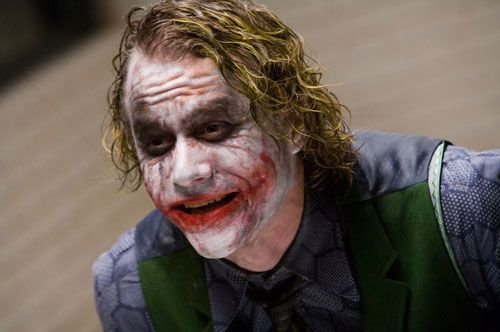
"- but his face deep scars of thunder had entrenched-"
-John Milton describing Lucifer in Paradise Lost
This article is a continuation of the Legerdemain series and benefits from reading the previous three installments. You might also want to read Bat Time, Bat Channel and This Joke Isn't Funny parts 1 and 2. It has been five years since The Dark Knight was released, so I have no qualms about spoiling this movie. It's not a synopsis anyway, but still, if you haven't seen The Dark Knight then you really have missed one of the greatest achievements of film making and performance of , well, of all time really. Go watch it right now. If you have already seen it, you probably should see it again.
I could talk about this movie forever and I probably will be. It is deep and it is great and there is much, much for consideration here. Seriously, fantasy film is the art form of the masses of the early 21st century, and there are few works that achieve these heights. I called Batman Begins "Batman Sublime," and The Dark Knight Rises is excellent as well. But The Dark Knight? This is a different animal altogether. If those other films are angels in the form of films, The Dark Knight is an archangel. One with deep scars of thunder. Let's take a look at some of what lies beneath the top level of this particular magic trick.

The Dark Knight is about duality, hoax building, initiatory process, sovereignty personification, and more than anything, sacrifice, on many, many levels. This promotional piece featuring the three main figures quite overtly broadcasts an occult manifesto. Totemic items are displayed obscuring one eye. Odin, the Norse equivalent of Thoth/Mercury/Hermes, sacrificed an eye for a drink from the well of knowledge. Horus, the avenging, solar messiah of ancient Egypt, lost his left eye in battle with Set. When his eye was later restored he sacrificed it again in hopes of restoring Osiris to life. You might be thinking now that these characters are covering their right eyes, and that's true, if we are a spectator looking them in the face. But might we be being cast in a reflective position (correcting, of course, the lettering on the pin and card)? That would be a more interesting view point for these psychological portraits after all. Note how this image equivilates these three rather than differentiates.
That there is a sacrificial theme to this story is inherent in the title alone. The Knight is a very common motif representing a transformative ordeal, a quest, that leads towards a perfected state. Just think of the Knights questing for the Holy Grail. It hardly needs explaining then that the Knight partaking in this quest represents the initiate. A Dark Knight symbolizes expiation and sacrifice, tribulations of sin and periods of obscurity on the path towards heightened consciousness or a higher level of being. This is an important concept to keep in mind. The White Knight, by contrast, stands for purity and illumination. The White Knight is the "Chosen One." Harvey Dent is presented and even described in the film as a "White Knight" as opposed to Batman's Dark Knight. But, huh, which of the major figures of this movie is overtly white? One of Heath Ledger's early major roles was in the 2001 film A Knight's Tale. The strangely anachronistic A Knight's Tale is overtly initiatory. It is also about the perpetuation of a hoax, as Ledger's character is a commoner masquerading as a noble.
Yes, the real star of The Dark Knight is Heath Ledger's Joker. It is very interesting to see how much charisma this villain of villains exudes, especially in comparison to Bale's Batman. Don't get me wrong. Bale produces charisma on command at the necessary story beats. Certainly the lack of personality is a storytelling, character-driven choice, representing the insular nature of an armored, hoax perpetuator operating as a living symbol. At any rate, the Joker steals the show. It's kind of what he does.
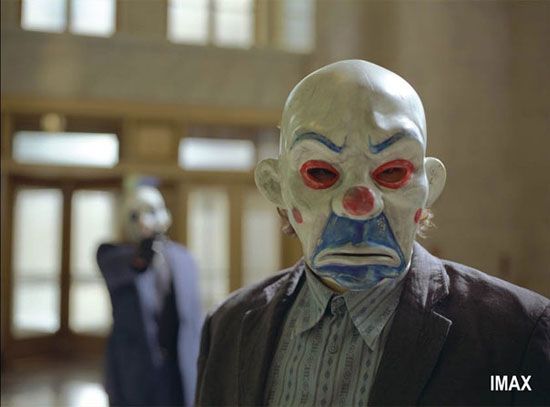
The movie begins with a brazen bank heist orchestrated by the Joker. And its done so with very deliberately utilized masks, which of course, as a Batman film, is a major symbolic item. A mask in a visual work represents illusion and concealment, key components to magic tricks and sleights of hand. It also stands for transformation, being equivalent to the chrysalis, and it confers a magical character. Of course metaphorical masks are necessary for the performance of con-jobs and hoaxes. The use of masks in plays evolved from activities of the ancient Dionysian Mysteries. This led to their use in sacred plays as representing the supernatural forces of deities and the inner psychology of characters normally hidden. And they still do. The origins of theater seem to stem from the worship of Dionysus. There's a long but direct stream (an Underground Stream) through history to every item of contemporary popular culture. Just think of how important the Mask is to the comic book hero, particularly the Batman. This is a Dionysian device. These works, whether they know it or not, are an expression of his Mystery.
And these masks are clowns because this is a Joker operation. The Joker is a clown. The Clown is the equivalent of the Fool, and of course the modern playing card Joker is the equivalent of the Tarot trump The Fool. The Fool is the initiate's card, the status of the seeker at the onset of his/her process of enlightenment. The Fool is the Ain Soph of the Kabbala, the unknowable, primary cause. The Clown/Fool is the opposite of the King (keeping in mind that Batman is the self-described King of Clubs). The King represents order and the Fool represents chaos, and this is very apparent in the presentation of these characters. This is the essential duality of this story, and one represented in many ways throughout the film. The Clown/Fool is also emblematic of unregenerate man, and this is an aspect certainly readable in this presentation of the Joker. Most importantly, the Fool is a symbol of sacrifice. In past cultures where the sovereignty of the king was felt to have direct correlation to the fecundity of the land, there were times when it was deemed necessary to sacrifice him for the common good. Kings don't like to be sacrificed, of course, and a system developed wherein the lowest member of the court was substituted. Or so the mechanism is described. Heath Ledger's first listed role on Wikipedia is a 1991 Australian film called Clowning Around.
It is not overtly presented in the film but reading the Nolan brothers' script for The Dark Knight reveals an interesting aspect of the bank heist. The assumed identities of these hired criminals, obviously strangers to one another in the manner of Resevoir Dogs, are Bozo (that's the Joker seen above), Chuckles, the unnamed bus driver, and then Dopey, Grumpy and Happy. The use of the Disney dwarf names might seem a simple throw away, but it is suggestive of a system of seven. Seven is a complete cycle, the days of the week and the days of Creation, both of which derive from the seven observable planets in a geocentric model.
But wait. There's only six actual robbers involved. Yes and no. The robbers don't realize that Bozo is the Joker. They talk about the Joker as the mastermind of the operation and as an additional share. So an alter-ego, a duality, a hoax, a trick, creates the extra figure. The bus driver is unnamed and unseen, and so he must be Bashful. The brains of the outfit, the obvious leader? That sounds like Doc.
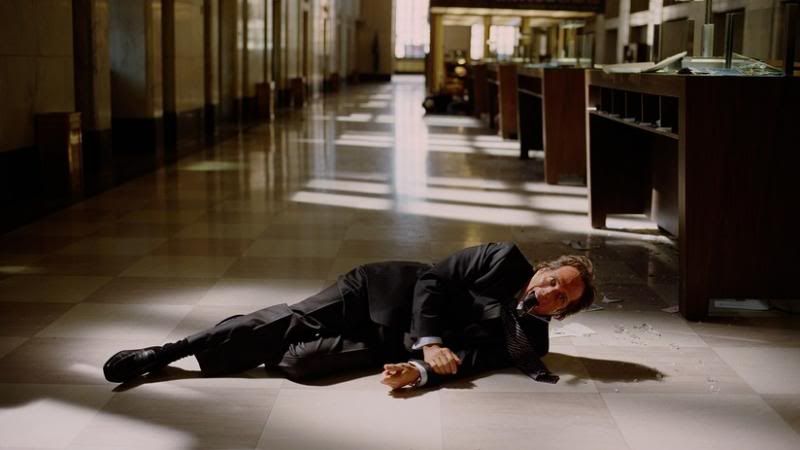
Here is Doc Joker teaching the mob-tied, criminal bank manager a lesson. Note the checkerboard floor. The Nolan films are rife with this symbol of initiatory process (I discuss checkerboard symbolism to great extent in Illuminating Harry Potter I: Romancing the Stone amongst other articles). Put simply, it is the interplay of dualities, positive and negative, night and day, solar and lunar, male and female. The tensions of these polarities controls the inherent irrationality by placing it within a strict, governed order. We see these interplays throughout this movie in many different forms, obvious and covert. The actual bi-colored grid is in place at very key moments that I will point out as this article progresses. They are all directly related to initiatory steps enacted by the Joker. This bank heist, the first step in the Joker's elaborate, criminal act of performance magic, is stage one. The subject is Gotham City. Note that the Harlequin, which is the exact equal of the Clown and the Fool, is traditionally garbed in a checker-pattern.
Is a Tarot analogy a stretch? Even if it weren't deliberate, a perceived symbolic content carries meaning even without the author's intent. This is one of the major themes of this blog. In this case I am certain the Tarot is being utilized quite purposefully as the story tellers tip their hat to this fact at the end of the scene (and far more overtly further on). The Joker makes a clean get away driving a bus marked "District 22." There are 22 Tarot trump cards. At the outset The Dark Knight is slyly declared as a work of cartomancy.
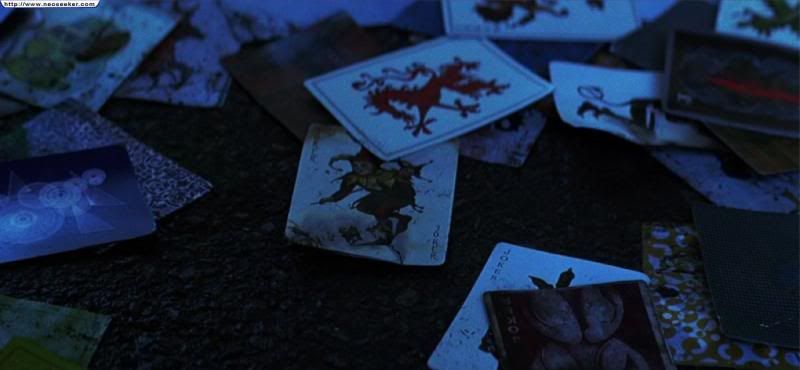
Let's talk a little bit about cards. The above still is a shot of the hundreds of Joker cards that litter the street after he blows up the judge's car. Note the geometric circles and triangles on the card to your far left. Without being able to specifically identify it, it looks like alchemical or Rosicrucian diagrams. The kind of thing you might find in a Manly P. Hall book. Hall was a genius of card (symbolism) tricks. Hall points out that in the two color scheme of cards we again find our dualistic patterning. There are thirteen cards of each suit which represent the thirteen lunar months of the year. That the 52 cards equal 52 weeks is easy enough to see. If you count the Jacks, Queens and Kings as 11, 12 and 13 then all the pips equal 364. If you add the Joker you get 365. The twelve court cards stand for the zodiac, which is always about time and timing. Timing is key to magic. Note how integral proper timing is to every major action enacted by the Joker throughout this film. This magician characteristic is not hidden.
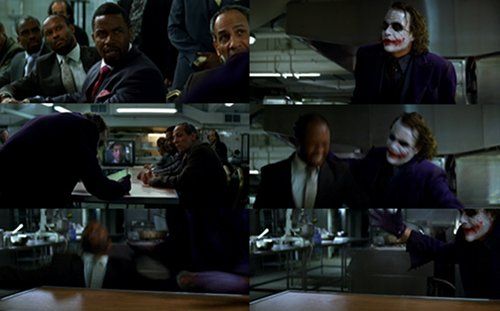
Ta da! The disappearing pencil trick. The Joker is very much presented as a Magician in this film. And Batman has already been presented as a Magician. They are hoax builders at war. This is the same central core as The Prestige. A striking example of the importance of timing in Batman's actions occurs in his first scene in this film, when he jumps down the spiral ramp of the parking garage onto the roof of a moving van.
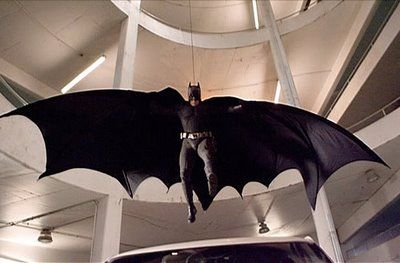
Let's take a moment to consider some of the connotations of the Bat.
As a double-natured entity, as a mouse/bird, the Bat's alchemical
symbolism is related to that of the androgyne. It's the Two-in-One, a
duality personified. In many cultures the Bat has stood for Vigilance,
and that's fully appropriate here. More commonly it represents superstition,
fear, death and madness, something Francisco (that's fun to say,
Francisco) Goya certainly understood.
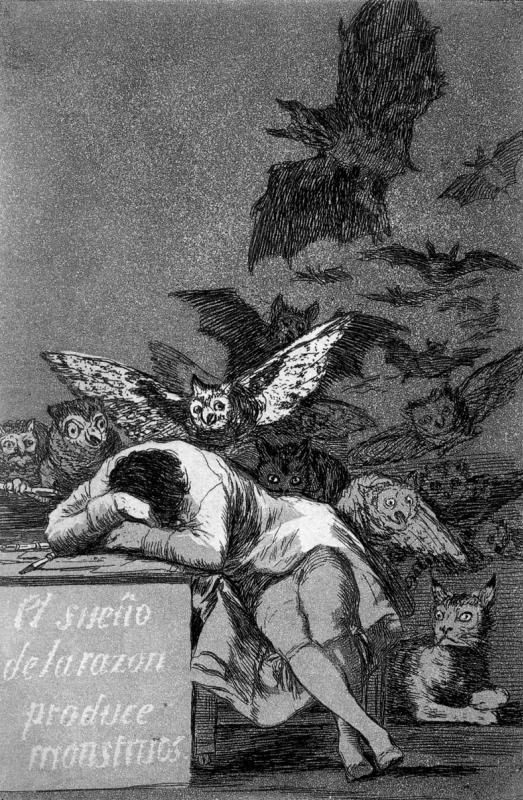 | ||||
| The Sleep of Reason Produces Monsters, Francisco Goya, c. 1799. |
The parking garage scene features a reappearance of Cillian Murphy's Scarecrow, a figure that is both Dionysiac and sacrificial (usually by fire, an important symbol set we'll return to).
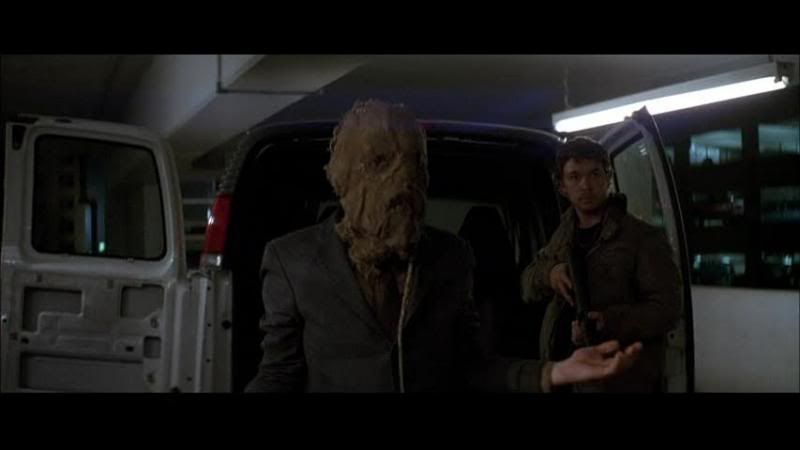
When criminally operative the Scarecrow appears masked. I'm certain Dr. Crane, in this version of the character, could talk all about the psychological symbolism of the Mask. Jungian archetypes, you know?
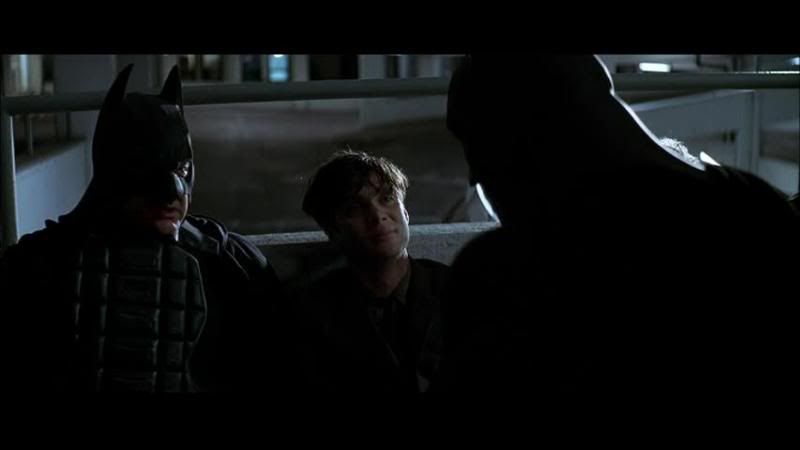
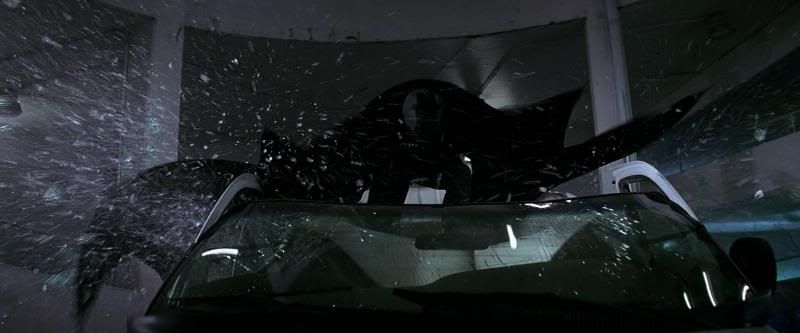
Once defeated his mask is removed. Unmasking is is an integral aspect of this story, the undoing of all the symbolic connotations described above. Unmasking is an unveiling, the exposure of the hoax, the undoing of the opponent's magic spells. This still also shows the most prominent of the false Batmans that appear in this scene. Duplicates, doubles, false figures. Think about The Prestige.
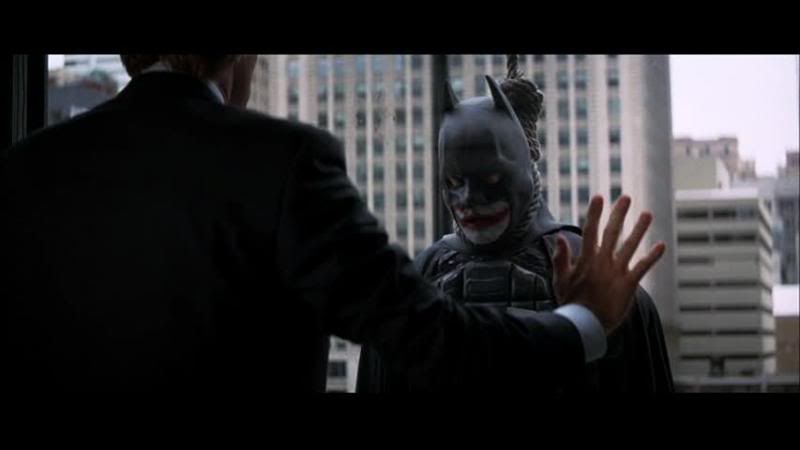
And about how these duplicate figures need to get sacrificed in magic acts. We'll talk about the significance of the Hanged Man later. Note how the Joker and Batman are combined here, the synthesis of opposites.
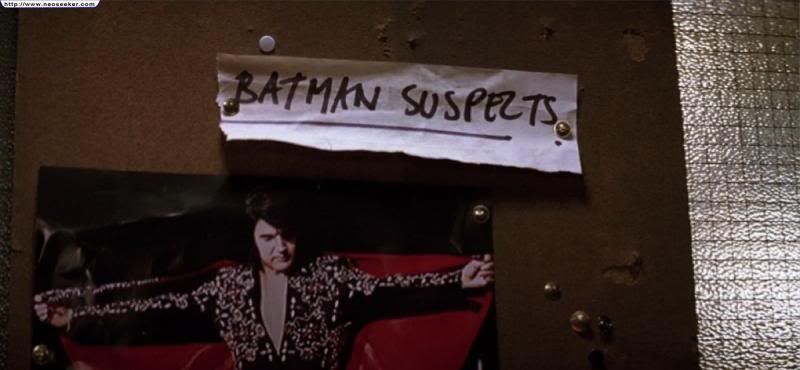
The hoaxing nature of the Batman is alluded to in the Gotham police department's joking bulletin board of Batman suspects. Besides Elvis we see Bigfoot and Lincoln, all figures attached to hoaxes and conspiracies. Note the silver grid work. We'll see this motif more prominently elsewhere.
Speaking of grid work, the second example of the initiatory checkerboard pattern associated with the Joker's activities occurs when he pretends to be dead in order to get to Gambol. The floor and the walls are all checkered. You can see it better in the video then in any still I can find. This Rising From the Dead scene is of course a major initiatory rite symbol, and one particularly tied to Dionysiac Mysteries. Here we also have the first of the Joker's explanations for his Glasgow Smile, which is an aspect of his hoax building. The scene ends with the Joker forcing Gambol's thugs to fight to the death for a position in the Joker's gang, emphasizing the sacrifice theme. Also note how this is just one of the false deaths/rebirths in this film as James Gordon later fakes his own death to get the drop on the Joker. What occurs after Gordon's "rebirth?" He achieves a higher rank/reaches a more elevated position as he is named the new police commissioner of Gotham City.
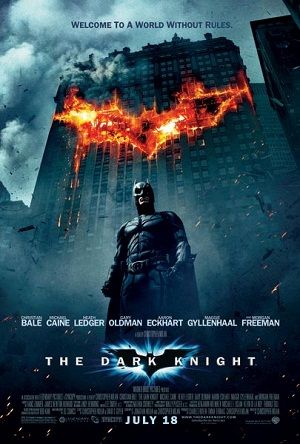
The primary poster for The Dark Knight combines two of the major symbolic devices of the film, those of Fire and the Tower. Together they formulate a very clear depiction of Tarot Trump sixteen, the Tower Struck by Lightning, aka Le Feu du Ciel/The Fire of Heaven. Seriously, if there were a Tarot deck combining popular super heroes with modern day terror anxieties, this would be card sixteen. Batman is positioned directly before the tower, like a column, repeating its format, identifying him with the structure of the city. This is fully appropriate as the Tower of Trump sixteen is representative of the human form. The enigma of the Tower card relates to the fall of man and the devastating consequence of over confidence. This happens to describe the Joker's objectives in this film. "Welcome To A World Without Rules" is essentially a reading of the aftermath of Trump sixteen's symbolism.
The Tower is also quite overtly used as a symbol of Bruce Wayne/Batman in this movie. His mansion having been destroyed by Ras al Ghul in Batman Begins, Batman is operating out of the tower of his corporate headquarters. There's an implied movement here between the films from the maternal cave to the paternal tower (and back again in the third film). The Cave is primordial shelter, and as an easy to read womb symbol representative of birth/rebirth. It is emblematic of the unconscious mind and associated in many legends with gods and heroes. The Tower is about ascent and vigilance, as well as the aristocratic nature Batman can never remove himself from, as it looms above the common level. While it is overtly phallic it is yet another item of combined duality. The protective nature of the Tower is a feminine quality, associating it with the Virgin. This is seen in many stories and legends. Just think about Rapunzel.
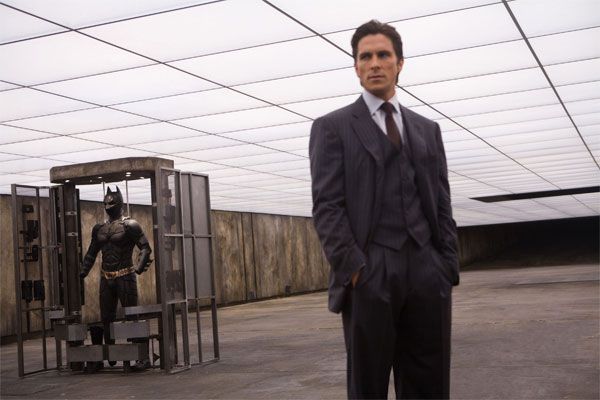
Here we see Bruce Wayne within a cave within his Tower. The complex encasement of his costume is intriguing. The arms of the Knight stand for symbolic potentialities. There is an article unto itself in examining the symbolic significance in the equipment of Batman and the Joker. But I include this still to display the striking ceiling used for Batman's secret headquarters. Notice we again have a single-tone grid in place associated with Batman. Its illuminated, as the grid on the police bulletin board is light reflective. So this is a system, a grid work, implying activity and development, but its not dualistic in these instances. Batman's essential initiation took place in Batman Begins. He's acts in this movie from a more elevated status, with a level of enlightenment. Note his desire to move up, and out, from this level and unite with Rachel Dawes, leaving it to Harvey Dent.
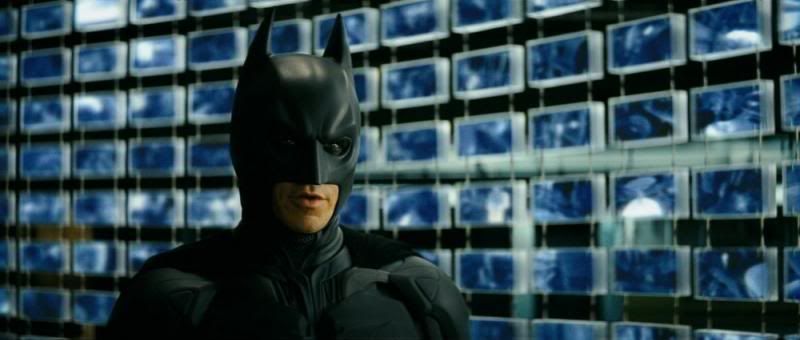
And another luminescent grid work associated with Batman/Bruce Wayne. This one is crafted by Lucius Fox (the light-bringing Promethean) and confers upon Batman a heightened sensory awareness of his city, confirming his role of sovereignty figure. This is truly what Batman and the Joker are fighting for in this story. Harvey Dent as well.
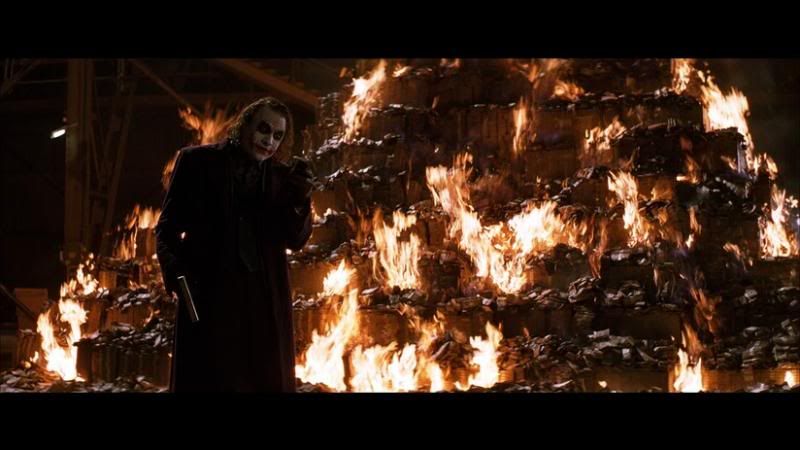
Fire is Divine Energy. It is spiritual passion, purification, revelation, regeneration. It is the medium for conveying messages to the heavens. It is (again) dual natured, divine and demonic, creative and destructive, intellectual and emotional. It is a device of ritual sacrifice and a common means of Christian martyrdom. It is the central element of alchemy. Fire is traditionally associated with Trickster Gods like Prometheus and Loki. Let me underline here how this version of the Joker and Loki are the same figure. There are many articles at this site delineating Promethean characters. The Joker and Loki are in that camp, retrograde.
According to Gaston Bachelard's Psychoanalysis of Fire, it is "-the archetypal image of phenomena in themselves". That's a bit of a hard concept to parse, but the basic idea is that experiential existence is like the visible and tactile energy of something burning. I'm still thinking about that one. Existence is a kind of release of energies. Think about the origins of the universe starting with a big explosion.
Even more on target than Loki or Prometheus is the association with Lucifer, as I suggest with the Milton quote at the top of the page. Hall recounts a story told by 18th century alchemy scholar Georgius von Welling that the material universe was created accidentally by Lucifer's misuse of the Schamayim, the Divine Fire. Here's the most prominent Joker card utilized in the film to hammer home this association.
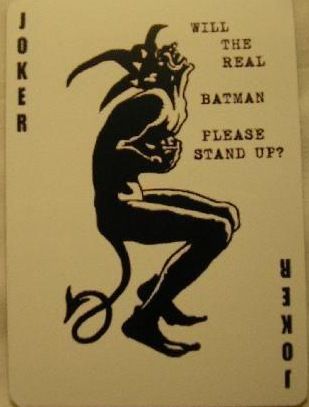
These cards are deployed to the potential victims of the Joker's triple murder plot. The judge is killed by fire. Fire in this context is about the Luciferian desire to annihilate time and bring all things to the end. This is what is meant by the key line of dialog for this film, when Alfred, speaking on how Wayne doesn't fully understand the Joker, states "Some men just want to watch the world burn".
It is by Fire that Rachel Dawes is murdered (sacrificed) and Harvey Dent is turned into Two Face. Note the floor Harvey's face is lying upon as it is half submerged in gasoline.
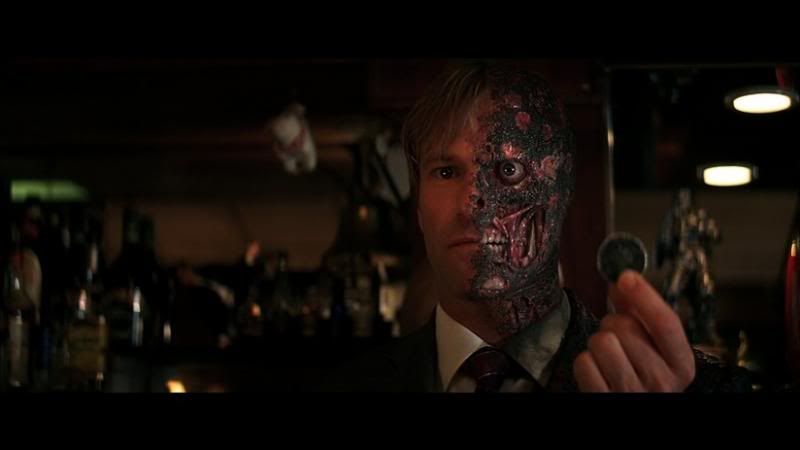
Here's Two-Face. All this talk of duality and combined dualities? That's overtly inherent in every iteration of this character. I talk in Illuminating Harry Potter about the Roman god Janus (when discussing Prof. Quirrell and Voldemort). Here he is again. Janus is the god of thresholds and beginnings, exits and endings. He is representative of acts of inversion and mutual sacrifice. He is the transmitter of the knowledge of the law and of agriculture (that's sowing and reaping).
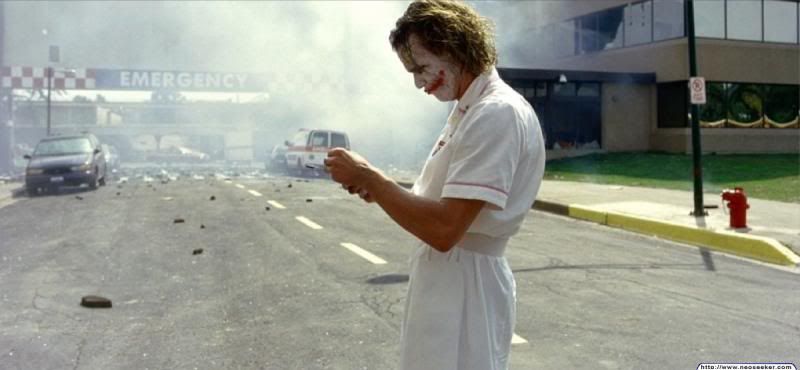
And when the Joker sets Two-Face, his initiate, loose on the city? There's fire. And there's a checkerboard. And this vital stage of initiation involves a cross-dressing Joker, a synthesis of Randall Patrick McMurphy and Nurse Ratched, the union of opposites. The androgyne or hermaphrodite is symbolically alchemy's coincidentia oppositorum, the incarnation of the Great Work. It is the same meaning as a head with two faces, interestingly enough. For this reason the androgyne is a common figure for conducting an initiation ceremony. Now take a look at the very first image of this article and note the hexagon pattern of the Joker's shirt. A hexagon is a six sided figure. Six represents unity and equilibrium. Why? Because the hexagram is the combination of an upward pointing male triangle, and a downward pointing female triangle. It's an androgyne.
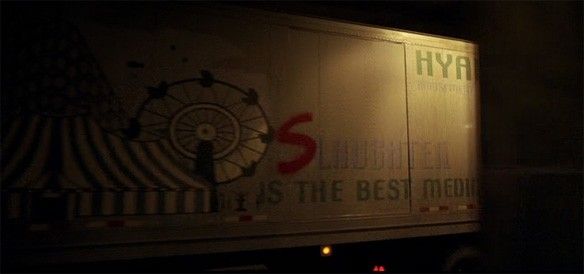
Does this seem like a lot to extrapolate from the graphics on the side of a truck? This is what esoteric symbolism is all about. In this case the above is emphasized by the black and white initiatory patterned tent, and the Ferris wheel, a circle, and one that looks like a sun burst and an eye. A single eye emitting a black beam or sitting atop a column. Now that I'm saying it, try not to see that Ferris wheel as a stylized Eye of Sauron. Return, if you like, to the obscured eye image at the start of the article. What is alchemy's Great Work? Turning base metal into gold. But that's an allegory. The basis of mythology is astronomy. It's time keeping. It's a turning that's a returning, back to the start of the circle, iron into gold.
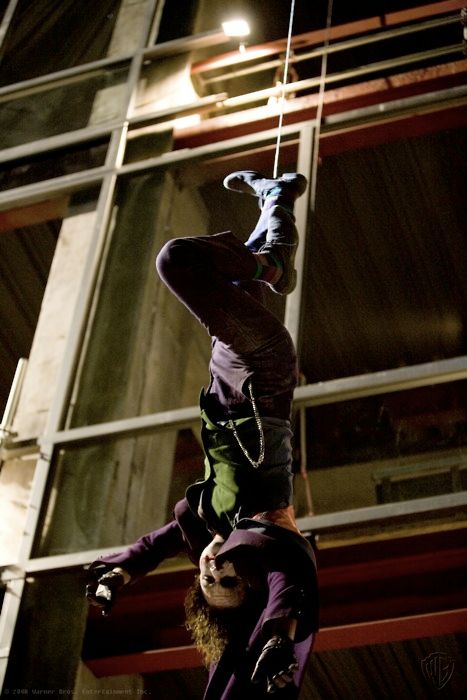
In his last act, the Joker has a failed use of fire involving the two ferries in a Prisoner's Dilemma scenario, and creates a hoax that Batman uses his enlightened senses to see through involving masking hostages as Clowns and his thugs as Doctors. As I contend in the Doctoring Art Gotic articles, Doctors are the teachers of the Invisible College. Batman gets caught in a net (a grid-structure of the visible and invisible, and a symbol of magical authority) prior to the Joker being displayed as Tarot trump twelve, The Hanged Man. The symbolism of this card is overtly sacrificial, and once again Odinic. It represents expiation, inversion and realignment. And what does The Hanged Man predict? The elevated Batman's Fall, generating a new hoax wherein he takes responsibility for the murders committed by Two-Face, an act of expiation, and the Dark Knight entering into obscurity.
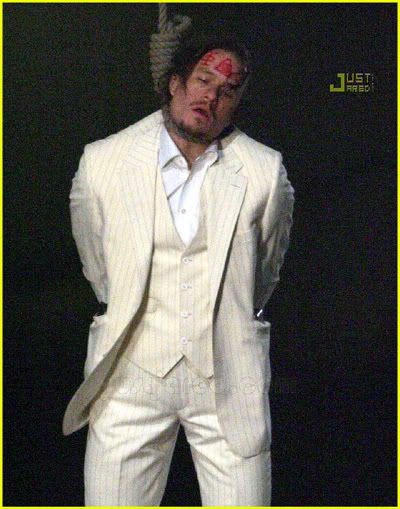
How interesting that in the Tim Burton Batman movie the Joker also hangs before falling (from a tower, weighed down by a statue of the Devil). In The Dark Knight the Joker lives but Two-Face dies in a Fall. Joel Schumacher's Two-Face also dies from a Fall. The Dark Knight is Ledger's last full role. He half finished Terry Gilliam's The Imaginarium of Doctor Parnassus. He enters that story as a hanged man, where his Joker role left off. Inverted.
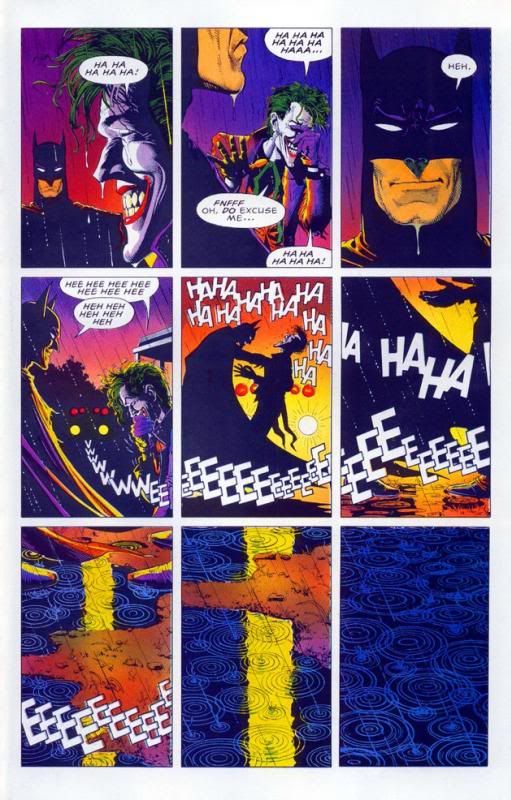 | |||
| art by Brian Bolland |


