Showing posts with label Star Wars. Show all posts

Wednesday, September 18, 2013

Occult (Lucas) Arts

I came across a blog article displaying the Christmas cards mailed out each year from LucasFilm, Cool Stuff: 30 Years of LucasFilm Christmas Cards. These are items sent to a relatively small number of people, employees, close associates, business partners, etc. I'm not sure what to make of them, but I find several of these images interesting. While putting this together I found the Star Wars: Community|Checklist: 30 Years of Holiday Cards from LucasFilm which had nicer images of some of the earlier pieces and great information. It might seem strange to do a Christmas post in April, but I came into this from the Star Wars side. As a kid a lot of Christmas for me was Star Wars anyway, so the two go naturally hand in hand in my mind.

Purely by coincidence, my last article dealt in part with movie poster artist Drew Struzan. This time we start with another giant of that corner of commercial illustration, John Alvin. Sadly, John Alvin died suddenly of a heart attack this last February. Alvin painted this card for Christmas 1978 (the 1977 card was an imprint on a generalized holiday card, though one with a blimp flying over the Hollywood sign).

Photobucket

These cards came to my attention while researching for an R2 and 3PO article. To keep things simple here I'll just point out the polarity of the pair, silver and gold, lunar and solar, short and tall, etc. Despite this both are typically described as male, a matter of programming, and in R2's case it seems strictly arbitrary. In this piece John Alvin subtly assigns sexual characteristics to the two of them with their musical instruments, C-3PO male and R2-D2 female, easy enough to read when you look at the picture with this idea in mind.

This gender assignment is just as subtly reversed two years later on the 1979 card, which was painted by Ralph McQuarrie.

Photobucket

R2's stag horns are clearly masculine, while C-3PO's skirt level Santa coat is feminizing. Note that "he" is removing a false beard, his male disguise. Actually both figures here appear to be horned due to the candles behind 3PO's head. There's just no way that this is an accident of positioning, not in a painting. The pair of goddess figure candle holders, each holding twin torch emblems, is a blatant occult emblem.

McQuarrie channeled Rockwell for a UK LucasFilm card from the previous year, 1978.

Photobucket

The lamp post is the familiar Column. I find the wreath with the centrally positioned red-ribbon to be an easy way to present a stargate symbol at Christmas time, here on a Door as is often the case with wreaths. Notice the yonic, grail form and/or sun on the horizon detail in the architecture behind the Droids. The gridwork of window is echoed by the grid of the grate R2-D2 is positioned on. The grate beneath R2 is an odd detail. There's no reason for it other then to demonstrate that R2-D2 is On the Square.

For 1980 McQuarrie presented the Droids as Santa's helpers.

Photobucket

This reads as a Santa's workshop scene due to the wreath (the same format of wreath from the 1978 card), the toys and the context of the presentation, but truly it is an odd depiction beyond the sci-fi trappings. Santa is out of his traditional garb, perhaps dressed instead as Obi Wan, but the overall effect to my eye is an Alchemist in his lab before his hearth. The toy castle seems potentially indicative of Templarism. Note the three columns of window panes.

Photobucket

For 1981 McQuarrie presented Yoda as Santa Claus, and this was repeated on the above 1982 card, this time including reindeer and sled. I'm trying to determine what locale Santa Yoda is meant to be at here. His sled has California plates, but this desert might be Tatooine. Or Egypt. The lines of the "mountains" in the background are suspiciously straight. I suppose it could be the North Pole with golden light reflecting on snow, but my eye reads that color ground as sand.

Photobucket

McQuarrie gave the Santa treatment to the Ewoks for the 1983 card. The Ewoks' hunter/gatherer society allows interesting details like the floral headdress, which seems a nod to the pagan/solar/agricultural origins of Santa Claus and Christmas. Tree of Life symbolism is easy to include with Ewoks. Again we have the same essential wreath. Outside the pyramidal entrance are five torches in a ring.

Photobucket

For the 1985 card by Alice "Bunny" Carter, Ewoks (from the Saturday morning cartoon) and Droids come together for a Christmas house party. Again, we have the wreaths, one on each of the three spires of the house. Lots of fun guests at the party, including the Max Rebo band, a snow duck (likely Howard) and a couple of shadowy Rabbits.

Photobucket

The 1986 card was designed by David Craig. Ewoks make a snow man of C-3PO, a figure they worship as a god. Again the sexuality of the figure seems to be the emphasis given the area where the Ewoks are working, the snow balls they seem set to attach indicating that to them 3PO is a father god. I also find that the basic forms of the torn paper make it just as easy to read the broom the snow droid carries as a torch.

Photobucket

The Star Wars theme wasn't used again until 1994 when McQuarrie presented some Jawas on Christmas morning. I just want to point out that some lucky Jawa got a miniature obelisk that year.

Photobucket

The 2001 card by Kathryn Otoshi features Enkidu resonator Chewbacca in a recreation of the almost touching fingers of God and Adam from Michaelangelo's famous Sistine Chapel fresco. Inside the card Chewie is depicted as a shepherd to the children of the world.

Photobucket

The 2003 card, again by Kathryn Otoshi, shows Yoda gazing upon a constellation shaped like his head. What I find really interesting here though is his vantage point, apparently our Moon, or something visually like it. I suppose if Yoda's to scale it's a very small object, B612 sized. Wherever he's meant to be, it isn't Dagobah, Coruscant, or any other setting we might expect to find the Jedi master at.

I have more questions then anything else regarding the card for 2005. Painted by Christian Alzmann, it shows many LucasFilm related entities crossing the Golden Gate Bridge to celebrate the company's move to the Letterman Digital Arts Center in the San Francisco Presidio.

Photobucket

Note the Tatooine Double Sun setting on the horizon. There's something about this image that I find highly evocative, the combination of that specific bridge and some of these figures maybe. The dinosaurs from "Jurassic Park" add a real time-warp feeling. There are all kinds of things here presented in pairs or trios, twin suns and the golden dome, two X-Wing Fighters and a Pod Racer (itself paired as a chariot to the yellow roadster from "American Grafitti"), the black Darth Vader with white Stormtroopers paired with the white THX 1138 and two black Robot Cops, R2, 3PO and Chewbacca, Indiana Jones swinging mirrored by I believe two Ewoks, etc.

The golden dome at the lower right is the aerial view of the Palace of Fine Arts, situated just beside the Letterman Digital Arts Center.

Photobucket

Photobucket

Just as evocative is the card from 2006 featuring a photograph of a detail from the stained glass dome of the Skywalker Ranch library.

Photobucket

The column form of the eight radiating rays is especially prominent in the black and white line drawing on the left. Here's the full dome.

Photobucket

I can't help but be visually reminded of the CERN ATLAS detector.

Photobucket

So then also to the floor plan of the Dome of the Rock, another Golden Dome.

Photobucket

Photobucket

The 2007 card by Lorraine LeBer features a pop-up of thirty caroling Stormtroopers for thirty years of LucasFilm. I find this one kind of creepy, Merry Christmas, Fascist New Year.

Dedicated with wishes of health and recovery to R2-D2 portrayer Kenny Baker. As far as I'm concerned anyone who can make you love a beeping cylinder on wheels is an actor of the highest ability.

Wednesday, June 4, 2008

A Familiar Story

The Lord of the Rings, Star Wars, Harry Potter, and His Dark Materials. These are key topics here. You mostly know these stories and certainly you will agree that these works are all related in a myriad of ways (with the former clearly inspiring and informing the other three). Recently some of the less overt connections between these and a few other related works of high romance fantasy struck my interest, and coincided with some other topics I've been mulling over lately.

I had the pleasure recently of rewatching "The Golden Compass". It is not a perfect film, if such a thing exists, but it is a serviceable enough adaptation of the first book of Philip Pullman's trilogy. Even more recently I reviewed the first five "Harry Potter" movies. While watching "Harry Potter and the Order of the Phoenix" it struck me how very similar the concepts of Pullman's Daemons and Rowling's Patronus Charm really are.

Harry's Patronus from "Prisoner of Azkaban", a stag related to his father's animagus form


Luna Lovegood manifests a fully name appropriate rabbit Patronus


Harry teaches Dumbledore's Army the art of the Patronus Charm


Lyra and Roger with their Daemons Pantalaimon and Salcilia


Lyra and Pantalimon with Fader Corum and his Daemon Sophonax


The aeronaut Lee Scoresby and Hester

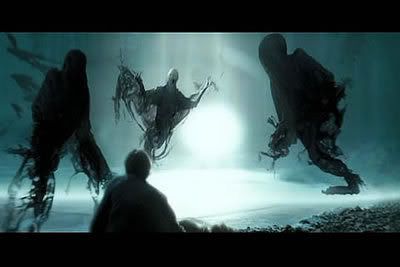
It is possible that one inspired the other. "Northern Lights" was first published in 1995, two years before "Harry Potter and the Philosopher's Stone", and four years before the Patronus Charm was introduced in "Harry Potter and the Prisoner of Azkaban". After its introduction the Patronus figures became one of the more prominent magical manifestations of the series, associated almost exclusively with the good guys. They are particularly visible in Part 5 as one of their primary functions is as protection from the Dementors, also returning from Part 3, entities clearly informed by Tolkien's Ringwraiths.


Dementors as seen in "Harry Potter and the Prisoner of Azkaban"


A Ringwraith from "The Fellowship of the Ring"

In fact there is no real need to determine which author devised which notions first as they all draw upon occult symbolic motifs of ancient origin, found multiculturally. There is a nice list of related concepts in the "See Also" section of the Wikipedia Daemon article. Particularly interesting is the similarity to the Norse Fylgja story, especially for those who have read the rest of Pullman's trilogy. And everyone is familiar with the Familiar, as a witch's black cat if nothing else. Daemons and the Patronus Charm are both extrapolations of this lore.

When I started preparing this article I did not expect Leonardo da Vinci to be a part of the topic, and yet I can no longer say I am surprised when he turns up in unexpected ways. In retrospect his presence in this matter makes perfect sense as I hope to demonstrate. As I learned from Wikipedia, in an interview for More Intelligent Life.com Philip Pullman credits the concept of the daemons to three particular portraits by great masters of the Renaissance and Baroque eras.


Leonardo da Vinci, "Lady with an Ermine" c. 1489-1490

Hans Holbein the Younger, "Lady with a Squirrel" c. 1526-28

Giovanni Battista Tiepolo, "Young Lady with a Parrot" c. 1758-60

And how Pullman derived his story device from consideration of these works is easy to follow as the coupling of a portrait subject to an animal in this manner is the artist depicting a "Daemon", a symbol of the sitter's persona. But of course with Da Vinci things go deeper. Here's a well-known self portrait of Da Vinci from around 1512-15 followed by a few of his more famous followers.

1512-15


Ian McKellan as Gandalf in "The Fellowship of the Ring"


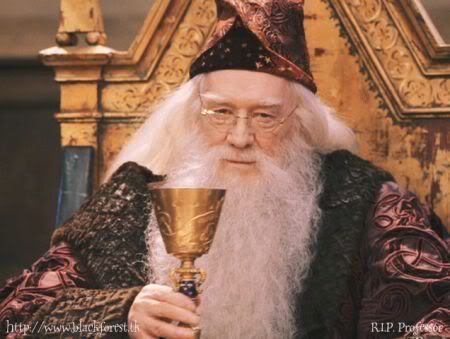
Richard Harris as Dumbledore in "Harry Potter and the Philosopher's Stone"


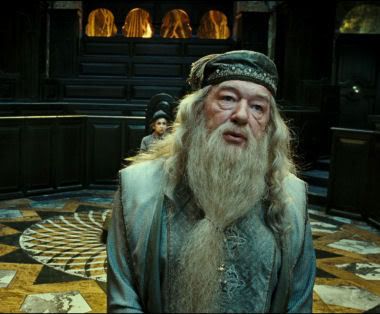
Michael Gambon as Dumbledore in "Harry Potter and the Order of the Phoenix"


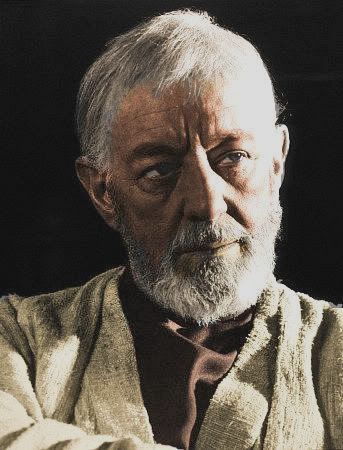
Alec Guiness as Obi-Wan Kenobi in "Star Wars Episode IV: A New Hope"

Of course all of these fictional old wizards look very similar, as they all represent the light-father and supernatural mentor figure of the monomythic Hero's Journey. And again, Gandalf clearly well predated and openly inspired Obi-Wan and Dumbledore. Of course all bear a clear similarity to other famous historical wizards like John Dee and Nicholas Flamel and to traditional depictions of legendary/mythological figures like Merlin the Magician.

In the case of the "Harry Potter" series the Arthurian elements are not even veiled as the term "Merlin" is used as a kind of wizard ranking, with Albus Dumbledore described as being of the "Order of Merlin First Class" (as well as being described as a "Mugwump", see Tingly Intuition). The great Richard St. John Harris then in his career graduated from being King Arthur on stage and screen versions of "Camelot" to a Merlin-figure in the first two Harry Potter movies.

Photobucket
Richard Harris as Arthur in a stage production of "Camelot"

If the roles played by actors color or otherwise inform their other performances, then things get even more interesting with Dumbledore with Harris' replacement Michael Gambon. Mostly this just makes Dumbledore creepier. A few months ago I caught Gambon playing a crime lord with the great name of Eddie Temple in "Layer Cake", costarring current James Bond (thus John Dee resonant) Daniel Craig, and directed by Matthew Vaughn who also brought us last year's adaptation of "Stardust". You might agree that Gambon's role in Robert De Niro's "The Good Shepherd" is very intriguing viewed through a Harry Potter lens. But what I'm really shocked by was learning that Michael Gambon was the Thief, Albert Spica, in the 1989 film "The Cook, The Thief, His Wife & Her Lover".

Photobucket

I'll never look at Dumbledore the same way now that I realize this. Have you seen this film? You should, but only if you appreciate lush, exquisitely crafted nightmares, to the fullest connotation of that term.

All of the works listed at the start of this article follow the same essential monomythic solar allegory hero's journey, which as stated involves the protagonist being assisted by a magical entity, usually an elderly male, great warrior and/or wizard. In "The Golden Compass" this role is largely filled by the armored polar bear Iorek Byrnison.

Photobucket

The voice of Iorek was provided by Gandalf portrayer Ian McKellan. McKellan was also the narrator of "Stardust". In the film version of "Stardust" the magical patriarch role comes in the form of the gay sky-pirate Captain Shakespeare, played by Robert De Niro. Of course "The Golden Compass" also featured Daniel Craig as Lord Asriel. Craig is currently slated to appear as Bond at least two more times, in this year's "Quantum of Solace" and then the 23rd Bond film "Skyfall."

Photobucket

McKellan also played Magneto in the three X-Men films, which is essentially the same magical mentor/patriarch figure in retrograde, the antagonist rather then the protagonist. Magneto might be the villain, but his character is much more akin to Dumbledore and Gandalf than Voldemort and Sauron. The other role of McKlellan's that I find most pertinent was as Sir Leigh Teabing in the 2006 adaptation of "The Da Vinci Code".

Photobucket

A part which you might agree involves these key aspects in more then one way if you're familiar with the story. Of course "The Da Vinci Code" involves the list of Grand Masters of the Priory of Sion used for Lincoln, Leigh and Baigent's "The Holy Blood and the Holy Grail", which includes Da Vinci as well as Nicolas Flamel, a friend and associate of Albus Dumbledore in "Harry Potter and the Philosopher's Stone".

"The Da Vinci Code" was directed by Ron Howard. One of Howard's film roles as an early adult was in George Lucas' 1973 coming-of-age movie "American Graffiti". Lucas and Howard teamed again when Howard directed Lucas' magical fantasy adventure "Willow" in 1988. Note how "Willow" is essentially the same story as Star Wars, beyond both following the monomyth, it is again more or less a treatment of Kurosawa's "The Hidden Fortress", and indeed, one of Lucas' early concepts for Star Wars involved Luke Skywalker being a little person, showing the Tolkien influence. And since we're talking about Lord of the Ring influences on Star Wars, note how Christopher Lee's roles in these films as Saruman and Count Dooku are virtually identical in almost every way, with the characters' primary roles occurring in the second installments of the trilogies, "Attack of the Clones" and "The Two Towers", both released in 2002.

Now, check out this section of "The Fellowship of the Ring" featuring Bilbo's birthday party.


Mischeif makers Merry and Pippin get into Gandalf's firework stash, and set off one that creates a convincing pyrotechnic dragon (approx. 2 minutes in).

This scene is then paid tribute in "Harry Potter and the Order of the Phoenix" when mischief makers Fred and George Weasley disrupt examinations with a fireworks display, including a convincing pyrotechnic dragon.


That's Charms Professor Flitwick who gives the little, sneaky cheer as the giant W (for Weasley) ignites in the sky. Flitwick is played by Warwick Davis. He's seen here in his more interesting presentation from the third film on. In the first two movies he looked more like Dumbledore's Mini Me.

Photobucket
Wingardium Leviosa

Photobucket

Davis was also the aforementioned Willow Ufgood in the Howard/Lucas film.

Photobucket

His first role was playing the Ewok Wicket W. Warwick in "Star Wars Episode VI: Return of the Jedi". He also had two bit parts in "The Phantom Menace", as Anakin's Rodian friend W. Wald and as an associate of Anakin's owner Watto named Weazel (close to Weasley).

Photobucket

Photobucket

In fact all of Davis roles in Lucas productions involve characters whose names start with W. No wonder he cheers the insignia. The W in "Order of the Phoenix" can also be seen as a reversal or opposition of the M utilized as a logo for the Ministry of Magic. Magneto is likewise often depicted using a simple M as a logo. Those familiar with "The Da Vinci Code" will recall Da Vinci's cryptic use of the M in the composition of his "The Last Supper", perhaps a reference to Mary Magdalene. It's worth noting that M is the 13th letter of the alphabet and W the 23rd, both highly significant occult numbers.

Going back to the Da Vinci self-portrait, it is conceivable that this image is itself allegorical in nature. Da Vinci has been similarly presented in Venetian master Giorgione's c. 1508-09 work "The Three Philosophers".

1508-09

Some regard this as an allegorical portrait of (from left to right) Giorgione, Hieronymous Bosch and Leonardo da Vinci. That these depictions are largely meant to be symbolic can be attested by the fact that Bosch and Da Vinci were roughly the same age despite Da Vinci here appearing to be far more elderly. Note too Giorgione's compass and square.

So this image of Da Vinci as a wizened, hermetic magician might have been just as cultivated and manufactured to confer symbolic meaning and role as the appearance of Gandalf, Dumbledore or Obi-Wan, all drawing from a greater occult tradition. Tolkien attested to the basis of Gandalf on the Wanderer form of the Norse god Odin. For his visual inspiration Tolkien cited a postcard that has been revealed to be the work of German artist Josef Madlener.

Josef Madlener
"Der Berggeist" (The Mountin Spirit), c. 1925-30

Madlener's daughter describes the image as a part of a series depicting Germanic folktales. So even if this does not directly represent Odin it still connects to traditions associated with him and his worship.

Photobucket
August Malmström, "Odin and the Wild Hunt"

It is not at all difficult to view the above illustration as Dumbledore driving off a Dementor or Gandalf fighting a Ringwraith. As stated many times before, Odin represents the planet Mercury and is the Norse correspondent of wisdom/knowledge deities Thoth/Hermes/Mercury/Nabu, also associated with the planet. So it should not be surprising, as with the Malmström illustration above, that Odin is at times depicted in almost exactly the same manner as the legendary figure of Hermes Trismegistus.

Photobucket
A floor mosaic from Duomo di Siena

He looks very familiar to me.

Thursday, May 22, 2008

Esoteric Star Wars VI: Human-Cyborg Relations

Photobucket

Photobucket
From "Star Bores: Re-Hash of the Jeti" published in "Mad Magazine" #242, October 1983. Written by Dick DeBartolo, illustrated by Mort Drucker

Sixteen years after this was published we found out that C-3PO is the brother of Luke Skywalker and Princess Leia, in a way, when we learned that he was the art/science project of nine year-old Anakin Skywalker in "The Phantom Menace". He is the creation of an overt messiah figure, and one can think of few motifs in mythology as significant as the ability to create life from inert matter.

This revelation about C-3PO is I imagine still somewhat controversial. But I find it adds a lot of interest to his role and his underlying purpose in the Star Wars saga. Just to save myself from typing extra letters I write the Droids' names using the numerics, but just as frequently we see their names written out, Artoo ("little Arthur") and Threepio or even See-Threepio, combining trinity and eye/seeing symbolism in the name alone. 3PO is a divine figure. The Ewoks knew what they were talking about. We can even observe this Holy Robot phenomenon in the most seemingly innocuous of locations, like this unauthorized item of merchandise from circa 1981, described as a lamp, and I'm guessing made in China or Taiwan.

Photobucket

Which I found in a list of 10 Unauthorized C-3PO Collectibles, See-Threepi-fauxs from a galaxy far, far away. A golden, Art Deco robotic, space Buddha that lights up. If you found some of the items on that list to be ridiculous, note that many of the licensed uses of the character for various products are only marginally less silly.

Photobucket

He's thinking about girls underwear based on himself.


Like his partner R2-D2, 3PO is one of the most important icons and figures in the Star Wars saga, a fact that I feel is somewhat veiled by his fussy mannerisms and comedic value. 3PO is frequently used throughout the films to provide humor and levity. But as important as that role is in any work of popular entertainment, it is only one aspect of his character. His importance can be testified by his position in the films as the speaker of the first and last lines of dialog ("Did you hear that? They've shut down the main reactor. We'll be destroyed for sure!" in "A New Hope" and "What? Oh, no." in "Revenge of the Sith"). I also feel that he gets many of the best lines.

As stated previously, R2 and 3PO were initially conceived as a space opera take on the p.o.v. peasants Tahei and Matakishi from Akira Kurosawa's "The Hidden Fortress". Like R2, 3PO translated relatively unchanged from the initial concept to his presentation in the films.

Photobucket
Art by Ralph McQuarrie

His visual inspiration came from the robotic gynoid from Fritz Lang's sci-fi chamber film classic "Metropolis" from 1927, truly the mother of all movie robots. She's sometimes called Maria after the woman in "Metropolis" she was built to duplicate.

Photobucket

The design of C-3PO is perhaps the readiest example of the strong influence of aesthetic principles in Star Wars from related design movements Art Nouveau, Futurism and Art Deco. In describing the sources and attributes of the latter, Wikipedia states:

"The structure of art deco is based on mathematical geometric shapes. It was widely considered to be an eclectic form of elegant and stylish modernism, being influenced by a variety of sources. Among them were the, so called, "primitive" arts of Africa, Ancient Egypt and Aztec Mexico, as well as Machine Age or streamline technology such as modern aviation, electric lighting, the radio, the ocean liner and the skyscraper. These design influences were expressed in fractionated, crystalline, faceted forms of decorative Cubism and Futurism, in Fauvism's palette."

And noting the overt solar character of C-3PO's design, the article observes how solar symbolism is inherent in the movement, "Some of these motifs were ubiquitous — for example, sunburst motifs were used in such varied contexts as ladies' shoes, radiator grilles, the auditorium of the Radio City Music Hall, and the spire of the Chrysler Building". Art Deco developed concurrent with Streamline Moderne, and both informed the look of what has come to be termed Raygun Gothic and the oxymoronic Retro-futurism. While perhaps not as obvious an example of the genre as "Sky Captain and the World of Tomorrow" or "The Rocketeer", Star Wars not only fits into this category of aesthetics, but furthered it, greatly propelling its influence on world culture. 3PO is no mere clockwork man. He's a Cartier.

3PO was inducted into The Robot Hall of Fame in 2004 alongside Astroboy, Robby the Robot and ASIMO. Maria didn't make it in until 2006. The induction ceremonies have been emceed more then once by 3PO portrayer Anthony Daniels.

Photobucket

Daniels of course is the actor who portrayed C-3PO in the Star Wars films and nearly all other major appearances of the character. He is notable as being the only actor to perform in all six Star Wars movies. Originally meant only to be the man in the suit, it was decided after listening through many auditions for the vocal part that Daniels' British accent and delivery gave a certain "English butler" quality to the character George Lucas found appealing.

Interestingly, Daniels has a brief cameo part that appears in both "Episode II - Attack of the Clones" and "Episode III - Revenge of the Sith", as Dannl Faytonni, a con man whose partner Achk Med Beq was played by Ahmed Best, the voice actor who portrayed Jar Jar Binks. Note how the character names are tuckerizations of the performers. The name Faytonni (Fay Tony) itself might be a play on words suggestive of a magical, non-human (but human-like) figure, which is truly what C-3PO is.

Photobucket

Daniels personally developed much of Faytonni's back story. The con man aspect of this cameo role is very interesting in more then one way. I find the pairing of Daniels and Best here as featured players making cameos as con artists to be a statement about the fundamentals of their primary characters. Both 3PO and Jar Jar are not really what they seem on the surface level, and this is done purposefully as the viewer is distracted, "conned", by their overt mannerisms.

In my last article, I'm sitting here in pieces and you're having delusions of grandeur!, I mentioned 3PO's highly influential abilities. In fact, his initial treatment by Lucas compared him to a used-car salesman, which is a less-direct manner of saying C-3PO is a con artist. This aspect of his character is especially apparent in "A New Hope". During the time of the initial Star Wars auditions in England, when the part of C-3PO was cast, Daniels was performing in a production of Tom Stoppard's "Rosencrantz and Guildenstern Are Dead" about the deceptive duo from Shakespeare's "Hamlet".

Daniels' second most famous role is likely his vocal performance in Ralph Bakshi's 1978 animated version of "The Lord of the Rings" as Legolas (remembering the character name Fay Tony).

Photobucket

The relationship that is developed between Legolas and the dwarf Gimli is a short/squat, tall/thin pairing like R2 and 3PO. Note how Daniels' most prominent roles feature him as half of a dynamic pair. As is also the case with R2-D2, the highly successful portrayal of C-3PO is due to the talented and skillful performance of the actor playing him, entirely obscured through an immobile mask. Daniels' acting similarly comes through in his role as Legolas. While not nearly as popular, the animated Legolas possesses a charisma at least equal to the character in Peter Jackson's (heavily Star Wars influenced) films.

In order to portray the prototypical, "naked" C-3PO in "The Phantom Menace", an appearance making a costumed portrayal impossible, a technique described as a form of Japanese full-figure puppetry was utilized, with the puppeteer subsequently digitally erased.

Photobucket

So Daniels only supplied the vocal performance in that instance. This method was originally utilized again for a portion of "Attack of the Clones", that time with Daniels performing the puppetry work as well. Originally it was written and filmed that 3PO was still unfinished when Anakin and Padmé returned to Tatooine to find Shmi, and it was Padmé who clothed C-3PO in his original coverings. Unfortunately this highly significant, religious moment was cut and refilmed, though there's as much mystical import to the adapted explanation of his coverings being fitted on him by Shmi Skywalker. It is not unlike various confusions between the two Marys.

Having mentioned the car-salesman aspect of C-3PO, and my assertion that George Lucas' autophilia greatly informed the development of his droid protagonists (in R2-D2 what are you?), I find it very interesting, as described by Star Wars sound designer Ben Burtt on the commentary track of "The Phantom Menace", that the subtle sound we hear when C-3PO moves (his servo-motors) was recorded from the window motors of a 1968 Cadillac El Dorado.

Photobucket

Naturally this model came in gold, as the name El Dorado refers to the legendary South American City of Gold, and literally translates as "the golden man" or "the gilded one".

On the surface level C-3PO is fussy, self-concerned and cowardly. As an artificial intelligence this then represents his programming. He was designed to protect his personal integrity, and this translates as anxious, even existential, statements and actions. But considering his origins and the important role he and R2-D2 play throughout the saga, I have true questions regarding a separation between C-3PO's conscious mind (his personality matrix, primary functioning and behavioral programming) and his sub or super-conscious mind (an underlying higher motivation principle). This super-program would then be an aspect of C-3PO that his consciousness is not directly aware of. And seeing as he was crafted by a nine year-old child, as advanced and gifted as he may have been, we can assume that this artificial soul was created intuitively by Anakin, as a channel of the Force, and as a part of the fulfillment of his prophesied role as the one who would "bring balance to the Force".

Throughout the saga individuals who are strong in the Force are depicted as being exceptional pilots and mechanically adept (though these are not universals). In both cases this seems to be the Force working or being channeled through the adept. Though both the Jedi and the Sith largely describe themselves as "using the Force"  it works the other way around as well, a paradox of the Force verbalized by Obi-Wan as early as "A New Hope". C-3PO is a product and an agent of the Force, seeking to set itself in balance through the incarnation of Anakin Skywalker.

Speaking of the subconscious, the three primary non-human characters of "A New Hope", Chewbacca, 3PO and R2, can also be seen as representative of the Id, Ego and Super-Ego respectively.

Photobucket

When we see them grouped together playing Dejarik (space chess) aboard the Millennium Falcon the Ego suggests to the Super Ego that it let the potentially violent Id win the game, an interesting point considering Obi-Wan concurrently training Luke to interact with the Force in an unconscious, Zen-like manner.